HVAC Tune-Up in Birmingham, AL — Spring AC and Fall Furnace Inspection
Licensed Alabama technicians • Serving Chelsea, Calera, Columbiana, Montevallo & Sylacauga • Call (205) 649-4480
BLUF: Birmingham Heating & Air Conditioning runs documented spring AC and fall furnace tune-ups across Shelby County and the Talladega corridor — Chelsea, Calera, Columbiana, Montevallo, and Sylacauga — with capacitor measurement, refrigerant verification, combustion analysis, and a written report on every visit. Call (205) 649-4480.
An HVAC tune-up is the documented spring or fall preventive maintenance visit covering electrical measurement (capacitor microfarads, contactor resistance, motor amperage), refrigerant charge verification (superheat and subcooling), combustion analysis on gas furnaces, heat-exchanger inspection, coil cleaning, and condensate-system service — performed per ACCA Standard 4 (HVAC residential maintenance) best practice.
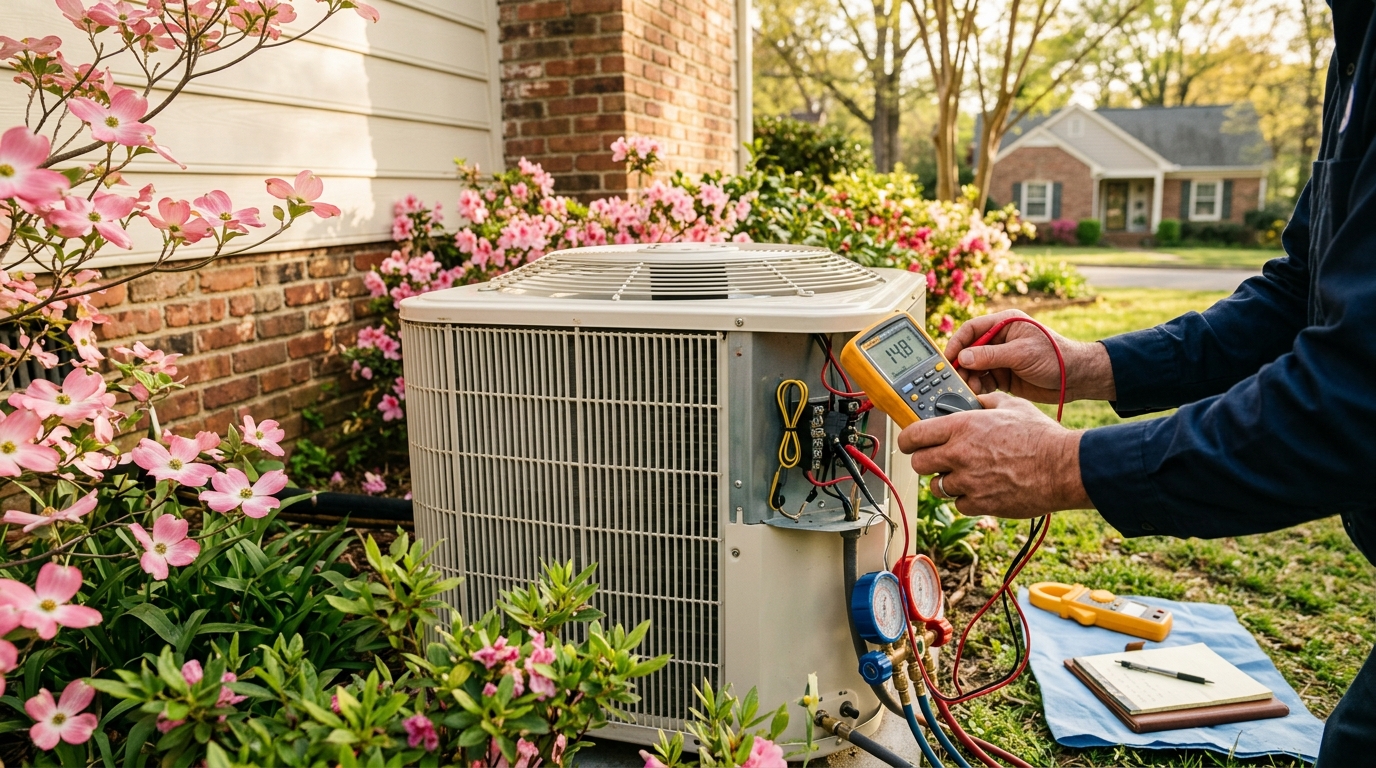
A real HVAC tune-up is not a guy walking around with a clipboard checking boxes. It is electrical measurement, refrigerant verification, combustion analysis, and physical inspection of every component that fails. Done right twice a year, it adds five to seven years to system life and catches the cheap problems before they turn into expensive problems. Done wrong, it is a $99 wasted afternoon.
Sources & further reading: U.S. Department of Energy — Heating & Cooling, ENERGY STAR Heating & Cooling, ACCA Technical Standards (Manual J, D, S).
Need HVAC Service?
Licensed Alabama contractor. Written estimate before any work begins. Call anytime.
(205) 649-4480What Real Spring AC Maintenance Includes
Spring is the most important HVAC visit of the year in Birmingham. The AC is about to start the long cooling season — five months of hard runtime in 90-100 °F heat. Anything marginal in the system will fail at the worst possible time. The tune-up exists to find marginal components in April and replace them on a scheduled basis instead of an emergency basis.
- Capacitor microfarad measurement — Capacitors are rated at a specific microfarad value and lose capacity over time. We measure with a calibrated capacitance meter. Anything more than 6% below nameplate gets replaced before it strands you in July.
- Contactor inspection — Pitted contacts on the compressor contactor cause hard starts and voltage drops. Visual inspection plus contact resistance measurement under load.
- Compressor amperage check — Running amps compared to LRA (locked rotor amps) on the compressor data plate. Excess current draw indicates internal wear, low voltage, or refrigerant problems.
- Refrigerant charge verification — Manifold gauges connected to suction and discharge ports. Superheat and subcooling measured and compared to manufacturer target. Off-spec charge fixed before the system starts the heavy-use season.
- Evaporator coil inspection — Pull the panel, look at the coil. Biofilm, dirt loading, ice damage from a previous freeze event. Cleaned with EPA-registered coil cleaner if needed.
- Condenser coil cleaning — Outdoor coil hit with garden hose from inside-out direction. Removes cottonwood, grass clippings, and dirt. Restored capacity and lower head pressure on every spring visit.
- Condensate drain treatment — Algaecide tab in the pan, drain line flushed and verified clear. Float switch operation tested manually.
- Electrical connections — Tighten every connection at the disconnect and the air handler control board. Loose connections cause arcing, voltage drop, and eventual component failure.
- Blower motor inspection — ECM motor health verified via the variable-speed control board. PSC motor capacitor measured and amperage checked.
- Duct static pressure — Manometer reading at the air handler. High static pressure indicates duct restriction or improper return sizing — caught early, fixed cheaply.
What Real Fall Furnace Maintenance Includes
Alabama winters are mild but real. Birmingham sees multiple freeze events every January-February, and a furnace that fails on a 28 °F night at 2 AM is the same emergency it would be in Cleveland. The fall tune-up exists to find the cheap furnace problems in October before they become emergency calls in January.
- Combustion analysis — Calibrated combustion analyzer at the flue. Measures O2, CO, and stack temperature. Pulls a draft reading on atmospheric units. This is the safety-critical step that 90% of "tune-ups" skip.
- Heat exchanger inspection — Borescope camera through the inducer port to inspect the heat exchanger surface for cracks. Cracked exchangers leak CO into the supply air and are non-negotiable replacement per ANSI Z21.47 and Alabama code.
- Gas pressure verification — Manometer at the gas valve outlet. Verify manifold pressure against the data plate. Off-spec gas pressure causes incomplete combustion, soot, and CO production.
- Igniter and flame sensor service — Visual inspection of the silicon nitride igniter for cracks. Flame sensor cleaned with fine emery cloth — oxidation buildup is the most common reason a furnace fails to stay running.
- Inducer motor — Run amperage check and visual inspection. Inducer failures lock out the furnace before it can fire.
- Pressure switch test — Magnehelic gauge on the inducer to verify draft pressure meets switch closing target.
- Limit switch and rollout switch test — Continuity checked on safety switches. Rollout switches that fail closed are the leading cause of mysterious no-heat calls.
- Filter check — Pulled, inspected, replaced if loaded.
- Blower wheel inspection — Dust loading on the blower wheel reduces airflow and causes heat exchanger overheat. Cleaned if needed.
- CO detector verification — Confirm working CO detector within 10 feet of sleeping areas. If absent, we tell the homeowner straight.
Why $99 Tune-Ups Are Usually a Scam
You will see $69, $79, $99 tune-up specials all over Birmingham every spring and fall. The honest version of a tune-up takes 60-90 minutes per system and uses calibrated instruments. The economics do not work at $99 unless something else is going on.
What is usually going on: the company uses the tune-up as a lead generator. The technician walks the home for 20 minutes, then the conversation pivots to a "found problem" that requires same-day service at full price. Capacitor "weak" but not actually out of spec. Refrigerant "low" but not actually leaking. Coil "fouled" but not actually impacting capacity. Upsells are the business model. The tune-up itself was never the product.
We charge fair-and-honest for a tune-up that includes the measurements above. If we find a real problem during the tune-up, we tell you and quote the fix in writing. No pressure, no scarcity tactics, no same-day-only pricing. If everything checks out, the report says everything checked out and we move on.
Maintenance Plans vs. Per-Visit
Some homeowners prefer per-visit tune-ups. Others want a maintenance plan that bundles spring and fall visits with priority dispatch on emergency calls. Both work. We do not push the plan.
The honest argument for a plan: priority dispatch in July when you are calling for emergency service and so is everyone else in the neighborhood. The honest argument against: if you only have one system and you trust your installer, you can just call us in March and October to schedule.
What matters more than the plan structure is whether the tune-up actually includes the measurements. A "plan" that produces a clipboard checkmark twice a year is worse than calling a separate company for a real diagnostic visit when something feels off.
What Documentation You Get
Every tune-up produces a written report. Capacitor microfarad readings with nameplate target. Compressor amps with LRA. Suction and discharge pressure with superheat and subcooling target and actual. Combustion analyzer printout. Heat exchanger photo if available. List of items found and recommended action.
That documentation matters in two situations: warranty claims (manufacturers require documented maintenance to honor extended warranty coverage) and resale (a documented service history is a real asset when you list the home). We keep your maintenance records on file and provide them on request.
HVAC Tune-Up Service Areas
Birmingham Heating & Air Conditioning provides hvac tune-up throughout:
- Chelsea, AL (Shelby County)
- Calera, AL (Shelby County)
- Sylacauga, AL (Talladega County)
- Montevallo, AL (Shelby County)
- Columbiana, AL (Shelby County)
Need HVAC Service?
Licensed Alabama contractor. Written estimate before any work begins. Call anytime.
(205) 649-4480Frequently Asked Questions
Ready to schedule service? Call (205) 649-4480 — Birmingham Heating & Air Conditioning serves Shelby County and the Talladega corridor.