R-22 to R-410A Conversion in Birmingham, AL — Refrigerant Changeover for Older Systems
Licensed Alabama technicians • Serving Chelsea, Calera, Columbiana, Montevallo & Sylacauga • Call (205) 649-4480
BLUF: Birmingham Heating & Air Conditioning handles R-22 system service, drop-in alternatives, and full R-410A replacement across Shelby County and the Talladega corridor — Chelsea, Calera, Columbiana, Montevallo, and Sylacauga — with EPA Section 608 compliant refrigerant recovery and documented work orders. Call (205) 649-4480.
R-22 to R-410A conversion is the EPA Section 608 compliant transition of an older air conditioning system away from R-22 refrigerant — either through partial system replacement (new R-410A condenser and evaporator coil with line-set evaluation) or through an EPA-approved R-22 drop-in alternative refrigerant (Bluon TdX-20, Hot Shot Two) on systems where mechanical condition supports patching.
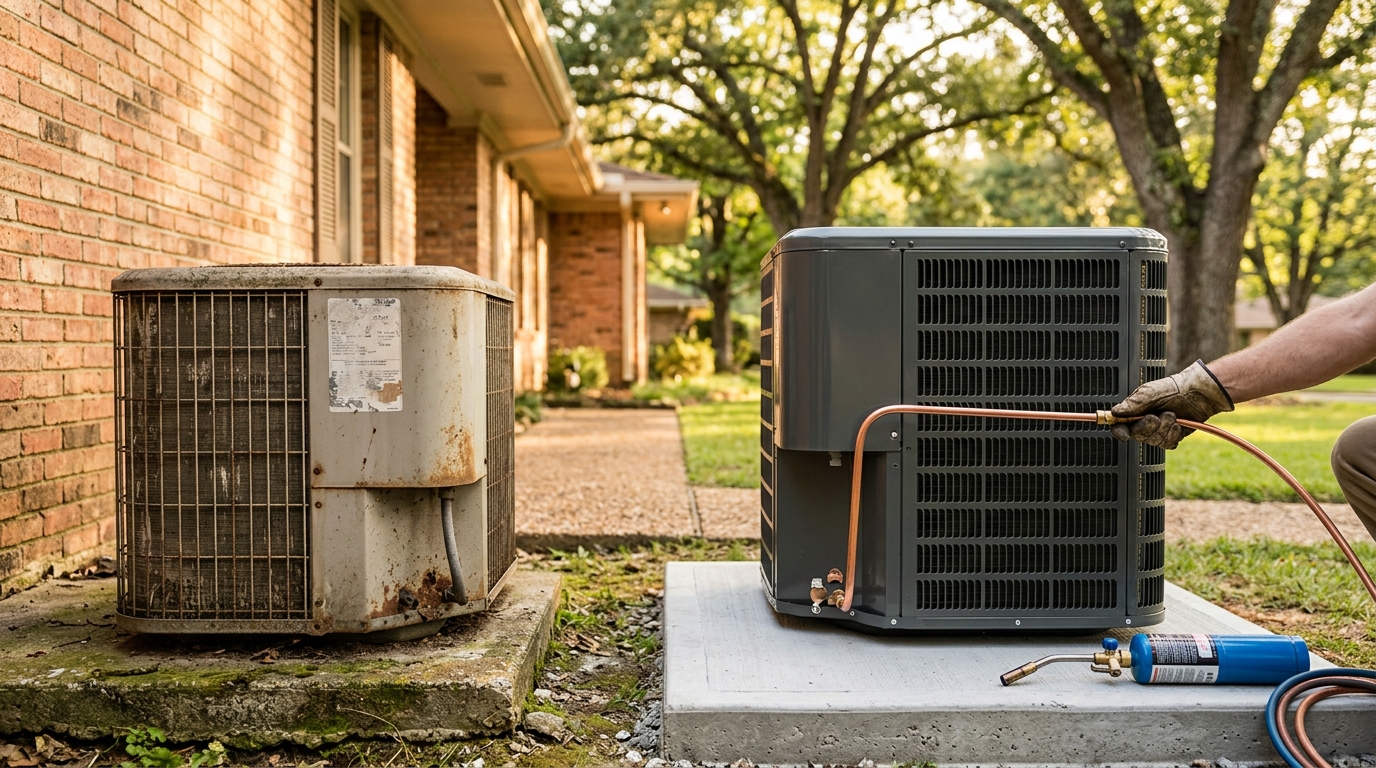
If your AC was installed before about 2010 there is a strong chance it still runs R-22 refrigerant. R-22 has been phased out of U.S. production since 2020 under the EPA Clean Air Act. What is left in the supply chain is reclaimed, expensive, and getting more expensive every year. When an R-22 system springs a leak, the math on patch-and-recharge versus full system replacement has shifted hard toward replacement.
Sources & further reading: U.S. Department of Energy — Heating & Cooling, ENERGY STAR Heating & Cooling, ACCA Technical Standards (Manual J, D, S).
Need HVAC Service?
Licensed Alabama contractor. Written estimate before any work begins. Call anytime.
(205) 649-4480What "R-22 Conversion" Actually Means
This is where the marketing gets murky. There is no such thing as pumping R-410A into an R-22 system. They operate at completely different pressures. R-410A runs at 1.5-2x the pressure of R-22. An R-22 condenser, evaporator, and line set are not rated for R-410A pressures. Trying to run R-410A through R-22 equipment will destroy the equipment and likely cause a refrigerant release.
So when someone says "convert R-22 to R-410A," they mean one of two things. Option 1: replace the outdoor condenser and indoor evaporator coil with R-410A-rated equipment, flush the existing line set if it is in good condition (or replace it), and run the new matched system. This is a partial system replacement, not a "conversion." Option 2: use a drop-in R-22 replacement refrigerant — these exist (Bluon TdX-20, Hot Shot Two, others) and approximate R-22's pressure curve so the existing equipment can keep operating. Some are EPA-approved for use in R-22 systems, some are not. Each has tradeoffs.
Per EPA Section 608 rules, only EPA-certified technicians can purchase, handle, and recover refrigerants. Anyone offering to "convert" your R-22 system needs to be certified and needs to recover the existing R-22 properly, not vent it. Vented R-22 is an EPA violation and an Alabama Board of Heating, Air Conditioning, and Refrigeration Contractors disciplinary matter.
When Conversion Makes Financial Sense
The honest answer: not as often as homeowners hope. Here is the math we walk through on every R-22 system call.
Age of the system. If the unit is 15+ years old, the compressor, fan motor, and contactor are all approaching end-of-life regardless of refrigerant. Putting money into refrigerant on a system about to fail mechanically is throwing good money after bad. Replacement of the outdoor condenser and indoor coil with a new R-410A matched system locks in 15+ more years of service and SEER2-compliant efficiency.
Size of the leak. A small slow leak that has been recharged once or twice is one situation. A major leak (compressor seal failure, coil rupture) that needs a full recharge of R-22 is a different situation. At current R-22 prices, a full recharge can run $150-250 per pound and a typical residential system holds 5-10 pounds. Doing that math on a 15-year-old system rarely makes sense.
Condition of the rest of the system. Outdoor coil fin condition, contactor pitting, capacitor measurement, compressor amperage, blower motor health. If multiple components are marginal, conversion is patching one problem while three more are lining up. Replacement deals with all of them at once.
Drop-in refrigerant availability. Some drop-in R-22 alternatives have legitimate EPA approvals and reasonable pricing. They are a real option for systems that are otherwise mechanically sound and where the homeowner is not ready to replace. We discuss this honestly when the math supports it.
How a Replacement Actually Goes
Most R-22 system calls in the Birmingham area end with replacement of the outdoor condenser and indoor evaporator coil. Here is what that work involves.
- R-22 recovery. Pull existing R-22 into a DOT-compliant recovery cylinder per EPA Section 608 rules. Documented, labeled, and disposed of through a certified refrigerant reclaimer.
- Disconnect and remove the existing condenser and evaporator coil. Old condenser hauled off, indoor coil disconnected from the air handler and line set.
- Line set evaluation. If the copper line set is the right diameter for the new R-410A equipment, in good condition, and not contaminated with old oil residue or moisture, it can be reused with a thorough nitrogen flush. If it is undersized, damaged, or run through a wall that complicates flushing, we replace it.
- New equipment install. R-410A matched condenser and evaporator coil sized to the home (Manual J load calculation, not by reading the model number off the old unit — old units are frequently the wrong size). Pad set, refrigerant lines brazed, electrical connected.
- Nitrogen pressure test. System pressurized to 350-500 psi and held to verify no leaks before introducing refrigerant.
- Deep vacuum. System evacuated to 500 microns or better with a micron gauge. Removes residual moisture and non-condensables that would otherwise contaminate the R-410A.
- Refrigerant charge by weight. R-410A charged to manufacturer-spec weight, then verified by superheat and subcooling under operating conditions. No "topping off until it feels cold."
- Commissioning and verification. Temperature split measured, blower static pressure checked, full operating cycle confirmed before the truck leaves.
What About Drop-In R-22 Alternatives
The honest case for a drop-in. If your R-22 system is mechanically solid (10 years old or less, clean coils, healthy compressor amperage), has a small slow leak that has been recharged once, and you are not ready financially or logistically for a replacement, an EPA-approved R-22 alternative is a legitimate option. Bluon TdX-20 is the most common in the Birmingham market. It approximates R-22's pressure curve, requires no equipment modifications, and currently runs less per pound than reclaimed R-22.
The honest case against. Drop-ins are still drop-ins. Manufacturer warranties on R-22 equipment do not cover non-OEM refrigerants. Future service technicians need to know what is in the system (we tag the equipment when we install a drop-in). Compatibility with mineral oil in the compressor is not always perfect. And eventually, when the next major component fails, you are still looking at a system replacement.
We will quote a drop-in refrigerant change-out if the situation supports it, with full disclosure of the tradeoffs. We will not quote one if the underlying system is past the point where the patch makes sense.
EPA Compliance and Why It Matters to You
Refrigerant handling in the United States is regulated under the EPA Clean Air Act Section 608. The rules are not optional and they apply to the technician who works on your system. Quick summary so you know what to ask for.
- The technician must hold EPA Section 608 Universal certification to purchase, handle, and recover refrigerants. Ask to see the card.
- Recovered refrigerant must be reclaimed through an EPA-certified reclaimer or recycled in approved equipment. Cannot be vented.
- Sales of R-22 in containers larger than 2 pounds are restricted to certified technicians. Anyone selling you a 20-pound jug at Home Depot is selling you something Home Depot is not allowed to sell.
- Documentation of refrigerant servicing is required on the work order. Specifically: type, weight added, weight recovered, technician certification number.
If a contractor cannot or will not provide that documentation, walk. The cost of taking shortcuts on refrigerant compliance ranges from EPA fines (up to $44,539 per violation per day per current EPA enforcement schedule) to Alabama Board disciplinary action. Birmingham Heating & Air Conditioning runs every refrigerant operation by the book and provides the documentation on request.
R-22 to R-410A Conversion Service Areas
Birmingham Heating & Air Conditioning provides r-22 to r-410a conversion throughout:
- Chelsea, AL (Shelby County)
- Calera, AL (Shelby County)
- Sylacauga, AL (Talladega County)
- Montevallo, AL (Shelby County)
- Columbiana, AL (Shelby County)
Need HVAC Service?
Licensed Alabama contractor. Written estimate before any work begins. Call anytime.
(205) 649-4480Frequently Asked Questions
Ready to schedule service? Call (205) 649-4480 — Birmingham Heating & Air Conditioning serves Shelby County and the Talladega corridor.