Furnace Repair in Birmingham, AL — Shelby County Heating Specialists
Licensed Alabama technicians • Serving Chelsea, Calera, Columbiana, Montevallo & Sylacauga • Call (205) 649-4480
BLUF: Birmingham Heating & Air Conditioning repairs gas and electric furnaces across Shelby County and the Talladega corridor — Chelsea, Calera, Columbiana, Montevallo, and Sylacauga — with combustion analysis, heat-exchanger inspection, and upfront quotes on every call. Call (205) 649-4480.
Furnace repair is the combustion-safety inspection, electrical testing, and parts replacement on a gas or electric forced-air heating unit — igniters, flame sensors, gas valves, inducers, pressure switches, limit switches, blower motors, control boards, and heat exchangers — performed per ACCA best practice and manufacturer specification.
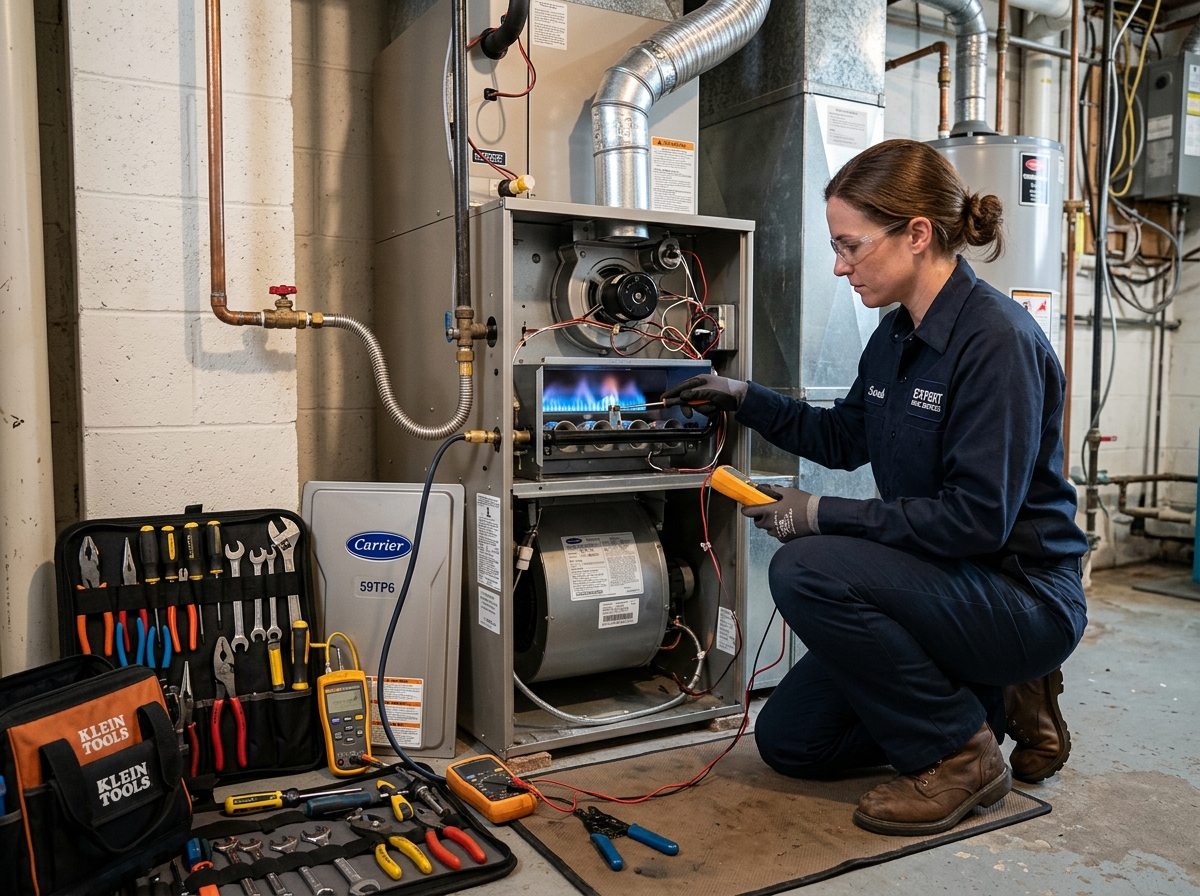
Alabama winters are mild by northern standards but can still deliver multiple nights below freezing each January and February. A furnace that fails at 2 AM when it's 28°F outside is a genuine emergency. Birmingham Heating & Air Conditioning provides 24/7 furnace repair throughout Chelsea, Calera, Columbiana, Montevallo, and Sylacauga — our Shelby County and Talladega corridor service area.
Sources & further reading: U.S. Department of Energy — Heating & Cooling, ENERGY STAR Heating & Cooling, ACCA Technical Standards (Manual J, D, S).
Need HVAC Service?
Licensed Alabama contractor. Written estimate before any work begins. Call anytime.
(205) 649-4480Common Furnace Problems in Birmingham-Area Homes
Gas furnaces in the Birmingham area fail in predictable patterns. Technicians who work the Shelby County and Talladega corridor regularly know where to look first — the short list of failures accounts for most heating calls in October through March.
- Igniter failure — Silicon nitride igniters are the most common furnace failure point. They crack and fail, leaving the furnace unable to light. Replacement is typically a straightforward one-visit repair.
- Flame sensor fouling — The flame sensor rod gets coated with oxidation over time, causing the control board to shut off the burner because it cannot confirm flame presence. Cleaning or replacing the sensor resolves this.
- Draft inducer motor failure — This motor exhausts combustion gases before the burner fires. A failing inducer triggers a pressure switch lockout. Common in furnaces over 12 years old.
- Cracked heat exchanger — The most serious furnace problem: a cracked heat exchanger allows combustion gases including carbon monoxide to enter the air stream. We perform combustion safety testing on every furnace call.
- Control board failure — The furnace's brain. When it fails, the unit exhibits erratic behavior — intermittent ignition, fan running continuously, no response to thermostat.
- Gas valve failure — Gas valves fail open or closed. A valve failed closed means no heat; a valve stuck open is a safety hazard. Gas valve diagnosis requires proper equipment and training.
- Blower motor failure — Heat builds in the heat exchanger, triggering high-limit lockout. We check blower operation, motor capacitor, and belt condition on every furnace service call.
Carbon Monoxide Safety — Every Furnace Call
Birmingham Heating & Air Conditioning includes a carbon monoxide safety inspection on every furnace service call at no extra charge. We use calibrated combustion analyzers to test flue gas composition and confirm the heat exchanger is intact. Alabama homes have CO detectors as a code requirement for new construction, but many older homes in our service area — particularly in Sylacauga, Columbiana, and Montevallo — do not have them installed.
If you do not have a working CO detector within 10 feet of your sleeping areas, we will remind you. Cracked heat exchangers in older furnaces are the leading cause of residential CO exposure in the Birmingham area.
Furnace Repair vs. Replacement
We apply the same honest analysis to furnace repair vs. replacement that we use for AC decisions. Key factors: system age (15+ year furnaces approaching end of service life), repair cost relative to replacement cost, whether the heat exchanger is compromised (always replace), and current efficiency of the existing unit.
A 78% AFUE furnace from 2005 costs significantly more to operate than a modern 96% AFUE condensing unit. In some cases the energy savings from replacement make financial sense even when the repair would be modest. We present the numbers honestly. Read our guide to whether repair or replacement makes more sense for your system.
Uneven Heating Room-to-Room — A Birmingham Winter Diagnostic
Uneven heating is the single most common heating and air Birmingham AL complaint we get from December through February. One bedroom freezes while the living room cooks. Homeowners assume the furnace is "weak." Most of the time, the furnace is fine — the problem is somewhere between the furnace and the room.
The three causes that account for almost every uneven heating call: a slowing blower motor that can no longer push air through the longest duct runs (we measure static pressure at the air handler and amperage on the blower to confirm), supply ductwork that has lost its R-value or pulled apart at a joint over a decade in a humid Shelby County crawlspace (we inspect with a borescope and pressure-test with a duct blaster on jobs where it matters), and an undersized return causing the furnace to starve for air on the high stages. On larger Chelsea, Highland Lakes, and Forest Lakes homes, the right fix is often a two-zone retrofit with a properly placed second thermostat, not a bigger furnace. We diagnose before recommending — uneven heating is rarely a "throw a new furnace at it" problem.
HVAC Not Responding to Thermostat — How We Trace It
"My HVAC is not responding to the thermostat" is a no-heat or no-cool call that almost always traces to the low-voltage control circuit, not the heating equipment itself. The diagnostic short list: a tripped condensate drain float switch (the system is protecting your ceiling — you have a drain problem upstream), a blown three-amp fuse on the air handler control board, a broken or chewed low-voltage thermostat wire, a thermostat that lost its program after a power outage, or a failed 24V transformer.
We meter the 24V signal at the thermostat sub-base and at the air handler R, W, Y, and G terminals. If voltage is present at both ends and the call is correct but the equipment does not respond, we move to the control board and limit switches. If voltage is missing, we walk the thermostat cable to find the open. We do not swap parts blind — every "thermostat replacement" we sell came after metering the existing one and confirming it actually failed.
Furnace Repair Service Areas
Birmingham Heating & Air Conditioning provides furnace repair throughout:
- Chelsea, AL (Shelby County)
- Calera, AL (Shelby County)
- Sylacauga, AL (Talladega County)
- Montevallo, AL (Shelby County)
- Columbiana, AL (Shelby County)
Need HVAC Service?
Licensed Alabama contractor. Written estimate before any work begins. Call anytime.
(205) 649-4480Frequently Asked Questions
Ready to schedule service? Call (205) 649-4480 — Birmingham Heating & Air Conditioning serves Shelby County and the Talladega corridor.