Indoor Air Quality in Birmingham, AL — Whole-House Air Purification, UV, Ventilators
Licensed Alabama technicians • Serving Chelsea, Calera, Columbiana, Montevallo & Sylacauga • Call (205) 649-4480
BLUF: Birmingham Heating & Air Conditioning installs whole-house indoor air quality systems across Shelby County and the Talladega corridor — Chelsea, Calera, Columbiana, Montevallo, and Sylacauga — covering MERV 11-13 media cabinets, HEPA bypass systems, UV-C germicidal lights, ERVs, and integrated humidity control. Call (205) 649-4480.
Indoor air quality service covers the assessment and installation of whole-house air-cleaning equipment — MERV 11-13 deep-pleat media cabinets, HEPA bypass systems, UV-C germicidal lamps at the evaporator coil, energy recovery ventilators (ERVs), and humidity control — addressing pollen, mold spores, and particulate per EPA, ENERGY STAR, and ASHRAE guidance.
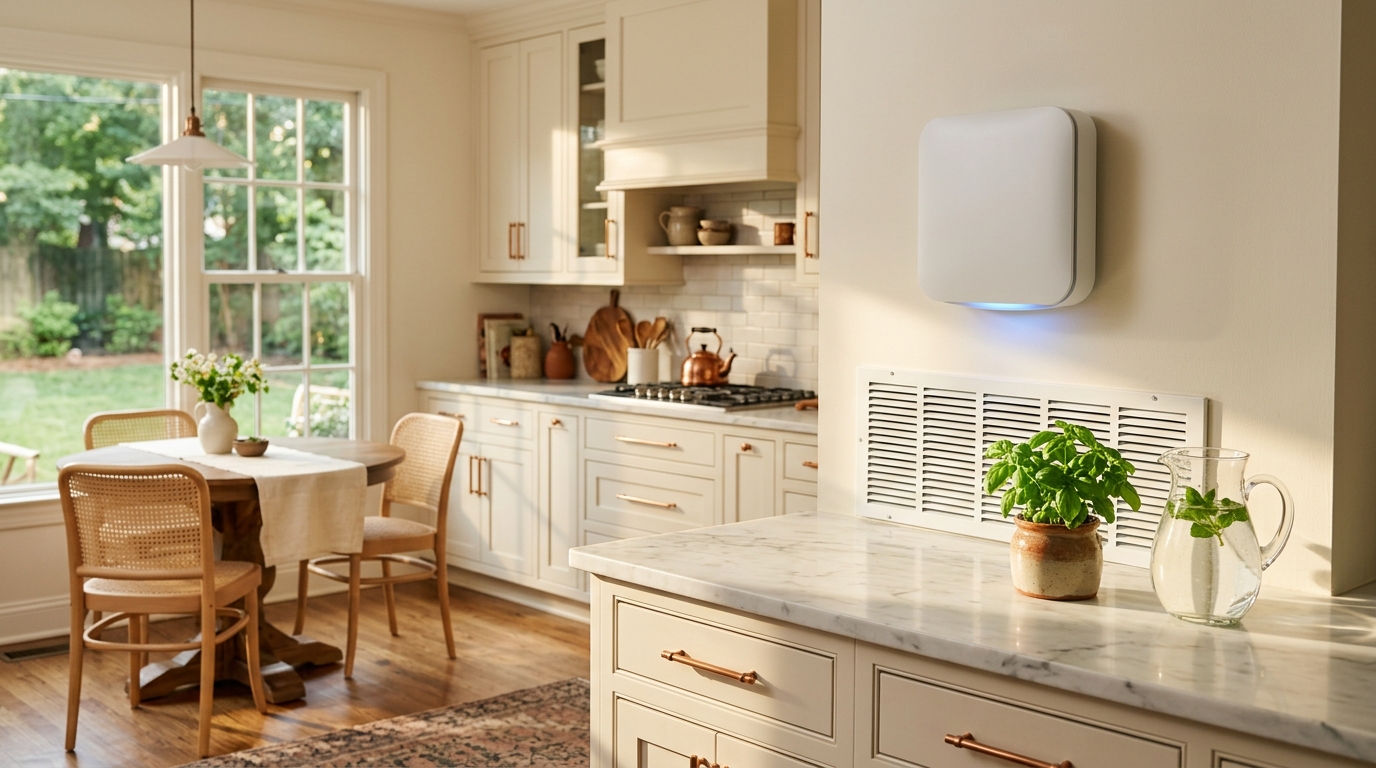
Birmingham air is harder on Alabama lungs than most people realize. Pollen counts run high March through May, humidity grows mold spores May through September, and tight modern construction traps everything inside. The fix is not a $40 box fan with a HEPA filter — it is whole-house equipment integrated with the HVAC system that already moves the air in your home.
Sources & further reading: U.S. Department of Energy — Heating & Cooling, ENERGY STAR Heating & Cooling, ACCA Technical Standards (Manual J, D, S).
Need HVAC Service?
Licensed Alabama contractor. Written estimate before any work begins. Call anytime.
(205) 649-4480What Counts as Indoor Air Quality Equipment
"Indoor air quality" gets used to sell everything from $80 ionizer plug-ins to $4,000 ERV systems. Here is what actually works and where each product fits.
- Media air cleaners — Deep-pleated MERV 11-13 filters installed in a 4-5 inch cabinet at the return. The single most cost-effective indoor air quality upgrade. Catches pollen, pet dander, mold spores, and most fine particulate. Filter changes every 6-12 months.
- HEPA bypass systems — Aprilaire 5000 series, Lennox PureAir. Pulls a portion of the return air through a HEPA-grade filter on each cycle. Higher capture rate than a media cleaner, lower static pressure cost than a full-flow HEPA. Right call for homes with severe allergies.
- UV-C germicidal lights — Installed in the air handler near the evaporator coil. Sterilizes biological growth on the coil and in the condensate drain pan. Does not "clean the air" the way marketing claims — it keeps the coil from becoming a source of contamination.
- Whole-house dehumidifiers — See our separate dehumidifier installation page. Hands-down the biggest IAQ improvement for an Alabama home.
- Energy recovery ventilators (ERVs) — Brings in fresh outdoor air and exhausts stale indoor air while transferring heat and humidity between the two streams. Right call for tight new-construction homes that are over-sealed.
- Bipolar ionizers and PCO devices — Marketed aggressively. Independent testing (per ASHRAE position documents on additive air-cleaning technologies) shows mixed results and potential byproduct ozone production. We do not push these.
The Alabama IAQ Problem Stack
Indoor air quality in a Birmingham home is shaped by a specific set of regional factors. Knowing the stack helps you spend money on the right equipment.
Pollen. The Birmingham metro is consistently in the top 30 of the AAFA Allergy Capitals list. Oak, pine, ragweed, and Bermuda grass dominate the pollen calendar from late February through October. A MERV 11 filter catches most of it. A MERV 13 catches more. Going past MERV 13 starts costing static pressure (airflow) faster than it improves capture.
Mold. Alabama summers run 70-85% relative humidity outdoors and 50-65% indoors if the AC is properly sized and running. Coil biofilm, drain pan slime, and humid duct insulation are the three places mold actually grows in a Birmingham home. UV lamps and proper coil cleaning solve the coil and pan. Reducing duct insulation moisture requires fixing the underlying duct leak or condensation problem.
VOCs and combustion byproducts. Gas stoves, gas furnaces with cracked exchangers, attached garages, new construction off-gassing, and fragrance products. The single most important VOC mitigation in an Alabama home is range-hood ventilation when cooking on a gas range and a working carbon monoxide detector.
Outdoor pollution. Birmingham historically had some of the worst air quality in the Southeast due to industrial sources. Modern levels are vastly better, but ozone alerts during summer afternoons still happen. A media air cleaner does not capture ozone, but staying indoors with AC running pulls you out of the worst of it.
What We Install and How
Our standard whole-house IAQ stack for a Birmingham home is: a 4 or 5-inch MERV 11-13 media cabinet at the return, a UV-C lamp at the evaporator coil, and a whole-house dehumidifier sized to the home. That combination solves pollen, prevents coil biofilm, and pulls humidity below the mold growth threshold across the cooling season.
The install is straightforward. The media cabinet replaces the existing 1-inch filter slot — we add a return-side cabinet between the return plenum and the air handler. The UV lamp mounts inside the air handler cabinet near the coil, runs off the existing 120V plug or the furnace control board. The dehumidifier goes in the attic or basement, ties into the return duct, and dumps to the same condensate line as the AC.
For severe allergy sufferers, we step up to a HEPA bypass system. Aprilaire 5000 series is the most common pick — it uses electronic precipitation followed by a HEPA-grade filter. Higher capture rate, longer filter intervals, lower static pressure penalty than a full-flow HEPA cabinet.
What Does Not Work (Save Your Money)
We will tell you what to skip. Portable HEPA air purifiers do a fine job in a single room but cannot keep up with whole-house air volume in any Birmingham home larger than 1,200 sq ft. The HVAC system is already moving 800-1500 cubic feet of air per minute through the home — anything that filters that air at the source beats any room-sized purifier.
Ionizers, ozonators, and "PCO" devices that claim to destroy contaminants in mid-air range from useless to harmful. Per EPA guidance on indoor air cleaners, devices that intentionally generate ozone should not be used in occupied spaces. Some bipolar ionization devices have shown ozone byproduct production in independent testing.
Duct cleaning is overhyped as an IAQ solution. EPA position is clear: duct cleaning has not been shown to prevent health problems in the absence of visible mold or contamination. We do not push duct cleaning as a routine IAQ improvement. If you have actual contamination — visible mold growth in the duct interior, vermin infestation, or major construction debris — duct cleaning is appropriate. Otherwise, fix the source of the contamination, not the symptom.
Documenting What Your Home Actually Needs
Before quoting IAQ equipment, we measure. We check relative humidity at the thermostat over a 24-48 hour log. We pull the existing filter and look at what is loading on it. We inspect the evaporator coil with a borescope to see whether biofilm is present. We check duct interior at a few accessible drops to see whether duct cleaning is genuinely warranted.
Then we tell you what is actually going on in your home and what equipment matches that. If your humidity sits at 48% all summer and your filter loads slowly with mostly pollen, you do not need a HEPA system. If your humidity creeps to 62% on a rainy August week and the coil shows biofilm, you need a dehumidifier and UV before you need anything else.
Honest measurement, honest recommendation. That is the difference between an IAQ upgrade that pays off and one that sits in your attic doing nothing.
Indoor Air Quality Service Areas
Birmingham Heating & Air Conditioning provides indoor air quality throughout:
- Chelsea, AL (Shelby County)
- Calera, AL (Shelby County)
- Sylacauga, AL (Talladega County)
- Montevallo, AL (Shelby County)
- Columbiana, AL (Shelby County)
Need HVAC Service?
Licensed Alabama contractor. Written estimate before any work begins. Call anytime.
(205) 649-4480Frequently Asked Questions
Ready to schedule service? Call (205) 649-4480 — Birmingham Heating & Air Conditioning serves Shelby County and the Talladega corridor.