
Birmingham summers are not just hot — they are wet. Outdoor dewpoint sits in the low-to-mid 70s from June through September, which means your AC is removing water as much as it is removing heat. When the AC cannot keep up with the moisture load, you get cold-clammy rooms, musty smells, and mold growth on duct insulation and around windows. A whole-house dehumidifier solves it.
Why a Window Dehumidifier Is Not Enough
You can buy a 50-pint portable dehumidifier at Lowe's for $250. It will work in one room. In a 2,000 square foot Birmingham home it will run constantly, never catch up, and produce a noise complaint from whoever sleeps in the room it lives in. Whole-house humidity needs whole-house equipment.
Here is what is different. A whole-house dehumidifier mounts in the attic, basement, or mechanical room. It ties into the return duct of your HVAC system. It pulls air from the entire house, removes moisture continuously, and discharges dry air back into the duct system. One unit, sized to the home, controlled by a remote humidistat at the thermostat. Capacity ranges from 70 pints per day for smaller homes up to 150-plus pints per day for larger homes with high latent loads.
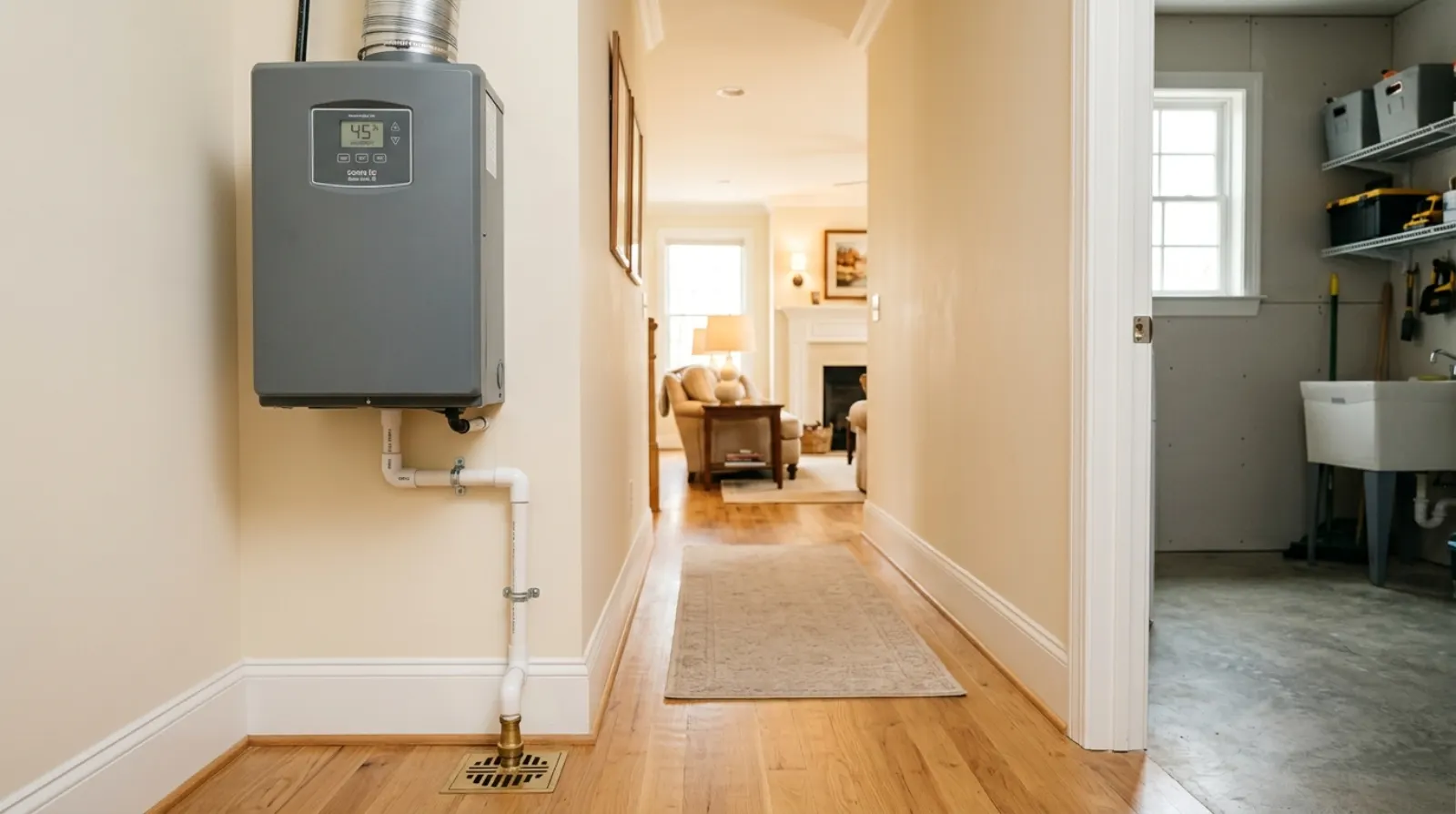
Brand-wise, we install Aprilaire (most common, strong warranty support), Honeywell TrueDRY (compact and reliable), and Ultra-Aire (commercial-grade for larger homes). All three drain via PVC condensate line to the same place your AC condensate goes — either a floor drain, a condensate pump, or out the side of the house through the existing AC drain stub.
How We Size the Unit
Sizing is the part everyone wants to skip. The result of getting it wrong is either a unit that runs constantly and never reaches setpoint (undersized), or a unit that short-cycles and wears out fast (oversized). We size based on the actual home, not a square-footage rule of thumb.
The calculation accounts for: home square footage, ceiling height (which sets cubic footage of conditioned air), envelope tightness (newer homes are tighter, less infiltration load), outdoor design dewpoint (Birmingham summer design dewpoint is 75 °F), the latent load that the AC is already pulling, and occupant patterns (number of people, how often the home is opened to outdoor air). Output is a pints-per-day number that matches a specific dehumidifier capacity.
Most Birmingham homes in the 1,500 to 2,500 sq ft range land on a 90-95 pint per day unit. Larger homes, homes with high outdoor-air infiltration, and homes with crawlspaces tied into the conditioned envelope land on 125-150 pint units. We do not use a rule of thumb — we run the numbers.
Installation Detail That Matters
A dehumidifier install is straightforward when done right and an expensive headache when done wrong. Here is the right-way checklist we follow.
- Location with structural support — Most attic installs sit on a platform across two ceiling joists or on the existing air handler stand. Vibration mounts under the dehumidifier feet prevent noise transfer to the ceiling below.
- Tied to the return, not the supply — The dehumidifier pulls air from the return duct, removes moisture, and discharges back into the return. That way the AC blower distributes the dry air through the supply ducts on its normal cycle.
- Dedicated 120V circuit — Dehumidifiers draw 5-9 amps continuous. Sharing a circuit with anything else risks nuisance trips. We pull a dedicated 15-amp circuit from the breaker panel.
- Condensate drain with slope — Gravity drain to a floor sink, condensate pump if no gravity path exists. We pitch the line at least 1/4 inch per foot and trap the drain to prevent sewer gas backup.
- Float switch on the drain — Same as AC. If the line clogs, the float kills the dehumidifier instead of overflowing into the ceiling. Non-negotiable for attic installs.
- Humidistat at the thermostat location — Wired control at a central, conditioned-space location. Setting humidistat at the dehumidifier itself causes false readings because the dehumidifier sits in the discharge stream.
What It Actually Feels Like After Install
Most homes feel the difference quickly. The clammy feeling in the house goes away. The musty smell that you maybe did not consciously notice — gone. Sleeping is better because 50% RH at 76 °F feels cooler than 65% RH at 73 °F. Wood floors stop cupping. Doors that stuck during humid weeks open cleanly again.
You will also notice the AC runs less. The thermostat may even let you raise the setpoint a degree or two without losing comfort, because at lower humidity the same air temperature feels cooler. That offsets some of the dehumidifier energy cost. Per Energy.gov guidance on home humidity, indoor RH of 30-50% provides best comfort and lowest mold risk.
One more thing: in Alabama crawlspace homes, the dehumidifier often eliminates the need for an encapsulation project that the crawlspace contractor was about to quote you. Pulling whole-house humidity below 55% drops the crawlspace humidity along with it (assuming reasonable connection between the spaces). If you have a crawlspace humidity problem, install the dehumidifier first and re-measure before you commit to encapsulation.
Maintenance Across the Cooling Season
Dehumidifiers are low-maintenance relative to AC equipment, but they are not zero-maintenance. Here is what we cover on the annual visit.
Filter check. Aprilaire and Honeywell units have a washable foam filter that catches return-side debris before it loads the dehumidifier coil. We pull it, hose it off, and reinstall it. Five minutes.
Coil inspection. Same as the AC evaporator — the dehumidifier coil is wet by design and can develop biofilm. We pull the cabinet panel, spray an EPA-registered coil cleaner, and rinse with clean water.
Drain line clear. Flush with hot water and an algaecide tab. Verify the float switch operates correctly by lifting it manually.
Humidistat calibration. Verify the displayed RH matches a calibrated psychrometer reading at the same location. Sensors drift over time.
This is a $0 add-on to your normal annual maintenance visit if Birmingham Heating & Air-Conditioning is already there for the AC tune-up.
Whole-House Humidifiers for the Other Half of the Year
Humidity control in Alabama cuts both ways. Summers need moisture pulled out; winters — especially in older plaster-and-hardwood houses — need it put back. Alongside dehumidifier installation, we install whole-house humidifiers: bypass and fan-powered units mounted on the supply plenum that hold the whole home in the 35-to-45 percent band, so floors stop gapping and static stops snapping every time the furnace runs. Whole house humidifier installation is a half-day job on most systems and rides the same truck as the rest of our indoor air quality work.
Whole-House Dehumidifier Installation Questions
Will running my AC longer fix my humidity problem?
Maybe. If your AC is properly sized and your ducts are tight, the AC removes humidity as a side effect of cooling. If your AC is oversized, it short-cycles — cools the house too fast and shuts off before removing enough moisture. If your AC is undersized or the ducts leak, the system never gets to a long enough run to dehumidify. Lowering the thermostat to "force" dehumidification is not a real solution and runs up your power bill. A whole-house dehumidifier handles the moisture load independent of the cooling load.
How loud is a whole-house dehumidifier?
Whole-house units in the attic run at roughly 55-65 dB at the unit itself, similar to a refrigerator. Through floor joists and ceiling insulation, sound at the conditioned-space level is typically not noticeable. We install vibration isolation mounts under the unit on every attic install to reduce structure-borne sound.
Do I need a dehumidifier if I have AC?
In Alabama, often yes — particularly in newer tight-construction homes, homes with high outdoor-air infiltration, and homes where the AC is oversized. The AC handles sensible heat load and the dehumidifier handles latent (moisture) load. They are complementary, not redundant. Measure your home RH for a week before deciding — if you sit above 55% during cooling season, a dehumidifier is justified.
Can I install a portable dehumidifier in the attic instead?
No. Portable dehumidifiers are designed for conditioned-space operation and will fail prematurely in attic temperatures. They lack the controls, drain, and capacity for whole-house use. Save the portable for the basement room that the whole-house unit cannot fully reach.
How much electricity does a whole-house dehumidifier use?
A 90-pint Aprilaire unit draws about 7 amps at 120V, so roughly 800-900 watts when running. In a Birmingham summer it runs intermittently — perhaps 6-10 hours per day during peak humidity. Monthly energy cost typically runs $15-30 during cooling season. Offset partially by lower AC runtime and the ability to raise the thermostat setpoint a degree or two while maintaining the same comfort.
What humidity should I set it to?
We set the humidistat at 50% RH for most Birmingham homes. EPA and ASHRAE both recommend 30-50% indoor RH. In a humid Alabama summer, 50% is achievable without overworking the equipment. Lower setpoints (45%) are possible but cost more in energy and may struggle on the most humid weeks.