HVAC Lifespan in Alabama
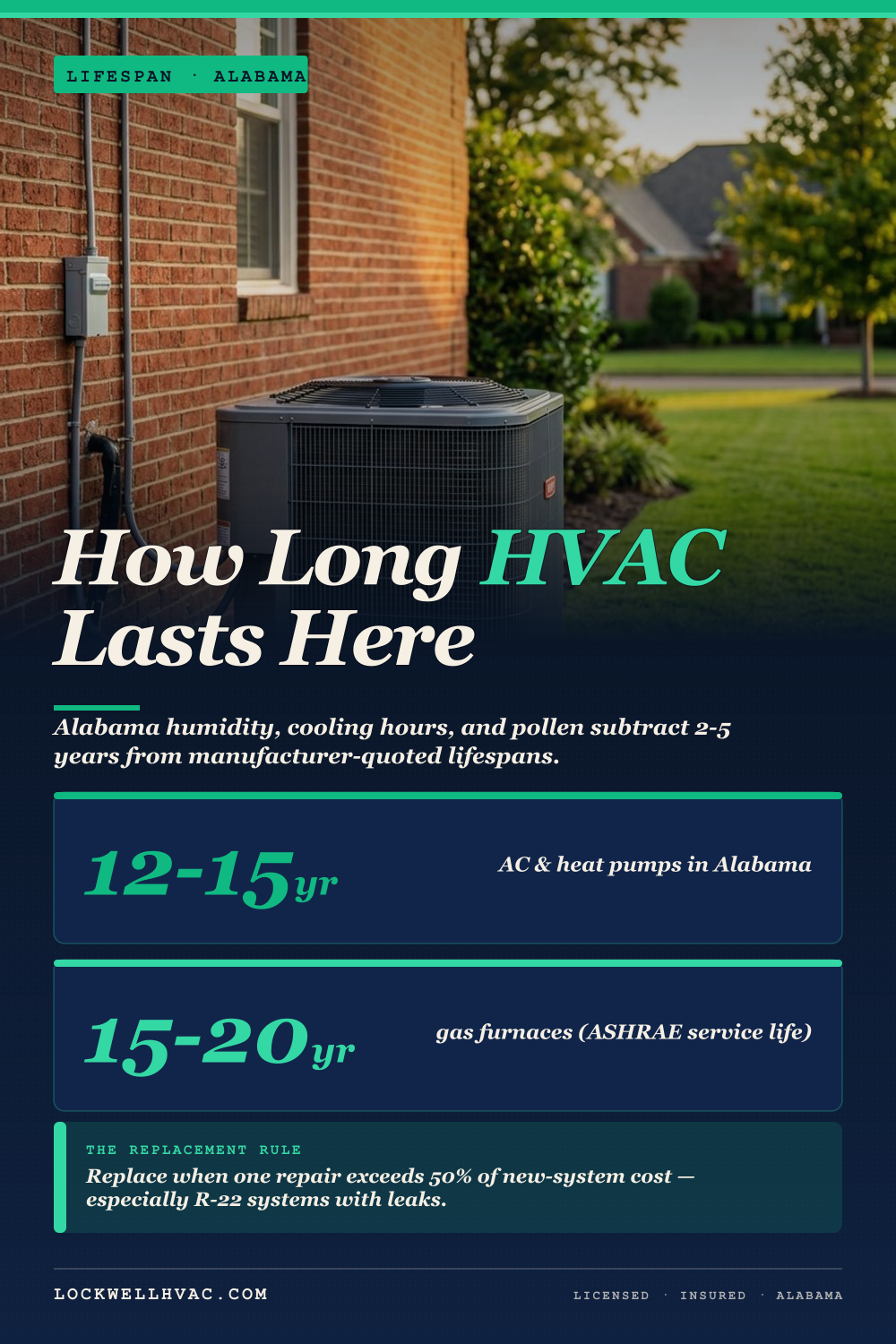
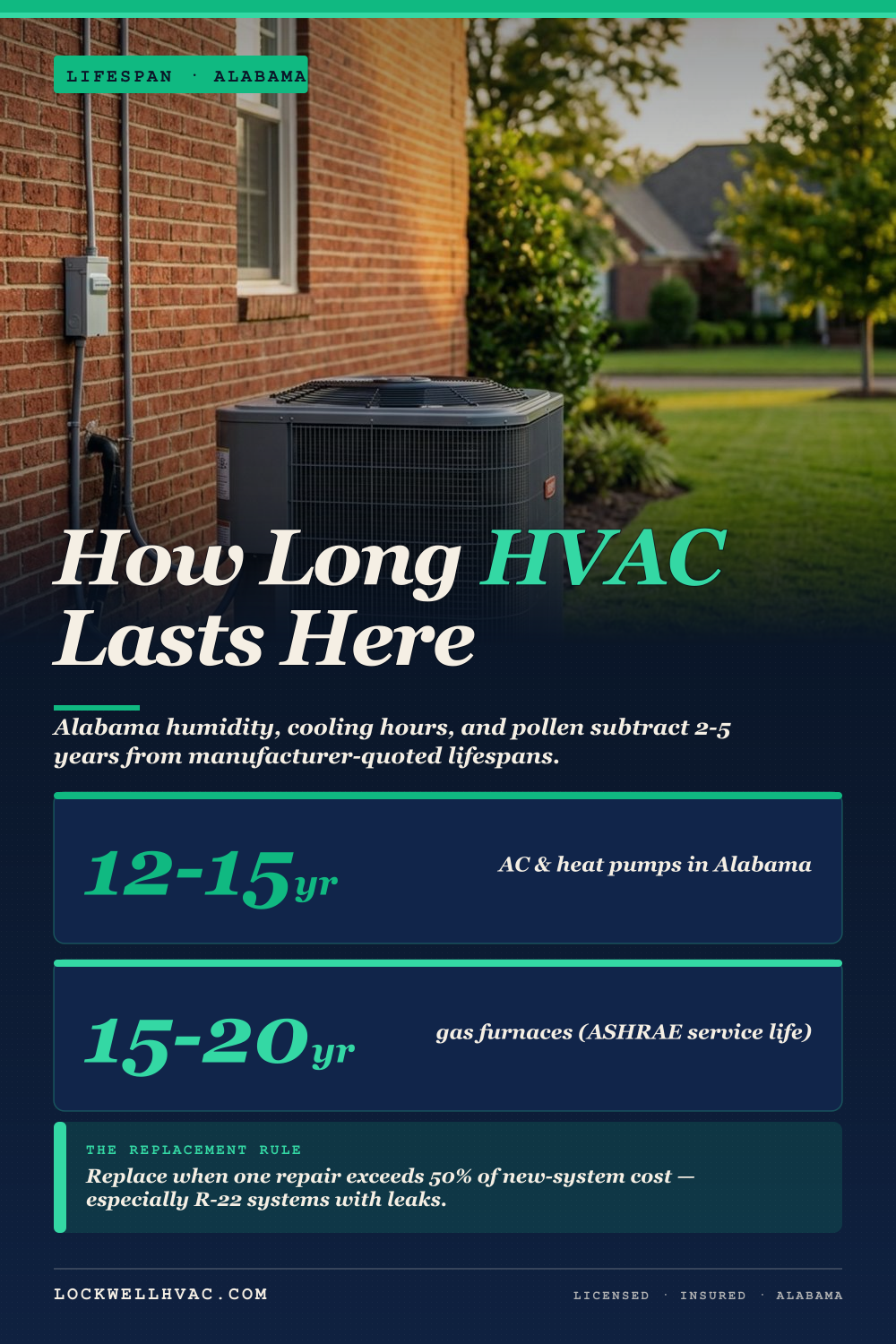
Air conditioners typically last 12 to 15 years in Alabama, gas furnaces 15 to 20 years, and heat pumps 12 to 15 years. Our humidity, salt-air corrosion near the coast, and high cooling-hour load shorten equipment life by 2 to 5 years versus dry climates. Annual professional maintenance, monthly filter changes, and proper sizing extend lifespan significantly.

What "Lifespan" Actually Means
When a manufacturer says a system lasts 15 years, that's the median expected life with reasonable maintenance — half last longer, half don't make it. The ASHRAE equipment service life database is the industry standard for these numbers.
Here's what those numbers really mean for a Birmingham, Hoover, or Trussville home:
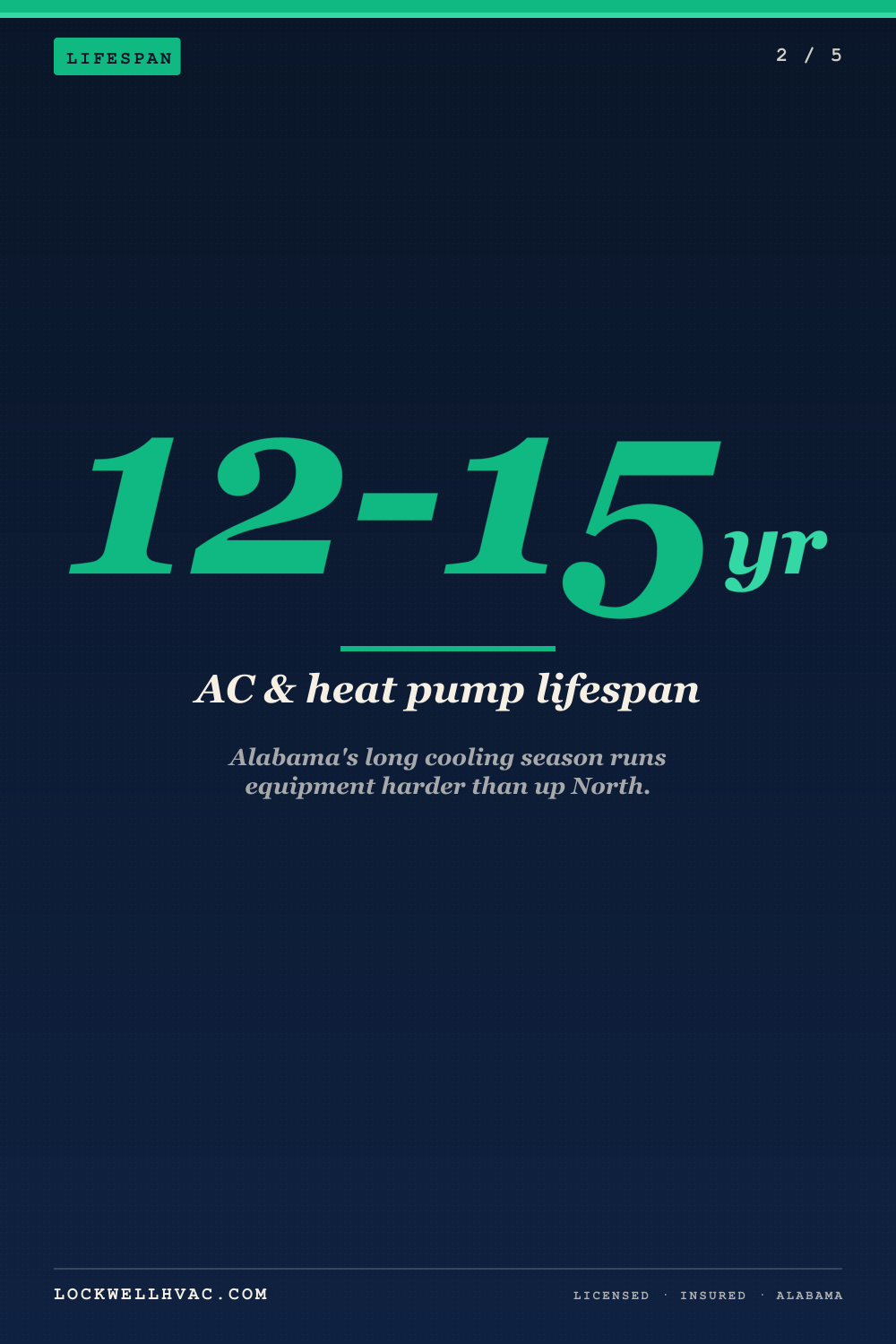
Air conditioners: 12 to 15 years median, with well-maintained units occasionally hitting 18 to 20.
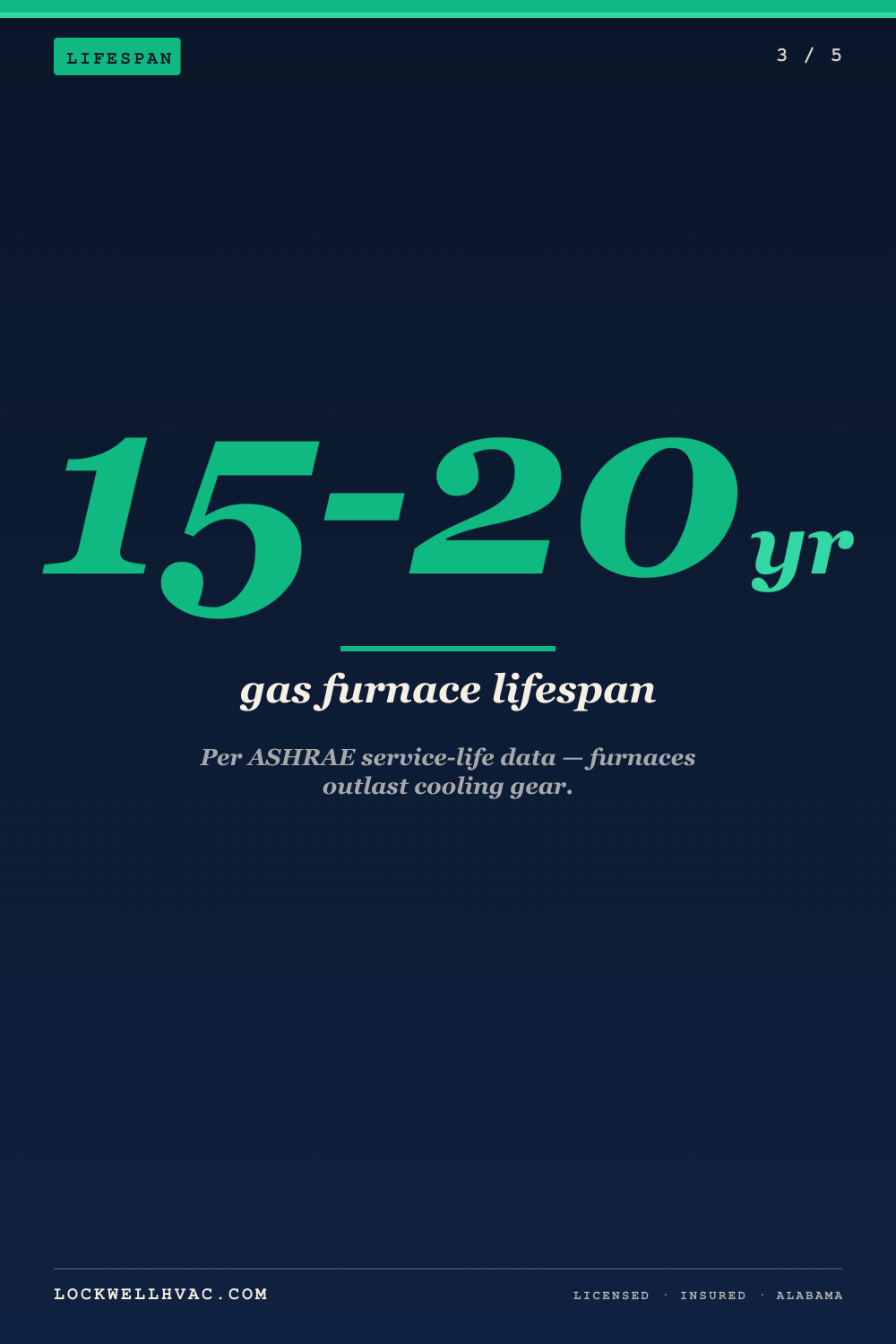
Gas furnaces: 15 to 20 years median, with high-efficiency condensing units sometimes lasting 25.
Heat pumps: 12 to 15 years median (run year-round, more accumulated hours than dedicated AC).
Ductless mini-split systems: 15 to 20 years median.
Boilers: 20 to 30 years (rare in Alabama homes).
The Alabama climate adjustment matters a lot. Our humidity, the high number of cooling hours per year, and salt air corrosion in coastal counties shorten these numbers. Most field techs working in Birmingham subtract 2 to 3 years from manufacturer-quoted lifespans for AC and heat pumps based on what they actually see fail.
Why Alabama Equipment Doesn't Last as Long
Three things age HVAC equipment faster here than in dry climates.
First, run hours. The U.S. Department of Energy uses cooling-degree-days to measure how much an AC has to work in a region. Birmingham logs roughly 1,800 cooling-degree-days per year, compared to under 800 for cities like Boston or Seattle. Your AC simply runs more hours, which is more wear.
Second, humidity. Constant high relative humidity inside the air handler creates conditions that accelerate evaporator coil corrosion, condensate drain biofilm growth, and electronic component oxidation. The EPA's IAQ guidance covers why humidity control affects more than just comfort.
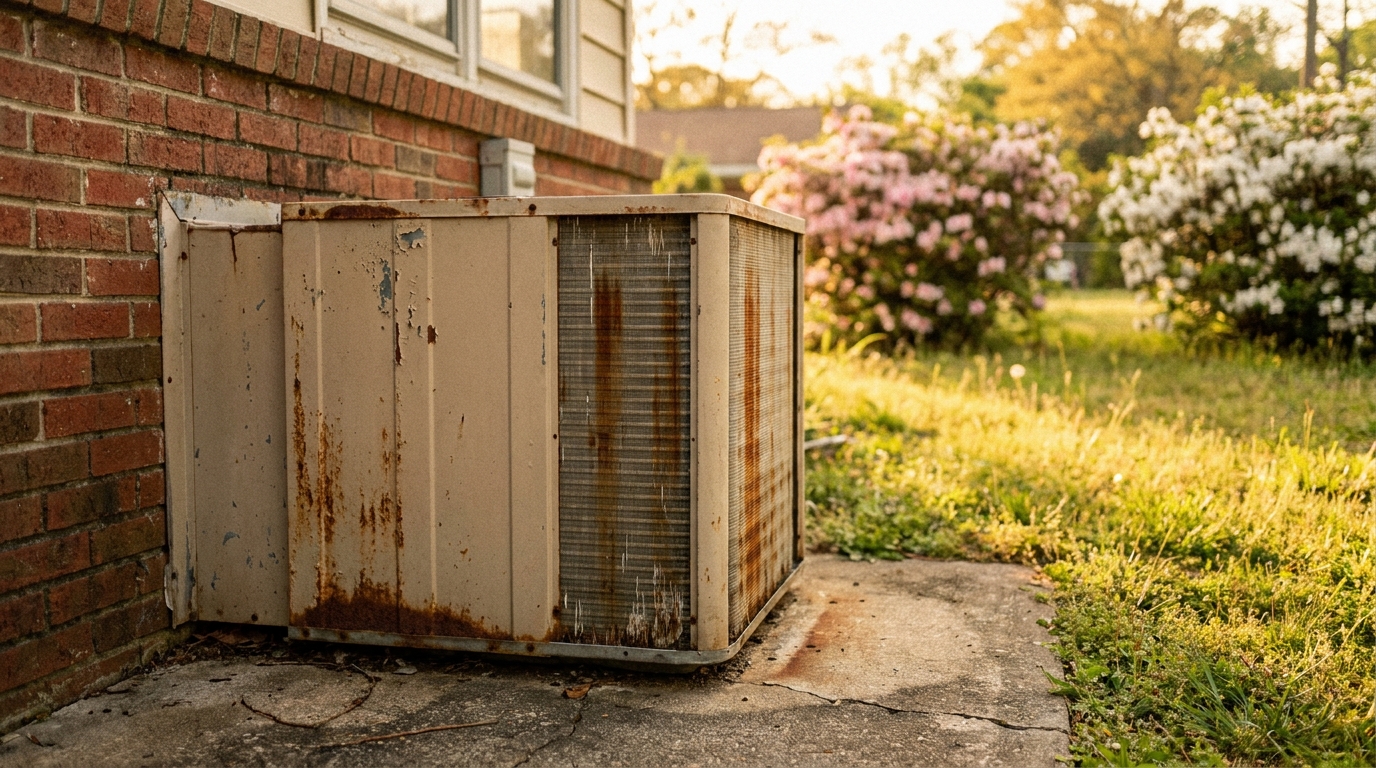
Third, pollen and particulate load. Birmingham's spring pollen seasons coat outdoor coils, indoor coils, and electrical components in a sticky residue that holds moisture against metal. Year over year, that residue accelerates corrosion measurably. We pull 8-year-old condenser fins in Hoover that look like 15-year-old fins from Phoenix.
Signs Your System Is Approaching Replacement
Some signs are obvious. The system stops cooling. Compressor failure. Heat exchanger crack. Anything that takes the system fully offline forces an immediate decision.
The subtler signs that replacement is coming within 2 to 3 years:
Repair frequency increasing. One repair every few years is normal. Two or three repairs in a single cooling season means components are failing in clusters — usually electrical and mechanical wear surfacing as capacitors, contactors, and motors all approach end-of-life.
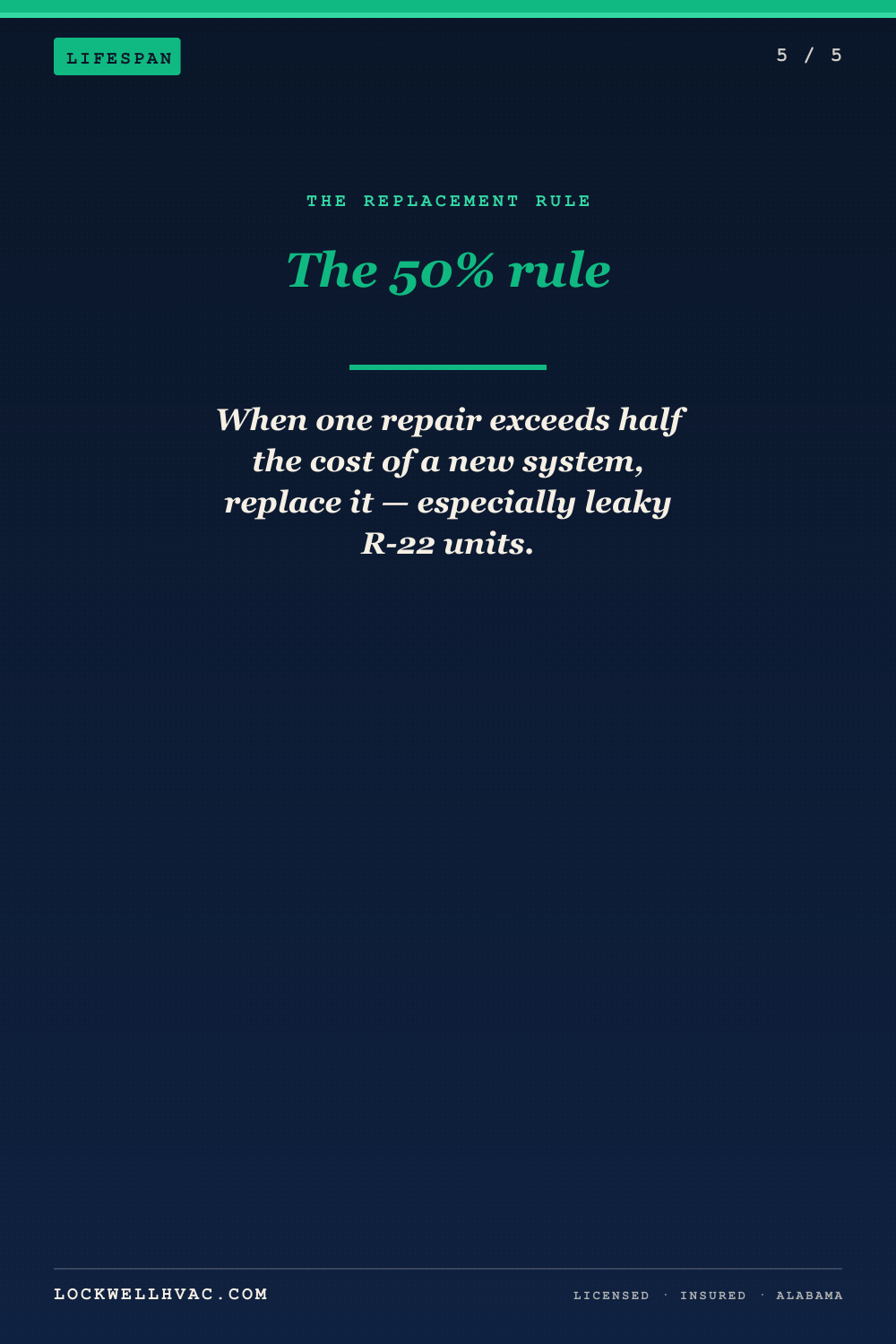
Repair costs hitting half the system replacement cost. The industry rule is to replace when a single repair quote exceeds 50% of new equipment cost. Putting $1,800 into a 14-year-old system is throwing good money after bad if the new system would be $4,500.
Refrigerant top-offs. Modern systems shouldn't lose refrigerant. If yours has been topped off twice in three years, you have a leak that's getting worse. R-22 systems facing leaks are particularly hard to justify repairing — the refrigerant cost alone often exceeds half the cost of a new R-454B or R-410A system.
Rising electric bills with no other change. A tired system doesn't fail dramatically. It loses efficiency gradually. Year-over-year increases in cooling cost during similar weather often mean the system is dying slowly.
Uneven temperatures and humidity that won't quit. Older systems lose their ability to dehumidify aggressively. If your house is 76°F but feels muggy and uncomfortable, the system isn't pulling enough latent load anymore.
Key takeaway: Pull last year's electric bills. Compare June-July-August to the same months three years prior. If cooling cost climbed 25%+ for similar weather and your filter habits haven't changed, equipment fatigue is showing up on your bill.
The R-22 Question
If your system was installed before 2010, it likely uses R-22 refrigerant. The EPA phased out R-22 production and import by 2020 under the Montreal Protocol. Existing systems can still operate, but new R-22 supplies are reclaimed-only and expensive.
For an R-22 system facing a refrigerant leak, the math usually points to replacement. Spending $1,200+ on R-22 recharge for a 15-year-old leaking system makes no sense when that money goes toward a modern R-454B unit instead.
R-454B is the current refrigerant standard for new residential equipment, replacing R-410A as part of the AIM Act phase-down. New systems installed in 2026 onward use R-454B almost exclusively.
How to Make Your System Last Longer
The honest answer is "do exactly what manufacturers and ASHRAE recommend, and don't skip steps." That's not exciting advice, but it works.
Monthly filter changes during cooling season. April through October in Alabama. A 1-inch filter every 30 days, a 4-inch media filter every 90 days. ENERGY STAR data shows filter neglect is the #1 cause of premature failures.
Annual professional tune-ups. Spring before cooling season, fall before heating season. A trained tech checks refrigerant charge, electrical connections, capacitor health, condensate drain, blower amperage, and coil condition. Catching small issues here prevents catastrophic failures later.
Keep clearance around the outdoor unit. 18 to 24 inches on all sides per manufacturer specs. Trim landscaping yearly. Hose down the condenser fins gently every spring after pollen season.
Address humidity issues early. Persistent high indoor humidity stresses the evaporator coil and accelerates condensate drain biofilm. A whole-home dehumidifier or a properly sized variable-speed system extends equipment life in Alabama climates.
Don't let problems fester. A weak capacitor running a struggling motor costs the motor. A clogged condensate drain that overflows costs ceiling drywall and potentially the air handler. Small issues that get ignored become large issues that take out major components.
Should You Replace Before It Fails?
A planned replacement before catastrophic failure has real advantages. You can shop quotes, compare equipment, and choose timing — usually shoulder season when contractors aren't slammed with emergencies. You also avoid the comfort gap of being without HVAC during peak heat or cold.
Three windows that often justify proactive replacement:
System is over 15 years old AND used R-22 AND needs any significant repair. The upgrade math wins clearly.
System is over 12 years old AND your home has had energy efficiency upgrades (new windows, attic insulation, air sealing). Your old equipment is now oversized for the upgraded envelope, which means short-cycling and humidity problems that cost more than replacement.
System is over 10 years old AND your bills have climbed materially over the past 2 to 3 cooling seasons. The efficiency loss is real money flowing out, and modern equipment recoups much of that.
For a real assessment of your specific Birmingham home, see our HVAC installation guide, SEER ratings explained, and the R-454B refrigerant transition guide. Local context for Birmingham homes is in the area pages.
[CTA]
How long should an AC last in Alabama?
Typical Alabama AC lifespan is 12 to 15 years with reasonable maintenance, slightly shorter than the 15- to 20-year ASHRAE national median because our high cooling-hour load and humidity accelerate wear. Well-maintained variable-speed equipment in tighter homes occasionally reaches 18+ years. Neglected equipment in 1990s-vintage homes often fails by year 10.
Is it worth repairing a 15-year-old HVAC system?
Generally not, if the repair exceeds 50% of new system replacement cost. The industry "$5,000 rule" — multiply repair cost by system age in years and replace if over $5,000 — captures the same idea. A $400 repair on a 14-year-old system equals $5,600 — replacement territory. A $200 repair on the same system makes sense.
How can I extend my HVAC system's life?
Monthly filter changes during cooling season, annual professional tune-ups (spring and fall), 18 to 24 inches of clearance around the outdoor unit, condenser coil cleaning every spring, and addressing small repairs immediately rather than letting them stress related components. Maintenance is the difference between a 12-year and 18-year service life in Alabama climates.
What is the average HVAC system lifespan?
Per ASHRAE service life data: AC units 15 to 20 years, gas furnaces 15 to 20 years, heat pumps 14 to 16 years, boilers 20 to 30 years, ductless mini-splits 15 to 20 years. Alabama's high cooling load and humidity typically subtract 2 to 4 years from these national medians, so plan accordingly.
My HVAC is 18 years old and still works — should I replace it?
If it works reliably and your bills haven't climbed dramatically, riding it out is reasonable. But have a contingency plan — proactive replacement during shoulder season is far less stressful than emergency replacement in 95°F July heat. Also consider efficiency: an 18-year-old system likely runs 30%+ less efficiently than current SEER2 minimums, which shows up in your power bill every month.