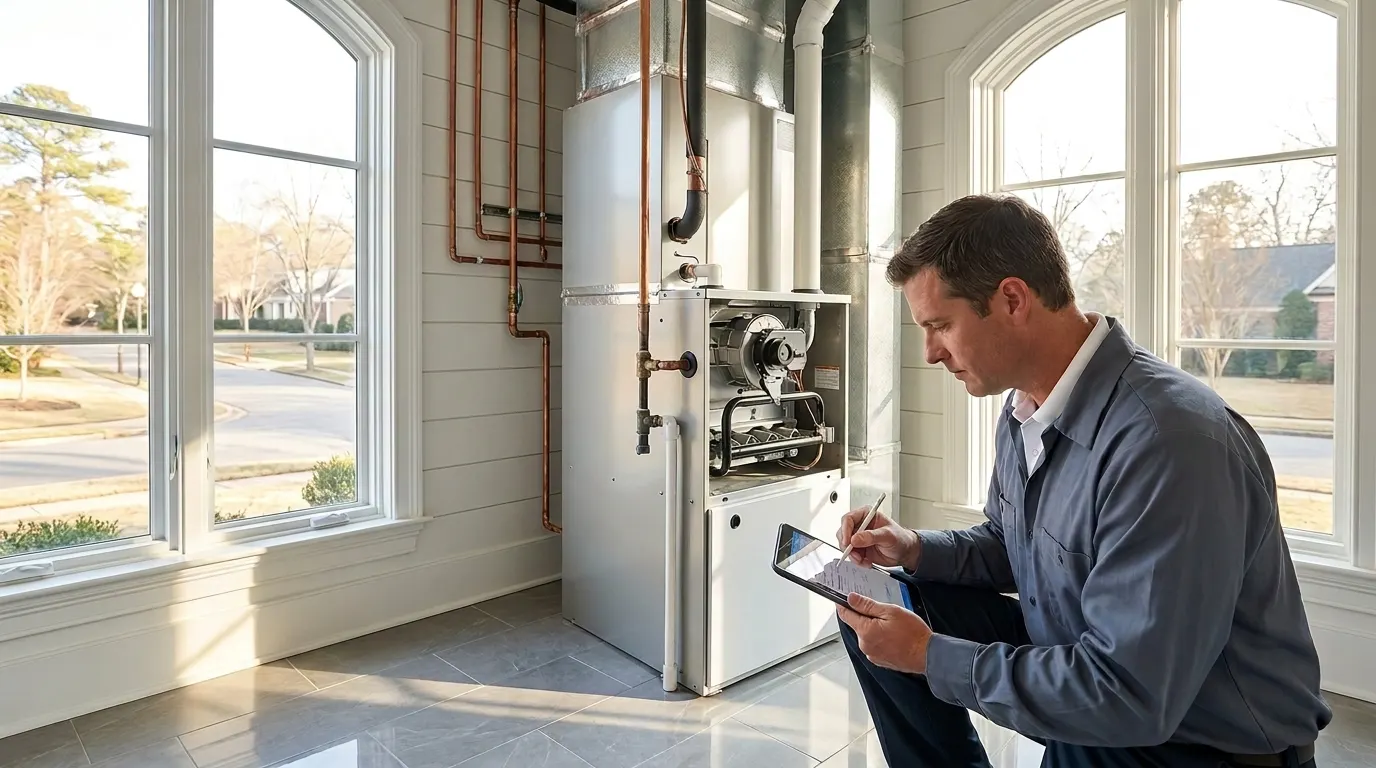
Birmingham winters are short but they are not soft — the metro sees real stretches in the 20s every January, and a house with no heat at 2am gets cold fast. Heating repair here is also more varied than most cities: on the same street we will work a 1990s gas furnace, a 2015 heat pump with electric backup, and a dual-fuel system that switches between the two. This page is the one owner for heating repair across the metro — whatever is making the heat, we repair it, and every gas-fired call includes a carbon monoxide safety check as a matter of policy.
The straight answer: a no-heat call in a Birmingham freeze is a safety call first — carbon-monoxide check on every gas-furnace job, then the ignition, blower, and thermostat. Call (205) 649-4480.
Emergency Heating Repair — When No Heat Cannot Wait
A no-heat call during a hard freeze is an emergency on two fronts: the people in the house and the plumbing in the walls. Birmingham homes are not built for sustained cold — pipe insulation is thin, crawl spaces are vented, and once indoor temperatures slide into the 40s, supply lines in exterior walls start freezing. We run emergency heating dispatch the same way we run summer AC emergencies: a person answers the phone, vulnerable-household calls move to the front of the queue, and the truck arrives carrying igniters, flame sensors, universal control boards, capacitors, and contactors — the parts behind most winter failures. While you wait: run space heaters in occupied rooms only, keep interior doors open to share warmth, open cabinet doors under sinks on exterior walls, and let faucets drip if the forecast is below 25.
Every Heating System Alabama Homes Run
- Gas furnaces — igniter and flame-sensor failures, gas valve faults, inducer motors, pressure switches, limit trips, and cracked heat exchangers. Combustion analysis and CO testing on every call.
- Heat pumps — reversing valves stuck in cooling, defrost boards that let the outdoor coil ice into a block, auxiliary strip heat that never engages (or worse, runs constantly and doubles the bill).
- Dual-fuel systems — the heat pump/gas changeover logic is the most common failure point; we verify balance-point settings so the system uses the more efficient heat source at the right outdoor temperature.
- Electric furnaces and air handlers with strip heat — sequencers, elements, and blown fuses in all-electric homes.
- Package units — the all-in-one rooftop or pad-mounted systems common on slab homes and manufactured housing across the metro.
The Usual Suspects Behind a Cold House
Most winter no-heat calls trace to a short list. A furnace that clicks but never lights usually has a failed hot-surface igniter — they are consumable parts and rarely outlive a decade. A furnace that lights and then shuts down in seconds has a dirty or failed flame sensor telling the board the burner never lit. A heat pump blowing cool air may simply be in defrost, or may have lost refrigerant and be limping on strip heat alone — the difference shows up on gauges, not guesses. A blower that will not start points at the capacitor, the motor, or the board that drives it. And a thermostat that lost its program, its batteries, or a low-voltage wire to a mouse in the crawl space can imitate any of the above. The diagnostic sequence sorts them in one visit, and the written estimate names the actual failed part.
Uneven Heat: The Room That Never Warms Up
Second-most-common winter complaint after no heat: one end of the house is cold while the thermostat swears everything is fine. The cause is almost always one of three things — a blower running below spec through aging ductwork, supply ducts that have pulled apart or lost insulation in the attic or crawl space, or a return-air path too small to feed the system. We measure static pressure at the air handler and temperature at the registers to find which one it is. Sometimes the fix is a blower repair; sometimes it is duct sealing; on larger two-story homes it is occasionally a zoning conversation. What it is never: guesswork or a bigger furnace by default.
Carbon Monoxide Safety — Non-Negotiable on Gas Heat
Every gas-fired heating repair we run includes a combustion safety pass: heat exchanger inspection, flue draft verification, gas pressure check, and ambient CO measurement at the registers. A cracked heat exchanger or blocked flue can push carbon monoxide into a home's air stream with no smell and no warning — and aging furnaces in the metro's older housing stock are exactly where it happens. If we find a CO hazard we shut the appliance down and show you the readings; that is a safety line we do not negotiate. Put a CO alarm on every sleeping level of the home regardless of who services your furnace.
Heater Repair, Gas or Electric, Both Counties
Heater repair in Birmingham means three different machines: gas furnaces, electric heat pumps, and the dual-fuel systems that switch between them. These heating repair services cover all three — from a gas heater repair with a failed igniter to a heat pump stuck in defrost. If you searched "heater repair near me" mid-cold-snap, the emergency heating service line answers around the clock, and local heating maintenance each fall is the most cost-effective way to never make that search again.
Heating Repair Questions
Do you offer emergency heating repair in Birmingham?
Yes. No-heat calls during winter cold snaps are dispatched with the same priority as summer AC emergencies — the line is answered around the clock, and households with infants, seniors, or medical conditions move to the front of the queue. Call (205) 649-4480 with your address and what the system is doing.
How much does heating repair cost in Birmingham?
It depends on the failed component and the system type — an igniter on a gas furnace is a very different repair from a reversing valve on a heat pump. Every call starts with an instrument diagnostic and ends with a written estimate before any repair begins, so you approve the scope knowing exactly what failed. Call (205) 649-4480 for an estimate on your system.
Why is my furnace blowing cold air?
Three common causes: the thermostat fan setting is ON instead of AUTO (the blower runs between heat cycles, circulating room-temperature air), the furnace is failing to ignite so the blower is moving unheated air, or on a heat pump the outdoor unit has lost capacity and the strip heat has not engaged. Check the fan setting first; if it is on AUTO and the air is still cold, shut the system off and call (205) 649-4480.
My heat pump is covered in ice — is that normal?
A light frost during winter operation is normal, and a defrost cycle should clear it periodically — you will hear a whoosh and see steam, which is the system working correctly. A solid ice shell over the coil, ice that never clears, or ice in cooling season is not normal; it points to a failed defrost board or sensor, or low refrigerant. Do not chip at the coil — the fins damage easily. Switch to emergency heat and call (205) 649-4480.
Should I repair my old furnace or replace it?
Age, repair history, and the specific failure decide it. A ten-year-old furnace with a failed igniter is an easy repair; a twenty-year-old unit with a cracked heat exchanger is a replacement conversation, because that repair often costs a meaningful fraction of a new system. We give you the repair estimate and the honest replacement math side by side in writing — the choice stays yours, without pressure in a cold house.
Is a carbon monoxide check really included on every gas heating call?
Yes, as standard procedure — heat exchanger inspection, flue draft check, gas pressure verification, and CO measurement at the supply registers on every gas-fired repair visit. CO is odorless and colorless, and an aging furnace is the most common residential source. If we find readings above safe thresholds we shut the unit down, show you the numbers, and walk through the options before anything else happens.