How Hoover got big — and what it did to the housing stock.
Hoover didn't exist as a city until 1967. Everything you see today was built in waves, and each wave installed a different generation of HVAC equipment. The wave you live in determines what's most likely to fail first.
A bedroom community south of Birmingham
Before Hoover, the area was known as Green Valley — farms, a few country homes, and the rail line. Any "HVAC" system was a coal stove or a fuel-oil furnace.
Named for William H. Hoover, local insurance exec
Incorporated April 28, 1967 as the city of Hoover. At incorporation, population was roughly 400. The building boom was still a decade away, which means almost nothing built before this date still has original HVAC equipment — anything older has been replaced at least twice.
Hoover absorbs its first planned community
The Riverchase business + residential community was annexed in one move, bringing with it big office buildings and the first wave of dense brick-home subdivisions. These 1980s Riverchase homes are now seeing second or third AC system replacements, with the original ductwork often still in place — undersized for modern system tonnages.
Tax revenue funds rapid annexation
The Galleria's retail + office complex gave Hoover the tax base to keep annexing. Through the late 1980s and 1990s, dozens of subdivisions were absorbed — Bluff Park, Shades Cliff, Trace Crossings, Chapel Hill — each with the builder-grade HVAC equipment typical of that era. These are today's most common service calls.
Master-planned community on Shades Mountain
Ross Bridge broke ground around 2002 as a Renaissance Resort + golf community. The homes were larger, the HVAC systems bigger, and the builder tier was noticeably higher than 1990s Riverchase. 15- to 20-year-old Ross Bridge systems are just now entering the failure window for compressors and outdoor fan motors.
Largest suburb in Alabama
Hoover is now the largest suburban city in Alabama and the sixth-largest city statewide. 39,008 housing units, roughly 1,926 residents per square mile. Every one of those homes has a heating and cooling system aging on its own timeline.
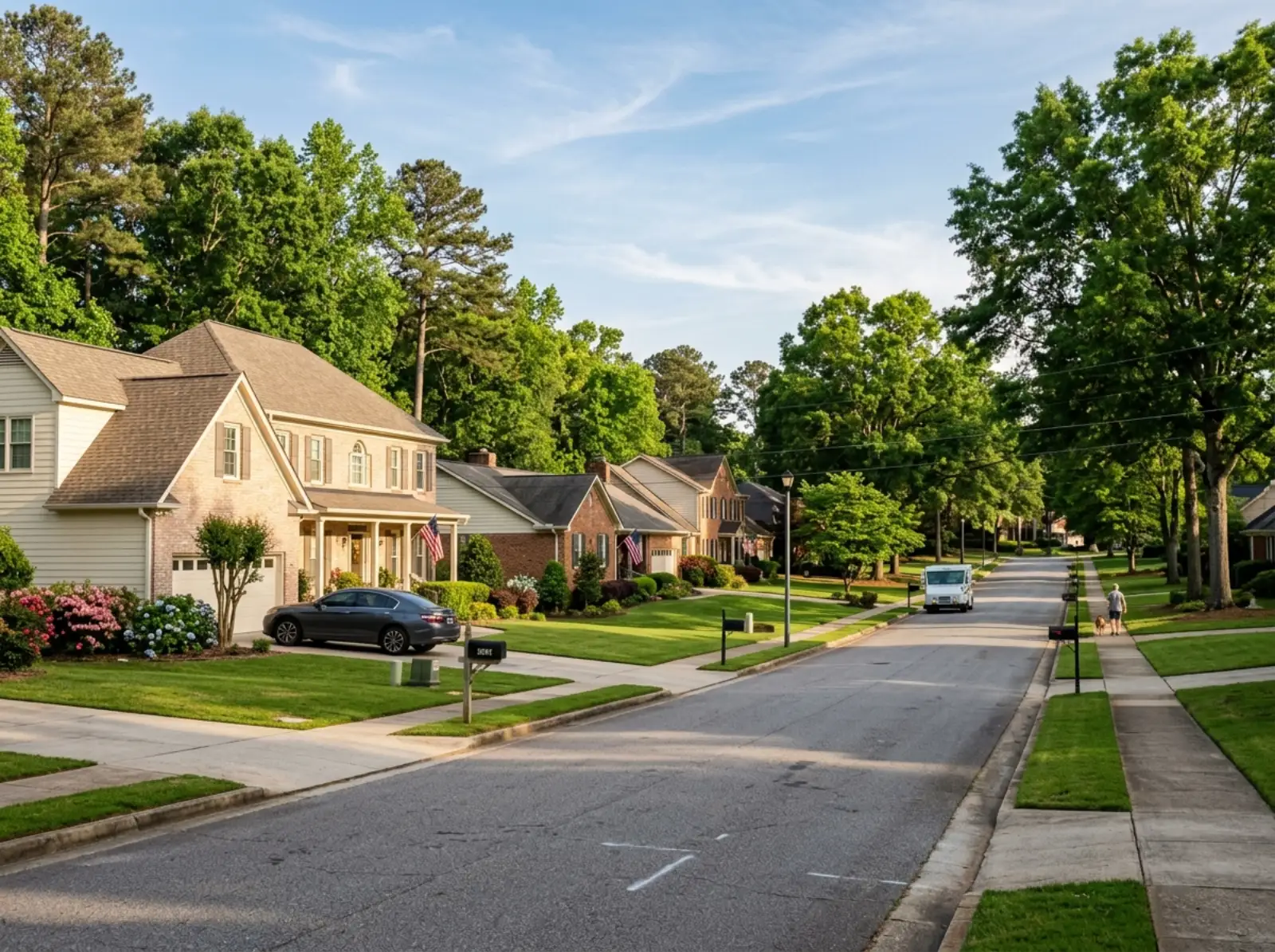
Ross Bridge — master-planned on the Shades Mountain foothills. Larger lots, larger homes, larger HVAC systems. The clock tower of the Renaissance Resort is visible center-frame.
Every Hoover ZIP, covered.
Hoover sprawls across two counties (Jefferson + Shelby) and ten ZIP codes. Dispatch treats every one the same — a call from 35244 gets the same by appointment dispatch coverage as a call from 35216 across town.
35022
Pleasant Grove edge, west Hoover
35080
Helena edge, south Shelby
35124
Pelham edge, Stadium Trace
35142
Shelby County fringe
35216
HQ · Riverchase
35222
Crestline corridor
35226
Bluff Park, Shades Mountain
35236
Chapel Hill, Trace Crossings
35242
Greystone, Inverness, US-280
35244
Ross Bridge, Lake Cyrus
Two-story Hoover homes fight their own AC.
Dramatic two-story foyers were the design signature of 1990s and early-2000s Riverchase and Ross Bridge construction. They look great. They're also thermodynamically hostile to a single-zone AC system.
Hot air rises and pools at the foyer ceiling. The thermostat — usually mounted on a first-floor hallway wall — sees cool air and shuts the system off. Meanwhile the second-floor bedrooms and the living room cathedral ceiling stay warm, and the system ends up running in short aggressive bursts that stress the compressor.
The fix, for homes where replacement is in the future, is a dual-zone system with a damper-controlled bypass. For homes staying with the original layout, we can rebalance ductwork and add supply-register adjusters to shift more cooling to the foyer.
Six Hoover neighborhoods, six HVAC stories.
We know which subdivisions used which builders, which builders preferred which brands, and which common failures surface first in each era of Hoover construction.
Riverchase
The original annexation. Brick traditional homes, most with their second AC system on the wall. Undersized 1980s ductwork is the hidden problem — it limits any modern system to about 80% of rated capacity.
Ross Bridge
Master-planned golf community on Shades Mountain foothills. Larger homes, larger loads, dual-zone systems were more common from the start. 18-22 year old Carrier and Rheem equipment is right in the failure window.
Bluff Park
Historic hilltop community atop Shades Mountain. Mix of 1940s cottages with retrofit central air, 1960s ranches, and contemporary renovations. Every service call here is a new puzzle.
Greystone / Inverness
Off US-280. Larger lots and larger homes, often with multiple HVAC systems serving separate wings. Zoning damper failures and staged-compressor diagnostics dominate the call mix here.
Lake Cyrus
Newer construction with more recent equipment. Systems here have another 5-10 years of runway before major failures, but pollen and Alabama humidity still clog outdoor coils every summer.
Stadium Trace / Chapel Hill
Stadium Trace Parkway corridor — suburban density, mixed 1990s-2010s construction. The brand mix here is wider than anywhere else in Hoover, which is why our techs carry universal parts inventory.
What a 20-year-old Hoover condenser looks like.
This is the kind of equipment our technicians meet several times a week. Original builder-grade, 15-25 years old, brick wall on the south side of a Riverchase or Bluff Park home, oak leaves packed around the base.
Outside appearances are only half the story. The inside of a condenser like this shows capacitor oil staining on the side panel, a contactor pitted from summer thunderstorm power fluctuations, and coil fins bent flat from a decade of yard debris.
When we arrive, we run a complete diagnostic before recommending any repair — because one failing component is often a symptom of several others reaching end of life. The last thing we want is to replace a capacitor this week and a compressor next week.
Hoover-specific questions.
Birmingham Heating & Air-Conditioning dispatches by appointment across all Hoover ZIP codes. Our technicians cover Riverchase, Highway 31, and every Hoover neighborhood on schedule.
Every ZIP code inside Hoover city limits: 35022, 35080, 35124, 35142, 35216, 35222, 35226, 35236, 35242, and 35244. Coverage extends into bordering ZIPs in Vestavia Hills, Pelham, and Alabaster as part of the greater Birmingham metro dispatch.
The two-story foyers common in 1990s and early 2000s Riverchase and Ross Bridge homes create a tall column of warm air that resists a single-zone thermostat. Cooling stratifies at the ceiling while the living level stays hot, making the AC run extended cycles. A properly balanced dual-zone system or variable-speed air handler resolves most of the symptom, but the original builder equipment rarely included either.
Hoover's 1990s building boom installed mostly builder-grade 10 SEER and 13 SEER systems sized for 2,000 sq ft of cooling at Alabama humidity. Those systems are now 25 to 35 years old — well past the 15 to 20 year design life of the compressor, capacitor, and outdoor fan motor. The failure rate steepens sharply after year 20, and Riverchase + the original Bluff Park builder homes are squarely in that bracket.
Yes. Shades Mountain and Double Oak Mountain push Hoover elevations to 495 feet, which means Ross Bridge, Greystone, and the higher sections of Bluff Park can run three to five degrees colder than downtown Birmingham during January cold snaps. Several nights each winter drop into the teens. Heat pump and gas furnace emergency calls spike during those events, and we keep common heating parts stocked.
Capacitor failures in the outdoor condenser are the number one summer emergency — Alabama's direct afternoon sun on south and west equipment pads degrades the run capacitor faster than the manufacturer's published lifespan. Contactor burnout, refrigerant loss at factory brazed joints, and blower motor seizures round out the top four. Winter failures are dominated by ignitor and flame-sensor issues on gas furnaces and defrost-board faults on heat pumps.
Hoover's three build waves each favored different brands. 1980s-1990s Riverchase and Bluff Park homes lean Trane, Lennox, and Carrier. 2000s Ross Bridge and Stadium Trace leaned Carrier, Rheem, and Amana as builders consolidated supply chains. 2010s-present Lake Cyrus and Trace Crossings have a mix of Goodman, American Standard, and Bryant. We service every brand; there is no manufacturer exclusivity.
During the peak of a Hoover August — daytime highs above 95°F with evening lows in the mid-seventies and dew points above 72°F — long cycles are expected. A right-sized system should still reach the thermostat setpoint. If the system runs for hours without getting there, the common causes are a slow refrigerant leak, a dirty outdoor coil caked with pine pollen or oak catkins, or inadequate attic insulation.
Hoover calls we actually run.
These are the Hoover jobs that keep our trucks busy:
Hoover HVAC Questions
How quickly can Birmingham Heating & Air-Conditioning reach Hoover?
Birmingham Heating & Air-Conditioning dispatches by appointment across all Hoover ZIP codes. Our technicians cover Riverchase, Highway 31, and every Hoover neighborhood on schedule.
Which Hoover ZIP codes does Birmingham Heating & Air-Conditioning cover?
Every ZIP code inside Hoover city limits: 35022, 35080, 35124, 35142, 35216, 35222, 35226, 35236, 35242, and 35244. Coverage extends into bordering ZIPs in Vestavia Hills, Pelham, and Alabaster as part of the greater Birmingham metro dispatch.
What makes Hoover two-story foyer homes especially hard on an AC system?
The two-story foyers common in 1990s and early 2000s Riverchase and Ross Bridge homes create a tall column of warm air that resists a single-zone thermostat. Cooling stratifies at the ceiling while the living level stays hot, making the AC run extended cycles. A properly balanced dual-zone system or variable-speed air handler resolves most of the symptom, but the original builder equipment rarely included either.
Why are 1990s-era Hoover homes seeing more HVAC failures now?
Hoover's 1990s building boom installed mostly builder-grade 10 SEER and 13 SEER systems that were sized for 2,000 square feet of cooling at Alabama humidity. Those systems are now 25 to 35 years old — well past the 15 to 20 year design life of the compressor, capacitor, and outdoor fan motor. The failure rate steepens sharply after year 20, and Riverchase + the original Bluff Park builder homes are squarely in that bracket.
Does Hoover get cold enough to need emergency heating service?
Yes. Shades Mountain and Double Oak Mountain push Hoover elevations to 495 feet, which means Ross Bridge, Greystone, and the higher sections of Bluff Park can run three to five degrees colder than downtown Birmingham during January cold snaps. Several nights each winter drop into the teens. Heat pump and gas furnace emergency calls spike during those events, and we keep common heating parts stocked.
What are the most common emergency calls from Hoover homeowners?
Capacitor failures in the outdoor condenser are the number one summer emergency — Alabama's direct afternoon sun on south and west equipment pads degrades the run capacitor faster than the manufacturer's published lifespan. Contactor burnout, refrigerant loss at factory brazed joints, and blower motor seizures round out the top four. Winter failures are dominated by ignitor and flame-sensor issues on gas furnaces and defrost-board faults on heat pumps.
What HVAC brands appear most often in Hoover homes?
Hoover's three build waves each favored different brands. 1980s-1990s Riverchase and Bluff Park homes lean Trane, Lennox, and Carrier. 2000s Ross Bridge and Stadium Trace leaned Carrier, Rheem, and Amana as builders consolidated supply chains. 2010s-present Lake Cyrus and Trace Crossings have a mix of Goodman, American Standard, and Bryant. We service every brand; there is no manufacturer exclusivity.
Is it normal for a Hoover home AC to run almost nonstop in August?
During the peak of a Hoover August — daytime highs above 95°F with evening lows in the mid-seventies and dew points above 72°F — long cycles are expected. A right-sized system should still reach the thermostat setpoint. If the system runs for hours without getting there, the common causes are a slow refrigerant leak, a dirty outdoor coil caked with pine pollen or oak catkins, or inadequate attic insulation.