
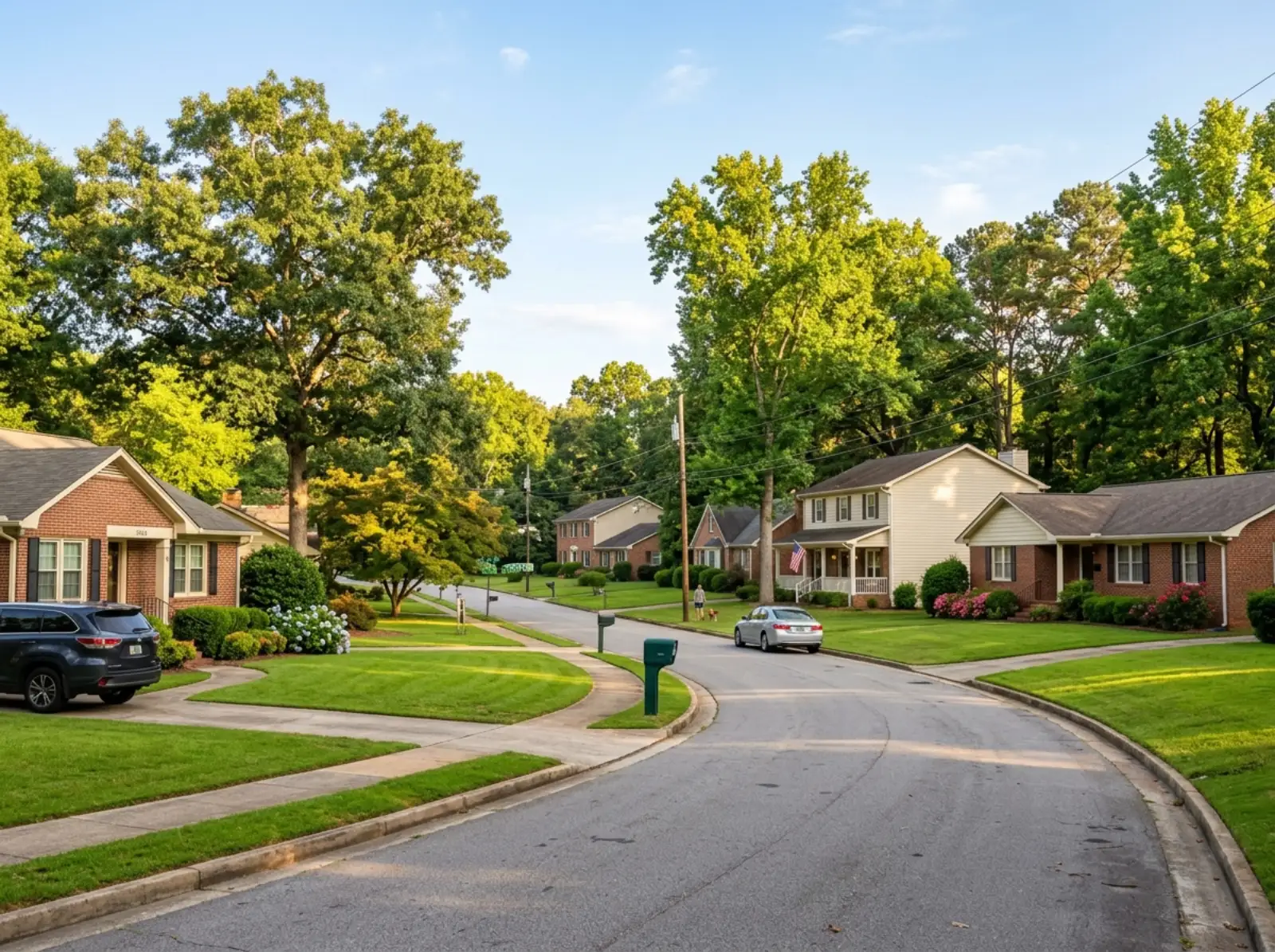
Birmingham Heating & Air-Conditioning dispatches daily across this part of the Birmingham metro. Our technicians work these streets every week and understand exactly what your home needs to stay comfortable through every Alabama season. When you call us, you are calling a crew that knows these neighborhoods.
HVAC service in Gardendale means dealing with three generations of homes — each with its own set of challenges. Ranch-style homes from the 1970s and 1980s along Mt. Olive Road have original ductwork that often needs sealing. Newer subdivisions off Decatur Highway have builder-grade HVAC systems now reaching end of life. The newest construction near Snow Rogers Road has warranty-era equipment that sometimes reveals installation shortcuts. Summer temperatures routinely exceed 93 degrees with humidity above 70 percent, pushing air conditioning systems hard from May through September.
Local HVAC Conditions
- Typical summer high: 93 degrees
- Typical winter low: 32 degrees
- Average humidity: 72%
Gardendale Housing Stock & Common HVAC Issues by Era
| Era | Homes | Common HVAC issues |
|---|---|---|
| 1960s–1980s | Brick ranch, crawl space, 1,200–1,800 sq ft | Original ductwork deterioration, single-stage equipment, crawl space moisture |
| 1990s–2000s | Traditional 2-story and ranch, 1,800–2,800 sq ft | Builder-grade systems at end of life, undersized return ducts, humidity control |
| 2005–present | Craftsman / modern farmhouse, 2,000–3,500 sq ft | Zoning calibration, shaded-lot defrost issues, warranty-period shortcuts |
Heat pump service and replacement in Gardendale.
Gardendale runs on heat pumps. The subdivisions built off Fieldstown Road and Mt. Olive Road in the past twenty-five years went all-electric almost block by block, which makes heat pump repair, heat pump replacement, and cold-snap defrost problems the backbone of our north-metro work. When a Gardendale heat pump ices over in January or blows lukewarm air in August, the diagnosis path is the same: check the defrost board and sensors, verify the charge, and inspect the reversing valve before anyone talks replacement.
When replacement is the honest answer — usually past year fifteen with a compressor on the way out — we quote a properly sized unit off a load calculation, not a nameplate swap. Gardendale homeowners also ask us about whole-house humidifier installation for winter dryness and duct sealing for the attic runs those same subdivisions were built with; both ride along on the same truck.
Gardendale Housing Stock — Three Generations, Three Sets Of Problems
Gardendale is a brick-ranch town. Drive Fieldstown Road, Mt. Olive Road, or the older stretch of Decatur Highway on a Saturday morning and you will see hundreds of one-story brick homes built between 1960 and the mid-1980s — most with finished or half-finished basements, most with original ductwork routed through vented crawl spaces, and almost all with HVAC equipment that has been replaced once or twice while the ducts have never been touched. When a Gardendale homeowner calls us for a “weak cooling” complaint, the equipment is rarely the problem. It is usually the forty-year-old flex duct sweating against a joist, the return pan being used as a supply chase, or the 1970s galvanized trunk that has separated at a sheet-metal seam. We tell people the same thing every time: do not replace the equipment until somebody has actually tested the ductwork. That is the Gardendale story in a sentence.
Crawl Space Ductwork — The Fieldstown Road Special
Every neighborhood off Fieldstown, Grayson Valley Drive, and Mt. Olive has one thing in common: the ducts run through a vented crawl space that is hot, humid, and full of spiders. When insulation falls off old flex duct, the supply air picks up eight to twelve degrees of heat gain between the air handler and the register. When a metal collar rusts loose at the takeoff, thirty percent of your conditioned air ends up cooling the crawl space instead of the kitchen. This is not a maintenance problem — it is a construction-era problem. We fix it by sealing the joints with mastic, re-insulating exposed runs, and in the worst cases, encapsulating the crawl space so the ducts live in a conditioned zone. It is not cheap, but it is the only fix that actually works, and most Gardendale homeowners see a ten-to-fifteen-percent drop in their power bill after.
Snow Rogers Road — Newer Homes, Newer Problems
The newer Gardendale subdivisions off Snow Rogers Road were built between 2005 and today, and they come with a completely different set of HVAC headaches. These homes have tighter envelopes, spray-foam attics in some cases, and zoned two-story systems that look great on paper but get installed by the lowest-bid subcontractor. We regularly find zone dampers that were never commissioned, return air pathways that were drywalled shut, and variable-speed blowers running at fixed speed because nobody ever programmed the board. If your Snow Rogers home has a “hot upstairs” problem, nine times out of ten the solution is not a second system — it is a correctly configured zone board and a proper return air balance. We bring a manometer and we make the numbers match before we quote anything.
Gardendale calls we actually run.
If you are in Gardendale, odds are your problem is on this list:
Recent Work Patterns Around Gardendale
Capacitor replacement, Fieldstown Road ranch
Weekend summer call on a 14-year-old single-stage condenser. Outdoor unit humming, fan not spinning. Dual-run capacitor tested at 22/3 instead of the 45/5 rating. Replaced with a matched Turbo 200X universal capacitor. System back up inside an hour.
Evaporator coil freeze-up, Mt. Olive Road 1970s ranch
Homeowner called with warm air and ice visible on the suction line. Filter had not been changed in six months, coil was blocked with pollen. Thawed the coil, replaced the filter, verified subcooling within spec. No refrigerant added — the charge was correct once airflow was restored.
Flex duct collapse, Grayson Valley crawl space
Back bedroom never cooled right on a three-bedroom ranch. Found three runs of R-4.2 flex duct that had separated from the sheet-metal collar and were kinked against crawl-space joists. Re-hung, re-sealed with mastic, balanced the registers. Temperature delta across the house dropped from 8°F to 2°F.
Heat pump replacement, Snow Rogers Road newer build
Thirteen-year-old 14-SEER builder-grade heat pump with a failed TXV and a compressor drawing locked-rotor amps. Quoted a 16-SEER2 variable-speed replacement with a matched coil. Manual J load calc confirmed a 2.5-ton system was appropriate — the original 3-ton install was oversized.
Furnace ignition failure, Pinchgut Creek area
Natural-gas 80% furnace not firing on a cold December morning. Hot surface igniter failed open. Combustion analysis on the replacement showed O₂ at 8.2% and CO at 35 ppm — within spec. Flame-sensor cleaned and heat exchanger inspected with borescope. No cracks.
Condensate drain clog, Decatur Highway corridor
Secondary pan float switch shut the air handler down during a summer thunderstorm. Algae buildup in the primary condensate trap. Blew the line back to daylight, flushed with condensate tablet, added a wet-switch safety on the primary pan. Documented the fix for the homeowner.
Gardendale Neighborhoods We Work
Fieldstown Farms
Popular subdivision along Fieldstown Road with homes built in the late 1990s and early 2000s. Three and four bedroom ranch homes and two-story traditional designs, 1,800 to 2,800 sq ft. Builder-grade systems reaching end of life, undersized return air ducts, humidity control challenges in two-story plans.
Mt. Olive Road Corridor
Established area with homes dating to the 1970s and 1980s near Mt. Olive Elementary. Brick ranch homes, 1,200 to 1,800 sq ft with single-level floor plans. Original ductwork deterioration in crawl spaces, outdated single-stage equipment, additions built without extending HVAC.
Odom / Snow Rogers Area
Northeastern growth corridor with newest residential construction in the city. Newer construction from 2005 to present, craftsman-style and modern farmhouse, 2,000 to 3,500 sq ft. Warranty-period defects, zoning calibration issues in larger plans, shaded lots affecting heat pump defrost.
Decatur Highway Corridor
Mix of residential and light commercial along the main east-west route. 1960s brick ranches, 1980s split-levels, and 2010s infill construction. Mismatched systems from partial upgrades, noise from commercial neighbors, older electrical panels.
Pinchgut Creek Area
Low-lying neighborhoods with mature trees and established landscaping. 1970s and 1980s single-story homes on large lots. Higher humidity from creek proximity, condensate drain issues, outdoor unit corrosion.
Black Creek overlap (Mt. Olive side)
Eastern edge of Gardendale bordering the Black Creek watershed and unincorporated Pinson-area residential. Mixed 1970s brick ranches and 2000s infill, 1,400 to 2,400 sq ft on wooded lots. Damp-crawl duct deterioration, condenser corrosion from creek proximity, harder defrost performance on shaded lots.
Gardendale HVAC Questions
How fast can Birmingham Heating & Air-Conditioning respond to an emergency in Gardendale?
We dispatch daily across this area and keep fully stocked service vehicles stationed in the area around the clock. Whether you live near Mt. Olive Road, Fieldstown Farms, or the newer developments near Snow Rogers Road, our dispatchers coordinate the nearest available technician to your door. Call (205) 649-4480 any time.
What size HVAC system does my Gardendale home need?
The correct system size depends on an ACCA Manual J load calculation (https://www.acca.org/standards/approved-standards) that accounts for your home insulation, windows, orientation, ceiling height, and ductwork condition. Many Gardendale homes built in the 1990s along Fieldstown Road were originally equipped with oversized systems. A properly sized system runs longer cycles at lower intensity, removing more moisture and distributing air more evenly.
Why is my Gardendale house humid even when the AC is running?
The most frequent cause is an oversized air conditioning system. When the unit is too large, it cools the temperature quickly and shuts off before removing adequate moisture. Other causes include leaking crawl space ductwork drawing in humid outside air, a clogged condensate drain, or low refrigerant charge.
How often should I change my HVAC filter in Gardendale?
Check your filter every 30 days and replace it no less than every 60 to 90 days. Gardendale has significant pollen from pine, oak, and sweetgum trees. During peak pollen season from March through May, filters clog much faster. Standard one-inch filters need monthly replacement during spring and summer.
How often should I schedule HVAC maintenance for my Gardendale home?
Twice a year — once in spring before cooling season and once in fall before heating season. Regular maintenance catches capacitor degradation, refrigerant issues, and coil buildup before they become emergency calls. Most Gardendale homes benefit most from the spring visit because the pollen load in March through May is brutal on outdoor condenser coils.
What does a real HVAC maintenance visit include in Gardendale?
Capacitor testing with a multimeter against rated microfarad values, amp draw on blower and condenser fan motors, refrigerant pressure readings on suction and head, temperature split across the evaporator, coil inspection and cleaning where needed, condensate drain treatment, contactor and electrical check. If your previous company only changed the filter and looked at the thermostat, that was not a maintenance visit.
What brands do you service in Gardendale?
We service every major HVAC brand common in Gardendale homes — Trane, Carrier, Lennox, Rheem, Bryant, Goodman, American Standard, Heil, Ruud, Amana, Payne, Mitsubishi, Daikin, and Fujitsu for ductless applications. Our trucks carry capacitors, contactors, igniters, and common control components for all of these. See our full brands hub at /manufacturers.
Is a heat pump worth it in Gardendale?
For most Gardendale homes, yes. Alabama winter lows average around 32°F in Gardendale per NOAA climate data (https://www.weather.gov/bmx/climate). Modern cold-climate heat pumps maintain efficiency down to the upper teens, which covers all but a handful of nights per year. Operating cost for a properly sized variable-speed heat pump is lower than a straight electric system and competitive with natural gas across our climate.