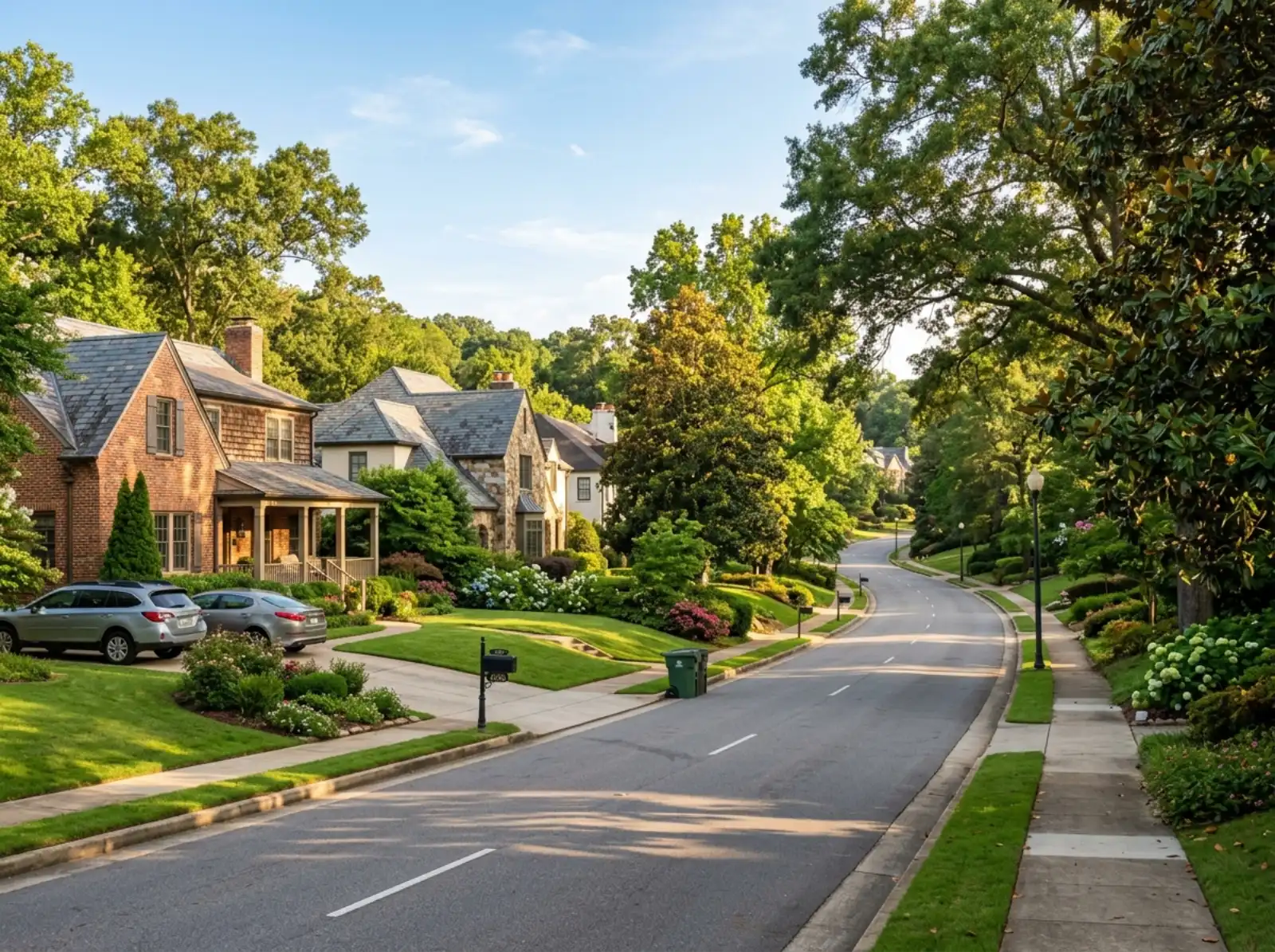
Mountain Brook is consistently ranked among Alabama's most affluent municipalities and one of the Southeast's most desirable suburban communities. Incorporated in 1942 around the vision of real estate developer Robert Jemison Jr., Mountain Brook's three villages — Mountain Brook, Crestline, and English — feature an English Tudor and Colonial Revival architectural character that sets it apart from standard suburban development. HVAC service in Mountain Brook demands the highest level of technical capability — large custom homes with complex ductwork, premium equipment brands, multi-zone systems, and homeowners who expect professional service and precise results.
Local HVAC Conditions
- Typical summer high: 93 degrees
- Typical winter low: 32 degrees
- Average humidity: 71%
Whole-house humidifier installation in Mountain Brook.
Mountain Brook is the one place in the metro where winter humidity calls rival summer cooling calls. The older plaster-and-hardwood homes in English Village, Crestline, and Cherokee Bend dry out hard when the heat runs — floors gap, trim cracks, and static builds — and portable units cannot keep up with 3,000-plus square feet. A whole-house humidifier installation mounts on the supply plenum, meters water through a distribution pad, and holds the entire house in the 35-to-45 percent range the woodwork wants.
Installation is a half-day job on most systems: a bypass or fan-powered unit sized to the square footage, a dedicated water line with a proper quarter-turn fitting, and a humidistat wired so the unit only runs when the furnace does. We also service and re-pad existing units that have scaled up on Birmingham's moderately hard water.
What you need to know about Mountain Brook HVAC.
Mountain Brook is Alabama's wealthiest municipality by median household income, incorporated in 1942 and built from 1929 onward in a pattern that bears almost no resemblance to the post-war suburban grid that defines most Birmingham-area communities. The city is organized around three distinct villages — Crestline Village on the eastern ridge, English Village in the center along Cahaba Road, and Mountain Brook Village on the western edge near US-280 — each with its own retail district and surrounding residential fabric.
The residential fabric itself is the HVAC challenge. Cherokee Road, Overbrook Road, Montrose Road, and the street grid between them carry homes built between 1929 and 1965 — Tudor revivals, colonial revivals, brick and stone English cottage styles, and the occasional modernist anomaly from a mid-century architect who got a commission from a forward-thinking family. None of these structures were designed with central air in mind. Central air arrived as a retrofit beginning in the 1960s, threaded through whatever attic, basement, and interior closet space the contractor could negotiate without tearing out irreplaceable millwork or plaster.
The result is ductwork that has been grandfathered into every system replacement since. When a Mountain Brook homeowner replaces a 20-year-old system, they are usually dropping new equipment onto ductwork that is 40 to 50 years old — frequently undersized by modern standards, frequently leaking at sheet-metal seams that have shifted through decades of thermal expansion, and frequently routed through attic zones that reach 140°F in July and August.
Mountain Brook Country Club's golf course and Jemison Park's tree canopy set the character of the city's landscape. The same tree canopy that makes Cherokee Road beautiful in October loads outdoor condenser coils with pollen, oak debris, and organic dust at rates that open-lot suburban condensers never experience. Annual coil cleaning is not adequate in Mountain Brook — semi-annual is the correct maintenance interval for properties in heavy-canopy positions.
The four failure patterns in Mountain Brook.
Duct Mismatch — New Equipment, Old Infrastructure
Replacing the equipment without addressing the ductwork is the single most common Mountain Brook HVAC mistake. A modern 18-SEER variable-speed system installed on 1970s trunk-and-branch ductwork delivers 1970s performance. The ducts cannot move the air the new equipment is designed to push. Static pressure climbs, the blower works harder, efficiency disappears, and the homeowner wonders why the new system performs like the old one. We measure static pressure before every Mountain Brook replacement and include a ductwork assessment in the written quote.
Multi-Zone Calibration Failures
Mountain Brook's multi-story estate homes frequently carry zone board systems installed by contractors who correctly identified the need for zones but never commissioned the damper positions and blower speeds to the actual building loads. Zone boards in these homes are often set at factory defaults — which bear no relationship to the square footage, ceiling height, and ductwork geometry of a 1940s colonial. A re-commissioning visit costs a fraction of a new system and frequently resolves temperature complaints that homeowners have tolerated for years.
Refrigerant Leaks at Aging Brazed Joints
Mountain Brook evaporator coils on systems from the 1990s and 2000s are now 20 to 35 years into service. The brazed joints that connect refrigerant lines to the coil — and where the coil lines enter and exit the metering device — develop micro-leaks that accelerate as the metal fatigues. A system recharged without the leak being located and repaired will lose refrigerant again. We use electronic leak detection to find the actual leak source before recommending whether repair or replacement is the right call.
Condenser Coil Fouling from Heavy Tree Canopy
Mountain Brook's dense oak, dogwood, and magnolia canopy loads condenser coils at rates that flat open-lot suburban properties never experience. Pollen, seed pods, leaf debris, and organic dust accumulate on condenser fins through every season. Fouled fins reduce heat rejection capacity, raise head pressure, increase compressor load, and accelerate wear on every rotating component. Annual coil cleaning is the suburban standard. Mountain Brook properties in heavy-canopy positions need cleaning every six to nine months.
Mountain Brook villages — what HVAC looks like in each one.
Crestline Village Area
The eastern ridge neighborhood surrounding Crestline Village shopping district. Homes from the 1940s through 1960s on lots with significant elevation change. Multi-story colonials and brick ranches on the ridge. Common HVAC issue: heat pump defrost faults on condensers placed on north-facing, shaded positions where ambient airflow is restricted. Second-floor temperature complaints in two-story colonials with original single-zone systems.
English Village / Cahaba Road
The commercial and residential center of Mountain Brook along Cahaba Road. Tudor revival and English cottage homes built in the 1930s and 1940s, some of the oldest residential stock in the city. Common HVAC issue: retrofit ductwork in plaster-wall homes where the original installer threaded supply runs through interior closets and did not have adequate space for return air paths. High static pressure and poor airflow balance throughout the building.
Cherokee Road / Mountain Brook Village
The western end of Mountain Brook near US-280, anchored by Mountain Brook Village shopping and the Mountain Brook Country Club. Estate-scale homes from the 1930s through 1960s on the largest lots in the city. Common HVAC issue: multi-equipment multi-zone systems that were added to over the decades without a unified control strategy. Technicians who have never seen the system before spend significant time tracing what is connected to what before diagnosing a failure.
What we handle in Mountain Brook.
AC Repair
Capacitor failure, refrigerant leaks, frozen coils, contactor pitting, blower problems. We test the actual circuit before swapping parts. Electronic leak detection for brazed joint failures in older Mountain Brook evaporator coils.
Heating & Furnace Repair
Gas furnace, electric furnace, heat pump heating mode. Igniter failure, flame sensor fouling, cracked heat exchanger, reversing valve stuck. Mountain Brook homes with original gas heat that pre-date 1980 require careful combustion analysis — older flue configurations carry elevated CO risk.
Heat Pump Service
Reversing valve, defrost board, low refrigerant in winter, auxiliary strip heat. Heat pumps on shaded north-facing Mountain Brook lots defrost less efficiently in cold snaps — defrost board faults are a predictable failure point on condensers in restricted-airflow positions.
Ductless Mini-Split
Mitsubishi, Daikin, Fujitsu, LG. Guest quarters above garages, pool houses, carriage house conversions, bonus rooms. Single outdoor unit can drive two to four indoor heads. The clean retrofit for historic Mountain Brook homes where threading new ductwork means demolishing original millwork.
Emergency Repair
by appointment dispatch — nights, weekends, holidays. Parts on the truck. Written estimate before work begins. Mountain Brook is within our primary service radius from the Hoover base. Call (205) 649-4480 and we will tell you honestly when to expect a technician.
All Services
Full list of HVAC services — AC installation and replacement, duct repair and sealing, indoor air quality, coil cleaning, condensate drain repair. View the complete service menu.
Mountain Brook HVAC — questions we get on every job.
Mountain Brook's housing stock spans 1929-era estates to 1960s brick colonials — most had central air retrofitted well after original construction. The dominant failures are: refrigerant leaks at aging brazed joints on coils recharged multiple times without the leak being found; duct mismatch failures where a modern air handler is running on 1970s ductwork; multi-zone board calibration failures where the dampers were installed but never commissioned to the actual building envelope; and condenser coil fouling from the dense hardwood canopy accelerating fin loading faster than annual cleaning intervals can manage.
Mountain Brook homes were built from 1929 onward — before central air was standard. Central air was retrofitted beginning in the 1960s, running ductwork through whatever attic and basement clearance existed. The retrofit ductwork generation, often galvanized trunk-and-branch, often undersized by modern airflow standards, was never replaced in many of these homes. When homeowners replace aging equipment on an old ductwork system, they are frequently surprised that the new equipment still underperforms. The ductwork is almost always the reason.
Yes, significantly. Pre-1960 estate homes along Cherokee Road, Overbrook, and throughout the English Village district were built with plaster walls and no HVAC duct chases. Central air was threaded through these buildings in ways that compromised both ductwork sizing and equipment selection. Many of these homes have multiple separate systems — not because the owners wanted multiple systems, but because there was no clean ductwork path to serve the whole building from one air handler. The complexity means repairs often require more diagnostic time to trace what connects to what.
In Mountain Brook homes, warm air with the AC running typically comes from one of three sources: duct leakage where conditioned air is escaping into unconditioned attic space before it reaches occupied rooms; a zone damper stuck in the wrong position, cutting airflow to the affected level; or a refrigerant charge problem that shifts the evaporator temperature in ways that reduce total cooling capacity. Fouled condenser coils — common in Mountain Brook's heavy-canopy positions — also reduce system efficiency without triggering any fault code. We test all four possibilities before recommending a fix.
Semi-annual — spring and fall — for condensers in heavy-canopy positions. Annual is the standard suburban recommendation for open-lot properties. Mountain Brook's oak, dogwood, and magnolia canopy loads condenser fins with pollen in spring, seed pods and leaf debris in fall, and organic dust year-round. A fouled condenser runs harder, bills more, and fails earlier. We rinse the coil, check refrigerant pressures, test capacitor and contactor, and verify temperature split at every visit.
Yes. Birmingham Heating & Air-Conditioning dispatches by appointment, 365 days a year — evenings and weekends. Mountain Brook is within our service area from the Hoover headquarters. Call (205) 649-4480 with your address and we will tell you honestly when to expect a technician. Written estimate before any work begins — that does not change for after-hours calls.
Mountain Brook homes installed their first central air systems in the 1960s and 1970s primarily with Carrier, Trane, and Lennox. Replacements through the 1990s and 2000s added Rheem, Bryant, and American Standard. More recent installations use Carrier, Trane, and Lennox at the premium end and Goodman and Daikin in budget-conscious replacement scenarios. For ductless, Mitsubishi and Daikin are the most common brands in Mountain Brook estate and outbuilding applications. We service all of these brands.
Mountain Brook system down?
by appointment dispatch from our Hoover base. Licensed Alabama HVAC technician. Parts on the truck. Written estimate before any work begins — that policy does not change for night or weekend calls.
No answering service. A dispatcher picks up.
Mountain Brook calls we actually run.
The repairs Mountain Brook homeowners ask about most:
Mountain Brook HVAC Questions
What HVAC problems are most common in Mountain Brook homes?
Mountain Brook's housing stock spans from 1929-era estates to 1950s-and-1960s brick colonials and ranch homes — most of which had central air added as a retrofit after the original construction. The dominant failure patterns we see are: refrigerant leaks at aging brazed joints in evaporator coils on systems that have been recharged multiple times without the leak being actually located and repaired; duct mismatch failures where a modern high-efficiency air handler was installed on ductwork designed for the 1970s system it replaced; multi-zone system calibration failures where the zone board was installed correctly but never commissioned to the building envelope; and heat pump defrost faults in older homes whose outdoor condensers are installed on shaded north-facing positions because that was the only practical equipment location on their lot.
How does Mountain Brook's age of construction affect HVAC?
Mountain Brook incorporated in 1942 but the city was platted and built from 1929 onward. Homes in the Crestline, English Village, and Mountain Brook Village areas were constructed between 1929 and 1960 — before central air was standard equipment. Central air was retrofitted into these homes beginning in the 1960s, running ductwork through whatever attic and basement clearance existed. The retrofit ductwork generation — often galvanized trunk-and-branch, often undersized by modern airflow standards — has never been replaced in many of these homes. When homeowners replace aging equipment on an old ductwork system, they are frequently surprised that the new equipment still does not perform as expected. The ductwork is the reason.
Do older Mountain Brook estate homes have different HVAC needs than newer construction?
Yes, significantly. Pre-1960 Mountain Brook estate homes along Cherokee Road, over the mountain on Overbrook, and throughout the English Village district were built with plaster walls, hardwood floors on multiple levels, and no HVAC duct chases designed into the structure. Central air was threaded through these buildings in ways that compromised both the ductwork sizing and the equipment selection. Many of these homes have multiple zones driven by separate equipment because there is no clean ductwork path to serve the whole building from one system. The complexity means repairs often require more diagnostic time to trace what is connected to what — standard in these homes, not a billing practice.
What does ductless mini-split service cover in Mountain Brook?
Birmingham Heating & Air-Conditioning installs and services ductless mini-split systems in Mountain Brook for guest quarters above detached garages, bonus rooms added to the footprint of existing homes, pool houses and carriage house conversions, and whole-estate retrofits where threading ductwork through a historic structure would require demolishing irreplaceable millwork. Brands serviced include Mitsubishi, Daikin, Fujitsu, and LG. Multi-zone outdoor units can drive two to four indoor heads — practical for a guest apartment above a garage on Cherokee Road without running refrigerant lines and electrical through a finished residence below.
Do you service Mountain Brook by appointment?
Yes. Birmingham Heating & Air-Conditioning dispatches by appointment, 365 days a year — evenings and weekends. Mountain Brook is within our service area from the Hoover headquarters. Call (205) 649-4480 with your address and we will tell you honestly when to expect a technician. Written estimate before any work begins — that does not change for after-hours calls.
What HVAC brands are most common in Mountain Brook homes?
Mountain Brook homes installed their first central air systems primarily in the 1960s and 1970s with Carrier, Trane, and Lennox — the dominant HVAC manufacturers of the era. Replacements through the 1990s and 2000s added Rheem, Bryant, and American Standard. More recent installations in the post-2010 window include Carrier, Trane, and Lennox at the premium end and Goodman and Daikin in budget-conscious replacement scenarios. For ductless, Mitsubishi and Daikin are the most common brands in Mountain Brook estate and outbuilding applications. We service all of these brands.
Why is multi-zone HVAC common in Mountain Brook homes?
Multi-story construction is the primary reason. Mountain Brook's estate and colonial-style homes from the 1930s through 1960s were built as two and three-story structures with formal stair halls and multiple wings — a geometry that makes single-zone HVAC impractical for comfort. The upper floors collect heat in summer because the staircase functions as a convection chimney. A zone board with separate thermostats and motorized dampers in the ductwork allows independent temperature control for each level. Many Mountain Brook homes with original single-zone systems have had zone boards added as a retrofit to address this problem without replacing entire systems.
How does the tree canopy in Mountain Brook affect HVAC systems?
Mountain Brook's dense hardwood canopy — oak, magnolia, and dogwood throughout the residential streets — accelerates condenser coil fouling at rates that homeowners in open-lot suburbs never experience. Pollen in spring, leaf debris and seed pods in fall, and organic dust year-round load the condenser fins with material that reduces heat rejection capacity, raises head pressure, increases compressor load, and cuts efficiency. Mountain Brook condensers should be cleaned twice a year — spring and fall — not the annual interval adequate for open-lot properties. A fouled condenser does not announce itself with an error code. It just runs harder and fails earlier.