
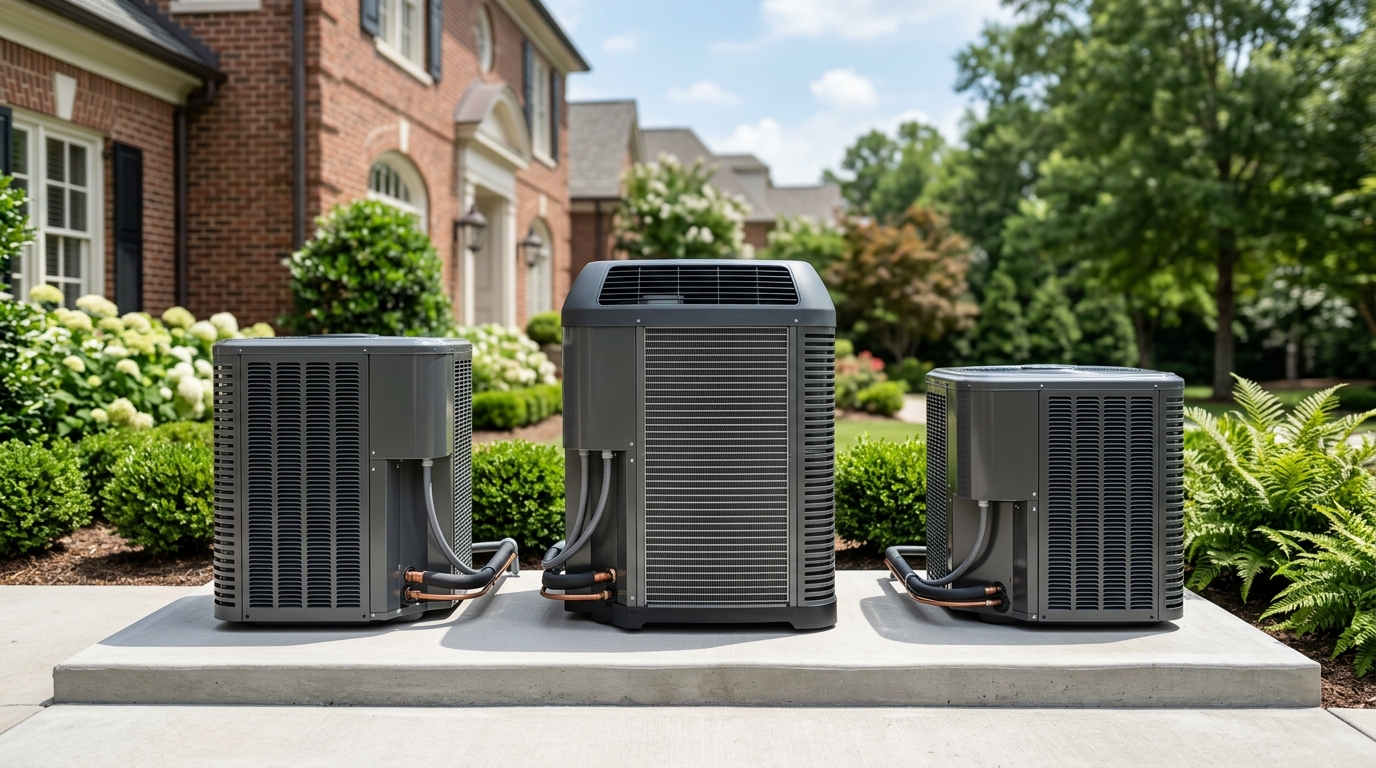
The Honest Brand Comparison
All three top-tier brands — Trane XV20i, Carrier Infinity 26, Lennox Signature SL28XCV — deliver excellent comfort when installed properly. The meaningful differences are warranty terms, control system architecture, dealer network depth, and parts-availability tail. The installer matters more than any of these. Pick the contractor first, then the brand.
Why Brand Matters Less Than You Think
Walk into any HVAC sales conversation and you will hear "Trane is the Cadillac" or "Carrier invented air conditioning" or "Lennox has the highest SEER on the market." All three statements are partially true and mostly marketing.
Here is what is actually true: top-tier variable-speed equipment from any of the three majors will hold up for 15-20 years if installed correctly and maintained on schedule. The compressor scrolls and inverter boards come from a small handful of suppliers (Copeland, Hitachi, Bristol). The cabinet metals are similar. The differences are real but smaller than the sticker price suggests.
What actually drives the comfort experience in your home:
- Proper Manual J sizing
- Static-pressure-tested ductwork
- Refrigerant charge within spec
- Thermostat properly paired with the equipment
- The installer's discipline on commissioning the system
A top-tier Lennox installed by a guy in a hurry will underperform a mid-tier Carrier installed by a tech who measures everything. The brand is the smaller of the two variables.
The Three Flagship Lines in 2026
Each manufacturer has a "flagship" variable-speed line that represents the top of their residential offering. These are the systems you are comparing when you sit down with a Mountain Brook installer who specializes in premium work.
Trane XV20i Variable-Speed
The Trane XV20i (and the XV18 step below it) is the volume leader in the premium tier. It uses a Climatuff variable-speed compressor (Trane-branded but built in their own plant), an ECM blower, and the Trane Link communicating thermostat for system control.
What it does well:
- Hot-climate durability — Trane has historically over-engineered cabinet construction for southern markets
- The TruComfort variable-speed staging is smooth and quiet, even at startup
- Dealer network is deep across Alabama — easier to find warranty service in a hurry
- Sound rating as low as 55 dB on the largest tonnages, comparable to a quiet dishwasher
Where it gets criticized:
- Communicating thermostat (Trane Link) is locked into Trane equipment — no swapping to Nest or ecobee without losing variable-speed performance
- Repair parts run on the expensive side compared to Carrier
- Older units (pre-2023) had a reputation for board failures that pushed Trane to extend their warranty terms
Carrier Infinity 26
The Carrier Infinity 26 (with the 24VNA6 being the current premium model) is the volume leader's volume leader — Carrier sells more residential systems globally than any other brand. The Infinity series uses a true variable-speed inverter compressor, a constant-airflow ECM blower, and the Infinity Touch communicating control.
What it does well:
- Best-in-class humidity control through the "Greenspeed Intelligence" staging algorithm
- 24VNA6 hits 26 SEER2 on some configurations — currently among the highest residential ratings on the market
- Parts availability is excellent — Carrier shares many components across the Bryant brand and aftermarket sourcing is straightforward
- Strong dealer network in Alabama with multiple "Factory Authorized" tiers
Where it gets criticized:
- Infinity Touch thermostat interface has a learning curve and some homeowners find it less intuitive than competitors
- Indoor coil sizing has to be matched precisely with the condenser for the full SEER rating — mismatched installs underperform
- Premium pricing on the highest tier — you pay for the 26 SEER number
Lennox Signature SL28XCV
The Lennox SL28XCV is the highest-SEER residential AC commercially available, rated up to 28 SEER2 in optimal configuration. Lennox uses a SilentComfort variable-speed compressor, an iComfort communicating control system, and proprietary Lennox cabinet and coil design.
What it does well:
- Bragging-rights efficiency numbers (28 SEER2 ceiling)
- iComfort thermostat is widely considered the most polished interface of the three
- Integrated indoor air quality options — PureAir purifier system pairs natively
- Premium cabinet construction with corrosion-resistant coil coatings (advantage in coastal markets — less relevant inland in Birmingham, but it shows up in long-term durability)
Where it gets criticized:
- Lennox uses more proprietary parts than competitors — repairs after the warranty period can be expensive and parts can be harder to source
- Smaller dealer network in the Birmingham area than Trane or Carrier
- The 28 SEER2 rating requires a very specific, perfectly matched system configuration — many real-world installs land at 20-22 SEER2
Key takeaway: The "top SEER" number on the box is achieved under ideal lab conditions with a perfectly matched air handler, perfect static pressure, and a perfectly commissioned system. Real-world installed SEER is typically 2-4 points lower. Ask your installer what your specific configuration will rate, not what the marketing literature says.
Warranty Terms That Actually Matter
Manufacturer warranties on premium HVAC equipment are confusing because there is a difference between "standard" and "registered" coverage. If you do not register your system within 60-90 days of install, you usually get the base 5-year coverage. Registered, you get the marketed terms.
Rough comparison of registered warranty terms in 2026:
- Trane XV20i: 10-year compressor, 10-year parts, lifetime heat exchanger (gas furnace pairings)
- Carrier Infinity 26: 10-year compressor, 10-year parts, lifetime heat exchanger
- Lennox Signature SL28XCV: 10-year compressor, 10-year parts, 20-year heat exchanger (gas furnace pairings)
All three offer optional extended labor warranties through their dealer networks at additional cost. These are worth considering on premium installs — at year 8 of a 10-year warranty, a parts-covered compressor swap can still run $1,500-$2,500 in labor without an extended labor agreement.
Control Systems and Why the Thermostat Matters
Every premium variable-speed system requires a communicating thermostat from the same manufacturer to fully unlock its modulating capability. This is the single most-misunderstood part of a premium HVAC purchase.
- Trane Link / ComfortLink II: Solid, reliable, slightly dated interface. Pairs natively with Nexia home automation.
- Carrier Infinity Touch: Color touchscreen, more configuration options, steeper learning curve.
- Lennox iComfort S30: Considered the most polished interface — full-color, Wi-Fi enabled, integrated weather and indoor air quality monitoring.
You cannot mix and match. A Carrier Infinity system with a Nest thermostat is a $15,000 system performing like a $9,000 two-stage. The "smart thermostat I already love" conversation derails more premium installs than any other factor.
For why this matters, see our breakdown on variable-speed deep dive — every word of it applies regardless of brand.
Dealer Network Reality in Birmingham
This is where the brand decision gets practical. In the Birmingham metro area:
- Trane: Largest dealer footprint, easiest to find warranty service quickly. Multiple "Trane Comfort Specialist" certified dealers operate north of I-459.
- Carrier: Strong dealer presence, multiple "Factory Authorized" and "Premier" tier dealers. Bryant (Carrier-owned sibling brand) extends the parts and service pool further.
- Lennox: Smaller but established dealer base. Fewer "Premier Dealer" certified shops in the metro. Service after-hours can be slower depending on availability.
If something fails on a Friday afternoon in July, your "best brand" is the one that has a tech in your neighborhood promptly. For most premium north-corridor homeowners, that means Trane or Carrier on availability alone.
Parts Availability and the 10-Year Mark
This is the conversation nobody has at install time but everyone has at year 8. Parts pricing and availability for premium HVAC equipment is highly brand-dependent.
- Trane: Generally good aftermarket support, but premium-line boards and specialized variable-speed components run expensive.
- Carrier: Best aftermarket parts ecosystem of the three. Many components shared with Bryant. Independent technicians can source most repair parts easily.
- Lennox: More proprietary components. Out-of-warranty repairs can hit hard if a control board or proprietary sensor fails. Authorized dealer network has consistent parts access, but non-authorized shops sometimes struggle.
The practical implication: a Lennox system at year 12 with a failed proprietary part may quietly push you toward replacement when a Carrier or Trane in the same condition would be a straightforward repair.
For more on equipment-life math, see how long HVAC systems last in Alabama.
Which One for Your Home?
The honest recommendation framework:
Pick Trane if:
- You value dealer-network depth and fast warranty service
- You want proven durability in a hot-humid climate
- You are pairing with a Trane furnace (gas heat in a premium system)
- You plan to stay in the home 10+ years and value parts ecosystem maturity
Pick Carrier if:
- You want the best humidity-control algorithm currently available
- You prefer broader independent-tech parts availability for long-term ownership
- You care about the highest SEER rating that has real-world dealer support
- The Infinity Touch interface appeals to you
Pick Lennox if:
- The 28 SEER2 ceiling actually matters for your math (solar home, very high cooling hours)
- iComfort interface and PureAir integration appeal to you
- You have an established Lennox dealer relationship with strong service track record
- You are budget-comfortable with potentially higher out-of-warranty parts costs
For most homes in Mountain Brook, Vestavia, and Homewood, the answer is between Trane and Carrier on practical grounds — dealer depth, parts ecosystem, and proven Birmingham-area service. Lennox is an excellent system, but the constraints around its dealer network and parts ecosystem make it a more conditional recommendation.
[CTA]
The Question That Actually Matters
When you sit down with an installer, ask one question that cuts through the brand pitch:
"Can I see the static-pressure measurement on my existing ductwork and the Manual J load calculation you ran for this proposal?"
If the answer is yes, you are working with someone who installs premium equipment correctly regardless of brand. If the answer is no — or worse, "we use a rule of thumb for sizing" — the brand decision is irrelevant because the install is going to underperform. Walk away.
See our piece on how to spot a bad HVAC installation in Birmingham for the full red-flag list.
Which premium HVAC brand is best for Alabama humidity?
Carrier's Greenspeed Intelligence staging algorithm currently has a slight edge on humidity control among the top three, particularly on the 24VNA6 model. Trane and Lennox variable-speed systems also dehumidify well — the practical difference between top-tier units is smaller than the marketing claims. Proper sizing and a long-runtime variable-speed compressor matter more than brand for humidity performance. Any of the three flagship lines will substantially outperform a single-stage system in our climate.
Is Trane really more reliable than Carrier or Lennox?
This is the most-repeated HVAC marketing claim and it does not hold up under data. Consumer Reports and contractor surveys consistently show all three top brands clustering tightly on long-term reliability scores. Trane has a reputation for durability that is partially earned and partially decades-old momentum. Carrier and Lennox flagship lines are equally engineered. The bigger reliability driver is install quality and maintenance discipline, not brand selection.
Can I use the same thermostat with different HVAC brands?
For single-stage and basic two-stage systems, yes — any 24V thermostat (including Nest, ecobee, Honeywell) works. For premium variable-speed systems from Trane, Carrier, or Lennox, no — each manufacturer requires their proprietary communicating thermostat (Trane Link, Carrier Infinity Touch, Lennox iComfort) to access the full variable-speed staging. Using a generic smart thermostat with premium equipment reduces the system to two-stage operation and costs you most of what you paid for.
How much more does premium HVAC cost than mid-tier?
Roughly 40-60 percent more on equipment alone versus a comparable mid-tier 16 SEER2 two-stage system. The premium tier adds the variable-speed compressor, ECM blower, communicating thermostat, and often integrated indoor air quality components. Total installed cost varies dramatically with ductwork condition, refrigerant lineset replacement, and tonnage. A real installer gives you a written, itemized proposal — not a phone quote.
Are there meaningful differences between Carrier and Bryant?
Carrier and Bryant are the same parent company (Carrier Global) and share manufacturing, engineering, and many components. Bryant's "Evolution" line uses the same variable-speed compressor and ECM technology as Carrier's "Infinity" line. The differences are dealer-network branding, warranty registration specifics, and minor cosmetic variations. Bryant typically prices slightly below Carrier for equivalent technology, making it worth a serious look if your installer carries the brand.
Does the brand matter more than the installer?
No. A well-installed mid-tier system will outperform a poorly-installed premium system every time. Static-pressure measurement, Manual J load calculation, refrigerant charge to spec, and proper commissioning matter more than the badge on the cabinet. When picking between equally qualified installers offering different brands, brand becomes a meaningful tiebreaker — but it is never the primary decision factor.
What about Goodman, Rheem, and other mid-tier brands?
Goodman, Rheem, Ruud, and similar brands make solid mid-tier equipment with shorter warranties and simpler control systems. For homes where the premium-tier features (true variable-speed, integrated IAQ, communicating thermostat) are not needed, these brands offer real value. For premium north-corridor installs where humidity control, quiet operation, and multi-zone comfort are priorities, the top-tier Trane, Carrier, and Lennox lines hold a meaningful comfort advantage. Pick the tier based on what you actually need, not what you can afford.