
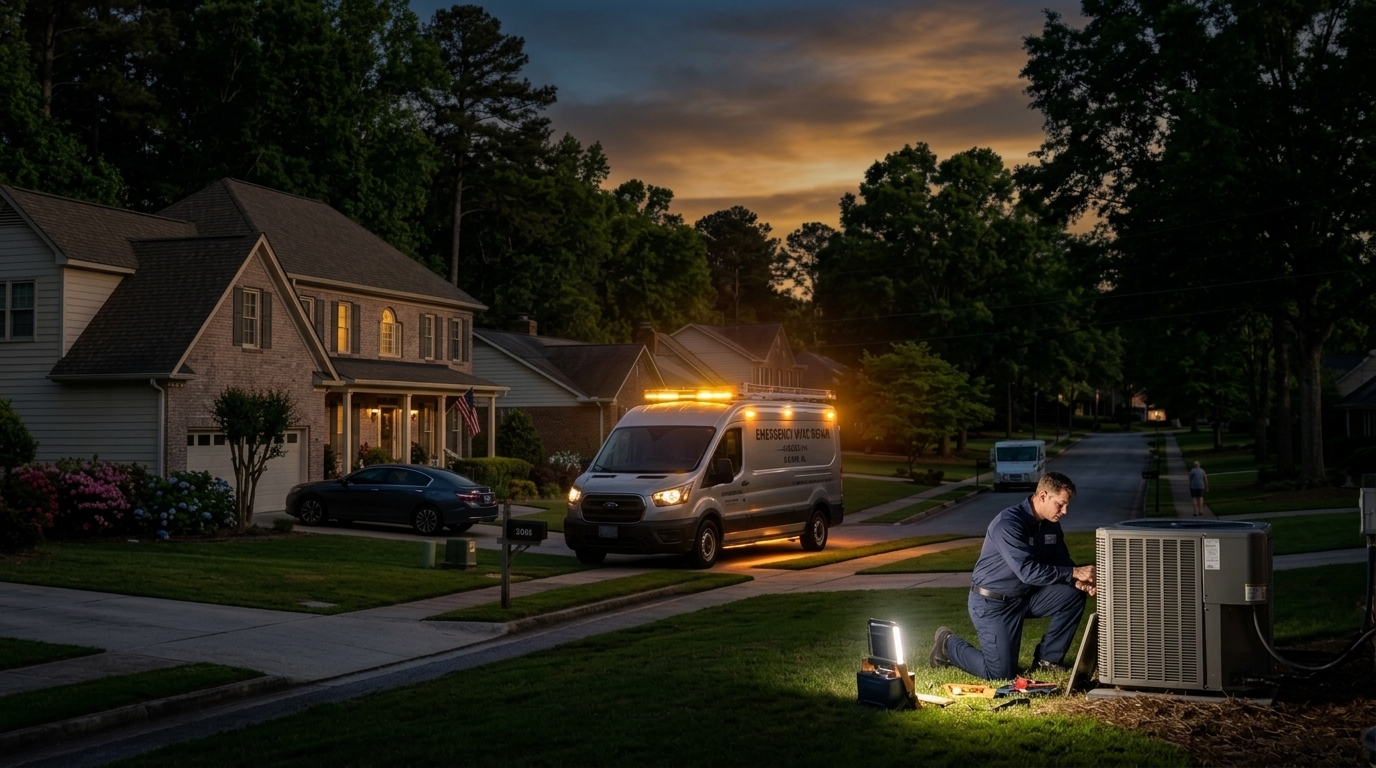
Calera sits at the crossroads of I-65 and US-31 in southern Shelby County, making it one of the most strategically positioned growth corridors between Birmingham and Montgomery. The city blends a historic downtown core with newer I-65 interchange subdivisions. Historic homes near downtown date to the 1890s and early 1900s, while newer developments along Hunters Chase and similar communities feature builder-standard HVAC from the 2000s and 2010s.
Calera is the southernmost city in Shelby County's I-65 growth corridor, positioned between Alabaster to the north and Jemison to the south. The city sits in a valley bowl formed by the convergence of Cahaba River tributaries and the I-65 ridge, and that geography shapes two things that HVAC technicians notice immediately: the valley floor runs hotter and more humid on still summer afternoons than surrounding elevated areas, and homes on the north-facing hillsides deal with outdoor condensers in partial shade that reduces heat rejection efficiency.
Calera’s housing stock tells the story of Shelby County’s growth wave. The oldest residential neighborhoods along Highway 31 carry homes from the 1960s through 1980s — brick ranch construction with original ductwork in crawl spaces and equipment that has been replaced once or twice but never paired with a ductwork upgrade. Moving out from the Highway 31 corridor, the 1990s subdivision wave produced homes in neighborhoods like Killough Springs and along Old Highway 31 where builder-grade systems are now well into their 15-to-25-year range.
The I-65 commercial corridor that runs through Calera creates a specific dispatch dynamic. The exit at Highway 70 / Alabama 26 services a concentration of fast food, fuel stops, light industrial tenants, and the Coosa Valley Electric distribution corridor. Commercial HVAC calls in this strip operate differently from residential — packaged rooftop units, make-up air requirements for commercial kitchen exhaust, and electrical infrastructure that sometimes confuses technicians accustomed to residential single-phase wiring. Birmingham Heating & Air-Conditioning handles both residential and commercial in Calera.
Valley-bowl geography means Calera’s air column in July and August holds heat unusually well on still days. Afternoon temperatures at the valley floor regularly exceed surrounding elevations by two to four degrees during heat events. A system working at its design limit at 93°F outdoor temperature is over its design limit at 97°F — and valley-floor Calera homes routinely see those temperatures in a heat dome. Systems that look fine in May start failing in mid-July when the valley heat amplification kicks in. Condensate drain failures spike in late July as humidity removal loads exceed drain capacity in systems that were never serviced or had drain lines installed without adequate pitch.
Local HVAC Conditions
- Typical summer high: 94 degrees
- Typical winter low: 27 degrees
- Average humidity: 74%
Calera Neighborhoods We Work
Killough Springs
Established subdivision on the northern edge of Calera with homes from the mid-1990s to mid-2000s.
Highway 31 Corridor
1960s to 1980s brick ranch homes along the original main road through Calera — oldest ductwork in the city.
I-65 Growth Corridor
Newer residential and commercial development near the Calera I-65 interchange, 2005 to present.
Calera HVAC Questions
What HVAC problems are most common in Calera, AL homes?
Calera's dominant problem is aging builder-grade equipment from the 1990s and 2000s growth wave hitting the end of its service life during July and August heat peaks. Capacitor failure is the most common single-component call — the outdoor unit hums and the fan won't spin. Second most common is condensate drain overflow from valley-floor humidity spikes. Third is crawl space ductwork deterioration in the older Highway 31 and Old Calera Road stock where insulation has failed over decades.
Why does Calera get hotter than surrounding areas?
Calera sits in a valley bowl formed by Cahaba River tributaries and the I-65 ridge. On still summer afternoons during heat events, valley floors trap air and the absence of convective mixing allows temperatures to build two to four degrees above surrounding elevated areas. This topographic heat amplification is why Calera sees more compressor failures per capita during July heat waves than cities at higher elevation — a system sized for 93°F may be operating at 97°F without the homeowner realizing why.
How old is the HVAC equipment in most Calera homes?
The majority of Calera's residential construction happened between 1992 and 2010, putting original equipment at 15 to 33 years of service. Alabama's climate — high run hours, heat-index peaks above 105°F, and year-round humidity — shortens equipment life compared to milder markets. The Department of Energy rates residential central air for 15 to 20 years under ideal conditions. In Calera's valley climate with the heat amplification factor, 15 years is the realistic outer limit for original builder-grade equipment without regular maintenance.
Do you serve Calera 24 hours a day?
Yes. Birmingham Heating & Air-Conditioning dispatches 24 hours a day, 365 days a year — nights, weekends, and holidays. Calera is in our Shelby County I-65 south corridor. Call (205) 649-4480 with your address and we will tell you honestly when to expect a technician. Written estimate before any work begins.
What HVAC brands are most common in Calera homes?
Calera's 1990s-to-2010s build era is dominated by Carrier, Trane, Rheem, and Goodman — the primary builder-installed brands of that period. Some newer construction along the I-65 corridor uses Lennox and American Standard. We carry service parts for all of these brands on every truck dispatched to the Calera area.
Should I repair or replace my Calera system?
The standard threshold applies here with one Calera-specific modifier: if the system is over 12 years old, needs a major component (compressor, evaporator coil), and you have not had ductwork evaluated, the ductwork evaluation needs to happen before replacement. Replacing equipment without addressing deteriorated crawl space ductwork in an older Calera home leaves most of the efficiency problem in place. We give you repair vs. replace numbers in writing — including duct scope — before you decide.
My Calera home has a crawl space. Is that causing HVAC problems?
Almost certainly, if it is a vented crawl space with older ductwork. Vented crawl spaces in Calera's valley-floor humidity environment stay at 80 to 90 percent relative humidity through the summer. Supply ducts routed through that environment — especially with degraded insulation — pick up eight to twelve degrees of heat gain between the air handler and the register. The system runs longer to compensate, bills increase, and rooms still feel warm. Duct sealing and re-insulation are the permanent fix.