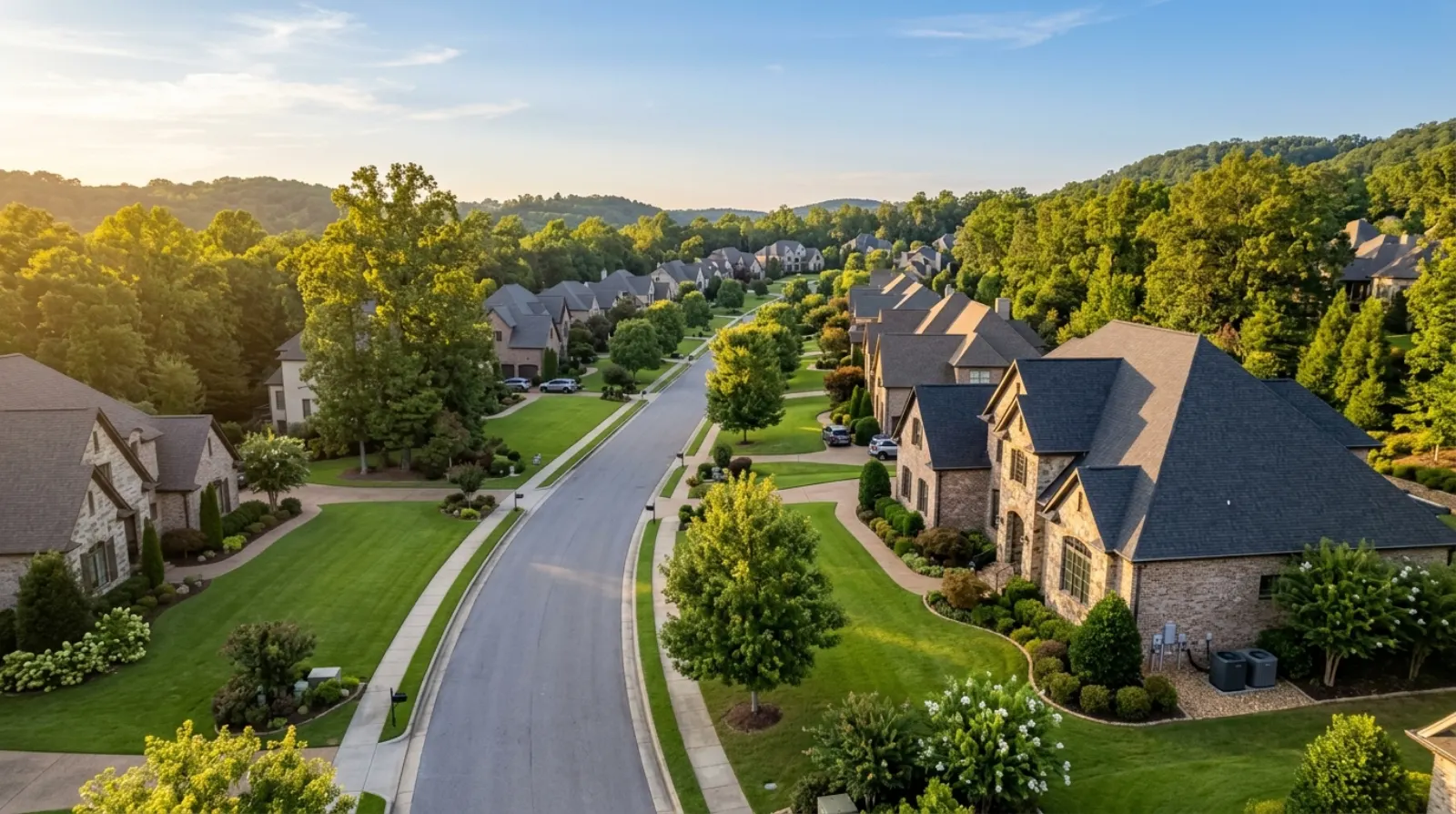
Greystone sits in the rolling terrain between Highway 280 and Highway 119 in Shelby County, roughly 20 miles southeast of downtown Birmingham. The community developed primarily in the 1990s and 2000s as a planned residential corridor, and the result is a housing stock that is large, consistent in construction era, and now hitting the window where original builder-grade HVAC equipment begins to fail in volume.
Most Greystone homes were built between 1995 and 2010. That puts the original condensers and air handlers at 15 to 30 years of service life. The failure curve on residential HVAC sharpens after year 15 in Alabama’s climate — capacitors, contactors, fan motors, and control boards all reach end of useful life on a predictable schedule. A Greystone system that has never had a service call is not a healthy system. It is a system that has not failed yet.
The large floor plans typical of Greystone create specific challenges. Two-story homes with open staircases and vaulted great rooms stratify heat: the upstairs can run 6 to 10 degrees warmer than the first-floor thermostat location. Builder-installed single-zone systems cannot compensate for this — the thermostat satisfies at the sensor location and shuts off while bedrooms above stay hot. A properly designed zoned system with independent thermostats and motorized dampers is the mechanical solution, not a larger unit.
Greystone’s clay soil holds moisture through summer. Crawl space relative humidity regularly climbs above 70% without active dehumidification. Return ducts in those crawl spaces pull humid air across the evaporator coil, accelerating biological growth and drain pan fouling. Properties near Greystone Country Club face an additional variable — irrigation mist and organic debris from the fairways foul condenser coils faster than open-lot homes, requiring more frequent cleaning.
The I-459 access through Shelby County keeps emergency response practical. A technician running the 280 corridor reaches most Greystone addresses inside 30 minutes. We stock common Greystone failure parts — dual-run capacitors, contactors, condenser fan motors, and TXVs for the Carrier, Trane, and Lennox equipment that dominated the Greystone build era — on every truck dispatched to this side of Shelby County.
Local HVAC Conditions
- Typical summer high: 93 degrees
- Typical winter low: null degrees
- Average humidity: 73%
Greystone Neighborhoods We Work
Greystone Farms
1990s-era homes on the western edge near Highway 280 — builder-grade systems in the 20-to-30-year range, first-replacement window.
Greystone North
Two-story traditional homes on the golf course north side — stratification and condenser fouling the dominant issues.
Greystone Highlands
Larger homes on elevated terrain between 280 and 119 — clay soil crawl spaces create humidity infiltration in return ductwork.
Greystone Neighborhoods We Serve
We work all through Greystone, including Greystone Legacy, Greystone Cove, Greystone Farms, Greystone Glen, and the original Greystone sections off Highway 280.
Look at the homes for sale in Greystone and you will notice something. Most were built between about 1996 and 2006, and plenty run 4,000 to 5,000 square feet or more. Here is why that matters for your heating and cooling. A house that size usually has two or even three systems, and if they all went in when the house was built, they are all aging together. One fails in July, and the others are often not far behind.
Big homes also hide big duct problems. Long runs to the far bedrooms, bonus rooms over the garage, and zoning dampers that stopped working years ago and nobody noticed. If one end of your house never feels right, that is usually where we start looking.
Down the 280 Corridor From Greystone
Greystone homeowners often have family in these towns, and we serve them too: Hoover AC repair · Chelsea AC repair · Vestavia Hills AC repair · Riverchase AC repair
How We Handle a Greystone Service Call
Let me be straight with you. We diagnose first, show you what failed, and put the price in writing before any work starts. If you are weighing a replacement on a 20-plus-year-old system, we will walk through repair versus replace with real numbers, system by system, so you are not replacing all three at once unless it actually makes sense.
Call (205) 649-4480 for AC repair, heating repair, or a second opinion on a replacement quote.
Greystone HVAC Questions
What HVAC problems are most common in Greystone homes?
The three most common calls from Greystone are: aging builder-grade equipment failing (capacitors, contactors, fan motors on 15-to-25-year-old condensers); temperature stratification in two-story homes with open staircases where upstairs bedrooms run 6 to 10 degrees warmer than the thermostat location; and crawl space humidity infiltrating return ducts, which causes evaporator coil icing and drain pan overflow. Each has a different fix — a capacitor swap is 45 minutes, solving stratification requires a zoned system design, and crawl space humidity requires vapor barrier work.
Why are upstairs bedrooms so much hotter than the rest of the house?
Heat rises. In a two-story home with an open staircase, warm air migrates upward continuously. The thermostat sits at the first-floor level, satisfies there, and shuts the system off while bedrooms above stay several degrees warmer. Greystone homes from the 1995-to-2010 build era typically had single-zone systems that cannot compensate for this geometry. A two-zone system with a second thermostat upstairs and motorized dampers in the ductwork solves the problem. A larger unit does not — it cools the main level faster and shuts off sooner, making upstairs worse.
How old is the HVAC equipment in most Greystone homes?
Most Greystone homes were built between 1995 and 2010, putting original equipment at 15 to 30 years of service. The Department of Energy rates residential central air systems for 15 to 20 years of service life with proper maintenance. Equipment installed in the late 1990s to early 2000s that has not been serviced regularly is at or past that range. The failure rate on capacitors, contactors, and fan motors accelerates sharply after year 15 in Alabama's climate — the combination of high summer load hours and heat-index peaks above 105°F shortens component life compared to milder markets.
Does living near the Greystone Country Club affect my HVAC?
Yes. Properties near the golf course see condenser coils foul faster from pollen, grass clippings, and irrigation mist. A fouled coil reduces heat rejection capacity, raises head pressure, increases compressor load, and cuts efficiency — without triggering any fault code your thermostat would catch. Properties along the golf course corridor should plan on condenser cleaning every six to nine months. Properties further from the fairways can typically go a year between cleanings.
Should I repair or replace my aging Greystone system?
The standard threshold: if the repair cost exceeds one-third of replacement cost and the system is over 12 to 15 years old, replacement is typically the better financial decision over a 5-year horizon. In Alabama's climate with 1,600+ annual run hours, a 20-year-old system is a higher-risk repair than the same age unit in a milder state. We give you a written estimate for the repair, explain the probability of the next failure based on the equipment's age and condition, and let you decide. We do not push replacement when a repair makes sense.
Do you serve Greystone 24 hours a day?
Yes. Birmingham Heating & Air-Conditioning dispatches 24 hours a day, 365 days a year — nights, weekends, and holidays included. Greystone is in our Shelby County service area along the Highway 280/119 corridor. Call (205) 649-4480 with your address and we will tell you honestly when to expect a technician.
What HVAC brands are most common in Greystone homes?
Greystone's build era — 1995 to 2010 — favored Carrier, Trane, Lennox, and Rheem as the primary builder-installed brands. Some homes in the late build phase have Goodman and American Standard equipment. We carry service parts for all of these brands and stock the dual-run capacitors, contactors, and TXVs most commonly needed for Greystone-era equipment on every truck dispatched to this corridor.
My Greystone home has three AC systems. Do I need to replace them all at once?
No. We evaluate each system separately and give you a written repair-versus-replace comparison for each one. Replacing them together only makes sense when they are all near the end of their life.
Why does one end of my Greystone home never cool properly?
Large homes often have long duct runs, under-supplied bonus rooms, or zoning dampers that have failed. We test airflow at the problem rooms to find the cause before recommending a fix.