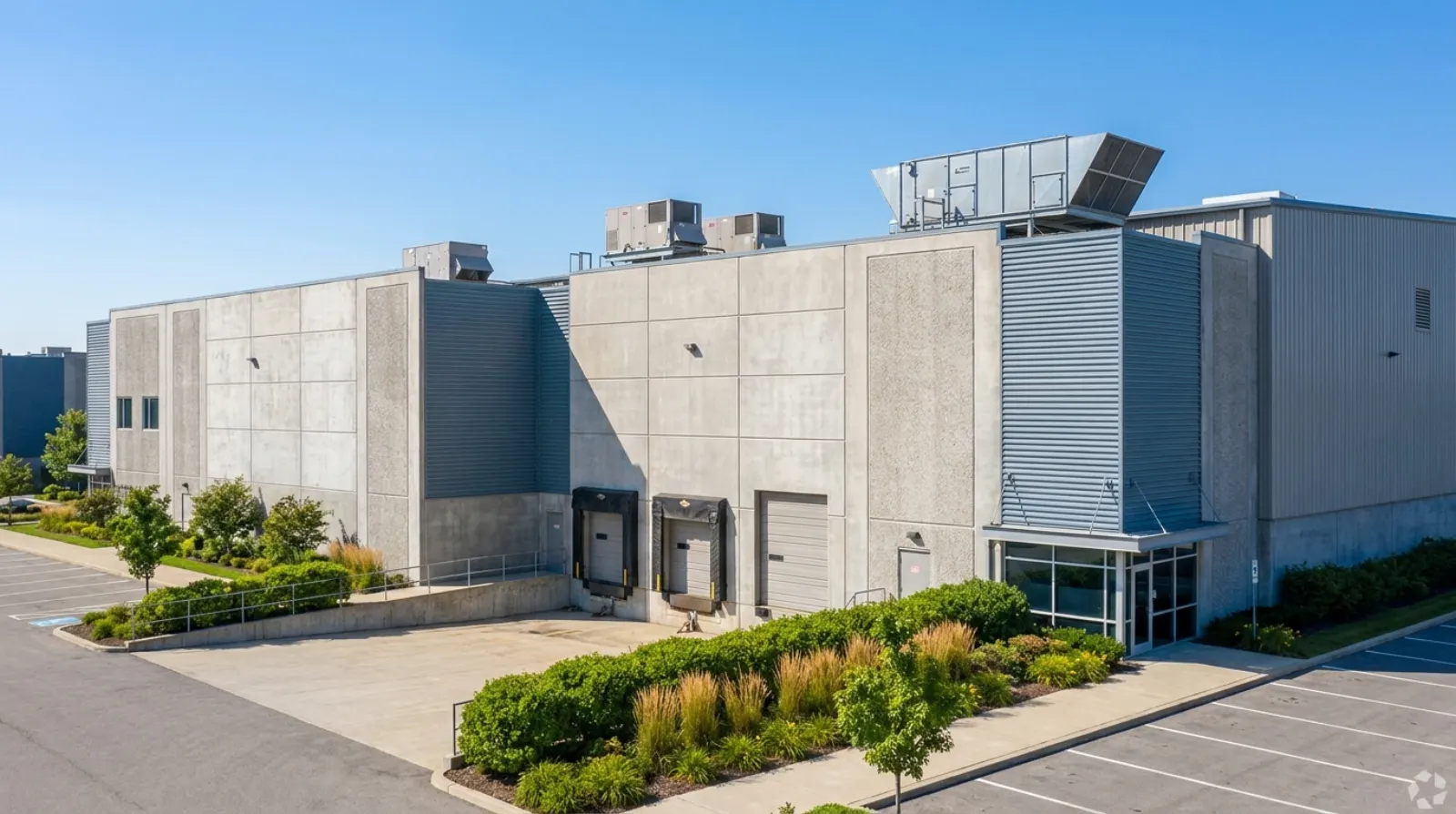
Warehouses, distribution centers, light manufacturing, auto repair. Make-up air units, warehouse unit heaters, process cooling, and office-within-warehouse RTUs — on a maintenance plan.
Industrial HVAC runs on different equipment.
Warehouse HVAC is production uptime. Makeup-air imbalance, RTU failure, or warehouse-heater lockout stops the shift until service arrives and restores ambient.
Light industrial HVAC is a category most residential contractors never work on. The dominant equipment is not split systems and residential RTUs — it is large-format make-up air units, gas-fired warehouse unit heaters, industrial exhaust fans, process cooling systems, and office-portion RTUs serving the administrative build-out inside a production facility. Each of these has a distinct service profile, failure mode, and compliance layer that differs from commercial office or retail.
Birmingham light industrial concentrates in defined corridors: the Oxmoor Valley Industrial Park near I-459 in southwest Jefferson County, the Tarrant and Tarrant City industrial belt along the railroad corridor, the Pinson Valley corridor along US-79 North, the Bessemer and Fairfield legacy industrial belt along the I-20/59 southwest corridor, the McCalla and Tannehill Commerce Park area near I-459 southwest, the Trussville and Clay industrial-commercial mix along I-59 northeast, the Pelham, Alabaster, and Calera growth zone along I-65 south, and the Airport Industrial District near BHM.
Make-up air is the defining equipment category for light industrial HVAC work. Direct-fired MUA units from Reznor, Modine, Ouellet, Greenheck, and Captive-Aire dominate warehouse and production facilities with any welding, painting, finishing, or food-processing operation. Indirect-fired rooftop MUA serves larger distribution buildings. Undersized or failed MUA creates negative building pressure, exhaust imbalance, fume buildup, and OSHA exposure. We carry MUA burner assemblies, gas valves, ignition controls, and fan motors in truck inventory for priority service on these systems.
Warehouse unit heaters are the second-largest service category. Gas-fired forced-air and infrared radiant unit heaters from Modine, Reznor, and Sterling serve high-bay warehouse heating. A warehouse heater failure in January is a production-line event — workers exposed to 25-degree ambient, cold-sensitive stored product at risk, and OSHA-compliant worker-environment thresholds breached. Our winter service rotation keeps unit heater burner assemblies and ignition components stocked through the November-to-March peak failure window.
Office-portion RTUs are the third category. Most light industrial buildings carry a built-out office space inside the warehouse envelope — 3 to 10-ton packaged RTUs serving the administrative staff, order desk, and sometimes lunchroom areas. An office RTU failure is a facility-management pressure call: operations continues on the warehouse side, but the office portion is down and the plant manager needs it fixed.
Process cooling and refrigerated warehouse service are specialty categories we send a technician for selectively — facilities storing food products, pharmaceutical inventory, or temperature-sensitive manufacturing material operate commercial refrigeration at a scale that exceeds standard HVAC. These calls route to our refrigeration specialty team with EPA Section 608 Universal certification and the diagnostic inventory for large-charge refrigerant systems.
Industrial facilities reference Industrial HVAC code + refrigerant · Multi-building PM contracts · Office-side RTU lifecycle — or review the case-studies index across all five verticals.
Industrial HVAC manufacturer reference →
Sources: OSHA 29 CFR 1910 ; ASHRAE Standard 62.1 industrial ventilation ; MCAA mechanical contractor standards ; NAIOP industrial real estate benchmarks ; DOE commercial and industrial buildings resources .
Light industrial HVAC operates on equipment residential contractors rarely see. Here is the capacity range we handle across Birmingham warehouse, distribution, and light-manufacturing facilities.
Source: <a href="https://www.mcaa.org" style="color:var(--warm)" rel="noopener">MCAA</a> mechanical contractor standards for industrial HVAC; <a href="https://www.ashrae.org/technical-resources/standards-and-guidelines/standards-addenda/ansi-ashrae-standard-62-1-2022" style="color:var(--warm)" rel="noopener">ASHRAE 62.1</a> industrial occupancy ventilation; ANSI Z9.2 industrial exhaust ventilation; <a href="https://www.ahrinet.org/certification" style="color:var(--warm)" rel="noopener">AHRI</a> industrial refrigeration certification.
Industrial corridors.
Southwest Jefferson distribution corridor
Oxmoor Valley Industrial Park near I-459. 1980s-2010s distribution warehouses and light manufacturing. High-bay heating with Modine and Reznor unit heaters; direct-fired MUA on production floors.
Legacy manufacturing belt
Tarrant and Tarrant City rail corridor. Legacy 1960s-1990s manufacturing facilities with deferred maintenance on make-up air and warehouse heaters. Urgent-response pattern dominates.
US-79 North industrial corridor
Pinson Valley corridor along US-79 North. Mixed light manufacturing and distribution with office-portion RTU build-outs inside warehouse envelopes.
Port-adjacent industrial
Birmingport industrial corridor with heavy-manufacturing tie-ins, paint and finishing operations, specialty industrial process equipment. OSHA-sensitive ventilation priority.
Historic steel belt
Ensley legacy industrial belt along southwest Jefferson. 1950s-1990s manufacturing and fabrication facilities. Natural-gas-fired equipment dominates; process-cooling chilled-water loops on larger facilities.
Eastern industrial growth
Irondale industrial-commercial mix along I-59 east. Newer logistics and distribution facilities plus legacy light manufacturing. Office-portion RTU plus warehouse heating.
What we work on.
- Direct-fired make-up air units — Reznor, Modine, Ouellet, Greenheck, Captive-Aire
- Indirect-fired rooftop MUA — larger distribution and production facilities
- Warehouse gas unit heaters — Modine Hot Dawg, Reznor, Sterling
- Infrared radiant heaters for high-bay and loading dock areas
- Office-portion RTUs — 3 to 15-ton Carrier, Trane, York, Lennox, Rheem Commercial
- Industrial exhaust fans — Greenheck, Cook, Hartzell
- Process cooling — chilled-water and direct-expansion
- Refrigerated warehouse — cold storage, food processing, pharmaceutical
What brings us in.
- Warehouse unit heater failure in January — production continuity and OSHA exposure
- Make-up air unit failure during production — fume buildup, worker exposure
- Office-portion RTU compressor failure — plant-manager pressure call
- Exhaust fan motor failure in paint or finishing area — ventilation loss
- Process cooling chilled-water loss — manufacturing line stopped
- Refrigerated warehouse evaporator coil freeze — product loss urgent
- MUA burner ignition failure in winter — facility heating lost
- Natural gas valve or regulator issue — safety lockout and fuel-supply coordination
The plant manager has a production line to run.
Light industrial HVAC buyers are plant managers, maintenance supervisors, operations managers, and occasionally a corporate facilities coordinator for multi-site operations. The priority hierarchy is different from office or retail: production continuity first, OSHA-compliant worker environment second, office-side comfort third. Our service and documentation are scoped to match that priority stack — priority service for production-affecting failures, documented corrective work for safety-code issues, scheduled service for office-side and comfort-side equipment.
Questions we hear from facilities teams.
Do you service large-format make-up air units on warehouse and production facilities?
Can you handle warehouse gas unit heater failures in the winter?
Do you service for office-portion RTUs inside warehouse buildings?
Can you support process cooling on manufacturing equipment?
Do you handle refrigerated warehouse and cold storage facilities?
What is your response approach for production-line HVAC service calls?
Can you scope preventive maintenance for multi-building industrial parks?
Do you handle natural gas equipment certification and code compliance?
What vendor onboarding paperwork do industrial facilities require?
What should a light-industrial HVAC maintenance contract explicitly cover?
How is scheduled service handled for production-line emergencies?
How do you handle a production HVAC problem on a weekend shift?
Is refrigerant responsibility on the facility owner or the contractor?
Do you provide equipment warranty tracking on industrial HVAC installations?
Are your technicians Alabama licensed and EPA 608 certified — verifiable?
Can you coordinate with industrial facility safety and environmental teams?
What is the scope of process cooling work versus specialty industrial equipment?
Do you support multi-site industrial portfolio servicing?
What do we need to know about AIM Act refrigerant phase-down for industrial equipment?
Commercial HVAC Compliance Checklist — Birmingham Commercial Buildings
The compliance checklist industrial plant managers and facilities coordinators use to stay aligned with ASHRAE, EPA, Alabama HACR licensure, and AIM Act refrigerant transition requirements. Built around Birmingham-specific code adoption and permit process.
- ASHRAE 62.1 industrial ventilation rates by occupancy
- ASHRAE 90.1 energy baseline requirements for commercial retrofit
- EPA Section 608 technician certification requirements
- Alabama mechanical code (IMC 2021) adoption status
- Birmingham mechanical permit process walkthrough
- AIM Act refrigerant phase-down timeline for industrial equipment
Download the Compliance Checklist PDF
Delivered by email. No phone call. Commercial buyers only.
No phone call. We use your email only to deliver this resource and follow up if you request it.
Let’s set up your service plan.
Commercial buildings only. Tell us about your building and equipment and we'll follow up with a plan and a quote. Prefer to talk? Call (205) 649-4480 .
- Scheduled maintenance plans, scoped to your equipment
- RTUs, chillers, VRF, walk-in coolers, make-up air
- Priority service for plan customers
- Portfolio & property-management accounts
Request a service quote
We'll email you back within business hours. Prefer to talk now? Call the line above.
The warehouse and light-industrial equipment stack.
Birmingham's industrial and warehouse inventory clusters around the I-20 / I-59 / I-65 freight corridors — Oxmoor, Tarrant, Trussville industrial parks, Pelham, Alabaster, and the Bessemer corridor. The equipment mix varies sharply by building purpose. A general-purpose dry storage warehouse usually runs minimal cooling — unit heaters for winter heating, dock-door ventilation, and possibly evaporative cooling in office and break-room areas. A temperature-controlled distribution center runs full cooling on the warehouse floor with high-tonnage packaged equipment or built-up air handling. A light-manufacturing facility often has process cooling for specific equipment, area cooling for worker comfort, and make-up air for combustion or exhaust ventilation.
The equipment scope we service in Birmingham light industrial: packaged rooftop units 7.5 to 50 tons, gas-fired or hydronic warehouse unit heaters, make-up air units (direct-fired and indirect), exhaust fans for ventilation and process applications, evaporative cooling systems where the building configuration supports them, process cooling equipment serving specific industrial equipment, and dedicated outdoor air systems on newer buildings. Brands include Carrier, Trane, York, Lennox, Daikin, Goodman, Greenheck (exhaust and make-up air), Reznor (unit heaters), Modine (unit heaters), and others depending on the facility.
The technicians sent to industrial calls in Birmingham carry EPA Section 608 certification, Alabama state HVAC licenses, and the truck inventory for the heavier equipment scope including combustion analyzers for gas-fired make-up air units and unit heaters. We are licensed, bonded, and insured for commercial work and we provide certificate of insurance documentation directly to facility safety and environmental compliance teams on request.
Commercial HVAC Questions
Do you service large-format make-up air units on warehouse and production facilities?
Yes. Make-up air is our highest-volume light-industrial service category. We send a technician for Reznor, Modine, Ouellet, Greenheck, and Captive-Aire direct-fired MUA and indirect-fired rooftop MUA on warehouse, distribution, and light-manufacturing facilities. Our trucks carry burner assemblies, gas valves, ignition controls, fan motors, and filter assemblies for urgent MUA service.
Can you handle warehouse gas unit heater failures in the winter?
Yes. Warehouse unit heater service is a winter-specialty service. We stock Modine, Reznor, and Sterling burner assemblies, ignition modules, gas valves, and blower motors through the November-to-March peak failure window. Warehouse heating failure in January is a production-continuity event and we prioritize service accordingly.
Do you service for office-portion RTUs inside warehouse buildings?
Yes. Most light-industrial facilities carry a built-out office space inside the warehouse envelope with 3 to 15-ton packaged RTUs. We send a technician for these on the same schedule as commercial office RTUs, with truck inventory covering Carrier, Trane, York, Lennox, and Rheem Commercial equipment common in light-industrial office build-outs.
Can you support process cooling on manufacturing equipment?
Yes, on a case-by-case basis. Process cooling service depends on the specific equipment — chilled-water loops serving manufacturing equipment, direct-expansion process cooling, and specialty temperature-controlled environments. For standard commercial refrigeration on food processing or pharmaceutical storage, we send a technician under our commercial refrigeration service with EPA Section 608 compliance. For specialty process equipment we scope the work separately.
Do you handle refrigerated warehouse and cold storage facilities?
Yes, with the specialty refrigeration team. Refrigerated warehouses, cold storage, and food-processing facilities operate commercial refrigeration at a scale that exceeds standard commercial HVAC. These calls route to our refrigeration specialty technicians with EPA Section 608 Universal certification and the diagnostic inventory for large-charge refrigerant systems. For facilities subject to Clean Air Act leak-repair reporting (systems over 50 pounds), we handle the documentation protocol.
What is your response approach for production-line HVAC service calls?
Production-line emergencies are our highest-priority light-industrial service. The coordinator confirms the visit by phone immediately, routes to the on-duty technician qualified for the equipment class, and maintains direct communication with the plant manager through resolution. We document arrival, diagnosis, and corrective work on the service ticket in a format that supports your production-continuity records and, where applicable, your OSHA safety-file documentation.
Can you scope preventive maintenance for multi-building industrial parks?
Yes. Industrial parks with multiple buildings under single ownership or management benefit from multi-building preferred-vendor contracts that cover every facility on scheduled service intervals. We scope the contract around the specific equipment at each building — some buildings heavy on MUA and unit heaters, some heavy on office RTUs, some with process cooling — rather than a generic template, and we invoice consolidated monthly per park.
Do you handle natural gas equipment certification and code compliance?
We handle the HVAC equipment side of gas-fired systems — burner assemblies, gas valves, ignition controls, combustion analysis, and manufacturer-spec installation. For primary gas-line work, regulators at the utility meter, or natural gas supply issues we coordinate with Spire or your facility plumbing contractor. Every gas-fired equipment service includes combustion analysis documentation and leak-check verification.