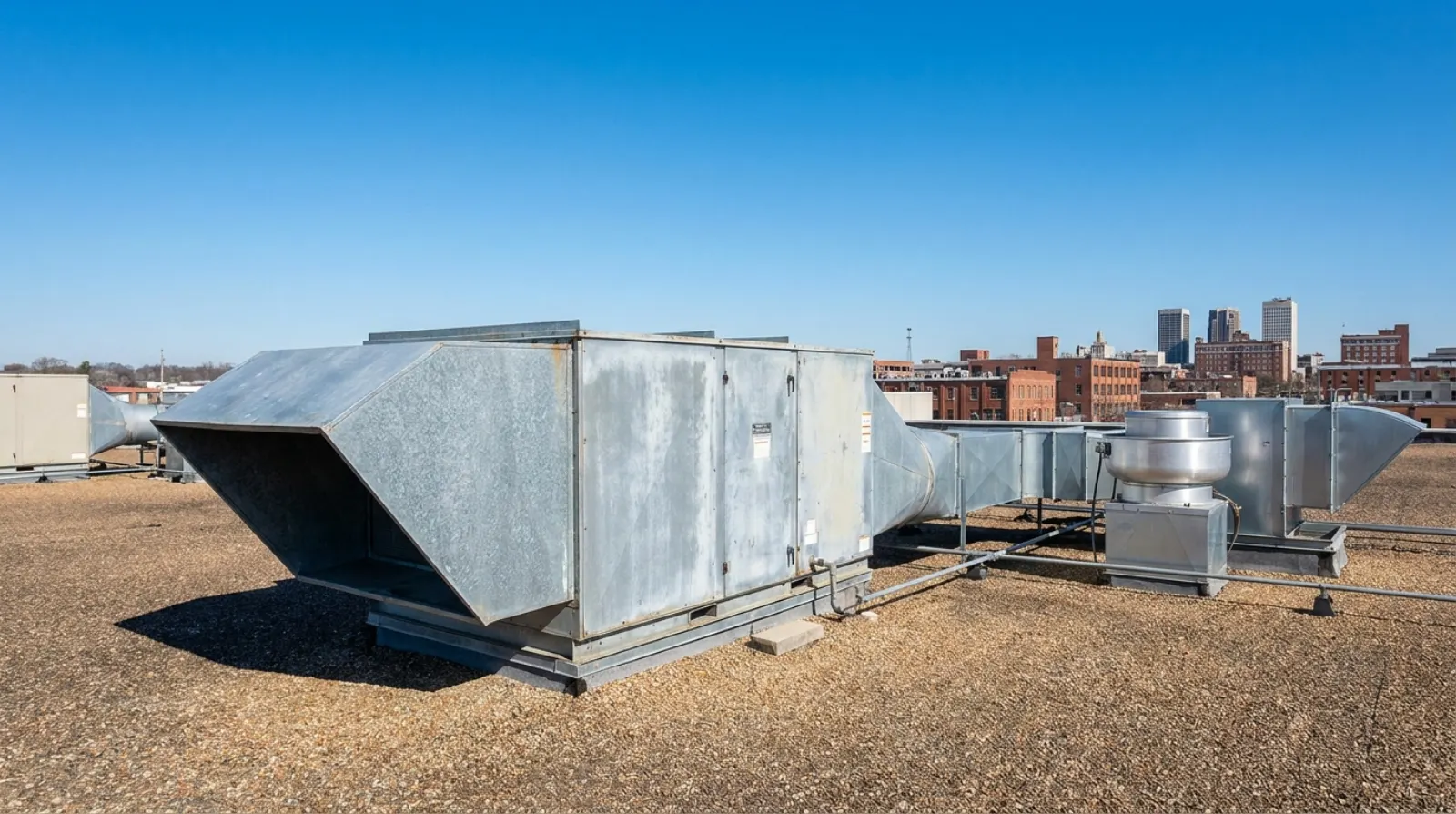
A make-up air unit replaces the air your kitchen exhaust hoods pull out. When it fails or was never balanced, the building goes negative: doors stick, the hood smokes, the water heater back-drafts, and the dining room runs cold. We service direct-fired and indirect-fired MUA units, and we rebalance them against the exhaust — under IMC 508 and NFPA 96.
Negative pressure is what you feel before you understand it.
When a building exhausts more air than it brings in, every symptom traces back to the same root cause. A make-up air unit is the fix — and a failed or unbalanced one is the cause. Here is the chain of failure in a Birmingham commercial kitchen running under negative pressure.
Exterior doors stick or slam
The building is pulling air in through every gap it can find. Staff fight the back door on the way to the dumpster; the front door whistles. This is the most-reported and least-understood symptom.
The hood smokes into the dining room
A Type I hood needs make-up air at the cookline to capture smoke and grease. Starved of supply air, capture velocity drops and the plume rolls out into the seating area instead of up the duct.
Pilot lights and water heaters back-draft
Negative pressure pulls combustion gases — including carbon monoxide — back down atmospheric flues instead of letting them vent. This is the dangerous one, and it is why we measure static pressure on every call.
The dining room runs cold and the bill runs high
In winter the building pulls unconditioned Alabama air through every crack to satisfy the exhaust. Guests near the door are cold, and the heating system never catches up because it is fighting an open building.
The single spec decision that defines a make-up air unit.
Choosing the wrong burner platform is the most common make-up air error we find on existing Birmingham installations. The two are not interchangeable — the right one depends on whether the air is dumped at the hood or delivered into occupied space.
We confirm the application before quoting a burner replacement. A direct-fired unit installed where indirect was required puts combustion byproducts into occupied air; an indirect unit where direct was acceptable quietly wastes gas every hour the kitchen runs.
12-task quarterly PM scope for commercial make-up air units.
A make-up air unit is a gas appliance, a fan, and a control interlock all at once — and it only works relative to the exhaust it serves. Below is the full PM scope we run on direct- and indirect-fired MUA units in Birmingham. Every task documented in the per-visit report.
Make-up air is a code requirement, not an upgrade.
The International Mechanical Code (Section 508) requires make-up air wherever mechanical exhaust is installed. NFPA 96 governs the commercial kitchen exhaust the MUA is balanced against. ASHRAE 62.1 sets the minimum outdoor-air ventilation rates a dedicated outdoor air system has to deliver. A make-up air unit that is failed, undersized, or unbalanced is not just a comfort problem — it is a combustion-safety and code-compliance problem. We document static pressure, CFM balance, and combustion on every visit so the system is defensible to the health inspector and the fire marshal.
Sources: IMC Chapter 5 — Exhaust Systems · NFPA 96 · ASHRAE 62.1 .
"A Vestavia restaurant called about a hood that smoked every Friday night. Three contractors had cleaned the hood and adjusted the exhaust. Nobody measured the building. The make-up air unit had a seized intake damper — the kitchen was running 0.08 inches negative. We freed the damper, rebalanced supply to exhaust, and the smoking stopped that night."
Questions we hear from facilities teams.
What is a make-up air unit and why does a commercial kitchen need one?
What is the difference between a direct-fired and an indirect-fired make-up air unit?
My kitchen doors are hard to open and the hood smokes — is that a make-up air problem?
How often should a make-up air unit be maintained?
Do you balance the make-up air against the kitchen exhaust hoods?
What make-up air brands do you service?
Make-up air rarely fails alone.
Walk-in cooler & freezer service →
The other half of restaurant refrigeration. Quarterly PM, defrost verification, FDA 41°F product-temperature compliance.
Packaged RTU service →
Dining-room and retail comfort cooling. Tonnage-matched PM under OSHA rooftop protocol.
Restaurant commercial HVAC →
Cooklines, walk-ins, make-up air, and NFPA 96 exhaust balance for Birmingham restaurants.
Commercial service contracts →
Put make-up air, refrigeration, and rooftop equipment on one quarterly PM agreement.
If the doors stick and the hood smokes, start with the building — not the hood.
Assessment includes total exhaust CFM measurement, make-up air supply verification, building static-pressure reading, combustion analysis, and a written balance report within 5 business days.
Let’s set up your service plan.
Commercial buildings only. Tell us about your building and equipment and we'll follow up with a plan and a quote. Prefer to talk? Call (205) 649-4480 .
- Scheduled maintenance plans, scoped to your equipment
- RTUs, chillers, VRF, walk-in coolers, make-up air
- Priority service for plan customers
- Portfolio & property-management accounts
Request a service quote
We'll email you back within business hours. Prefer to talk now? Call the line above.
Commercial HVAC Questions
What is a make-up air unit and why does a commercial kitchen need one?
A make-up air (MUA) unit replaces the air that commercial kitchen exhaust hoods pull out of a building. A Type I hood over a cookline can exhaust 3,000 to 8,000 CFM. If that air is not "made up" by a dedicated unit, the building goes into negative pressure — exterior doors get hard to open, back-drafting pulls combustion gases down the water-heater flue, the hood stops capturing smoke and grease at the source, and the dining room gets pulled cold in winter. Mechanical codes (IMC 508 and NFPA 96) require make-up air to be provided wherever exhaust is installed. The MUA is what keeps the kitchen, the dining room, and the exhaust system all working together.
What is the difference between a direct-fired and an indirect-fired make-up air unit?
A direct-fired MUA passes the incoming outdoor air directly across an open gas burner — roughly 92% thermal efficiency, products of combustion enter the airstream, and it is approved for kitchen make-up air where the air is exhausted, not recirculated. An indirect-fired MUA heats a sealed heat exchanger and the combustion byproducts are vented separately through a flue — lower efficiency (around 80%) but the supply air never touches combustion gases, which is required when the make-up air is delivered into occupied space rather than dumped at the hood. Choosing wrong is one of the most common spec errors we find on existing Birmingham installations. We verify the application before recommending a replacement burner platform.
My kitchen doors are hard to open and the hood smokes — is that a make-up air problem?
Almost always, yes. Doors that suck shut, whistling gaps around windows, a hood that lets smoke roll out into the dining room, and a pilot light or water heater that keeps blowing out are the classic symptoms of a building running under negative pressure because the make-up air unit has failed, was undersized, or was never balanced to the exhaust. We measure building static pressure, total exhaust CFM, and MUA supply CFM, then rebalance the system. In Birmingham restaurants this is one of the most common — and most misdiagnosed — service calls we take.
How often should a make-up air unit be maintained?
Quarterly for any MUA tied to a commercial kitchen running daily service. The gas train, burner, and combustion need annual analysis at minimum, but the intake filters and the exhaust/MUA balance drift faster than that in a grease-laden kitchen environment. We inspect the direct-fired burner profile or indirect heat exchanger, verify the gas pressure and combustion (CO/CO₂), check the intake damper and actuator, replace the intake filter bank, confirm the interlock between the MUA and the exhaust fans, and re-measure building static pressure on every visit.
Do you balance the make-up air against the kitchen exhaust hoods?
Yes — balancing is the core of the job. A make-up air unit is only correct relative to the exhaust it serves. We measure total Type I and Type II hood exhaust CFM, set MUA supply to leave the building at a slight, code-appropriate negative pressure (so odors stay in the kitchen, not the dining room), and verify the electrical interlock so the MUA can never run without the exhaust or leave the exhaust running with no make-up air. NFPA 96 governs the exhaust side; we coordinate the MUA side so the whole system is correct.
What make-up air brands do you service?
We service Captive-Aire, Greenheck, RuppAir, Reznor, Modine, Cambridge Engineering, Trane, and AAON make-up air platforms — both direct-fired and indirect-fired, and the packaged "heat-and-cool" MUA units increasingly used on Birmingham restaurants that want tempered supply air year-round. We also service the dedicated outdoor air systems (DOAS) used on offices and schools for ASHRAE 62.1 ventilation, which are mechanically close cousins of kitchen make-up air.