
Quick Answer
Office HVAC is a tenant-retention problem.
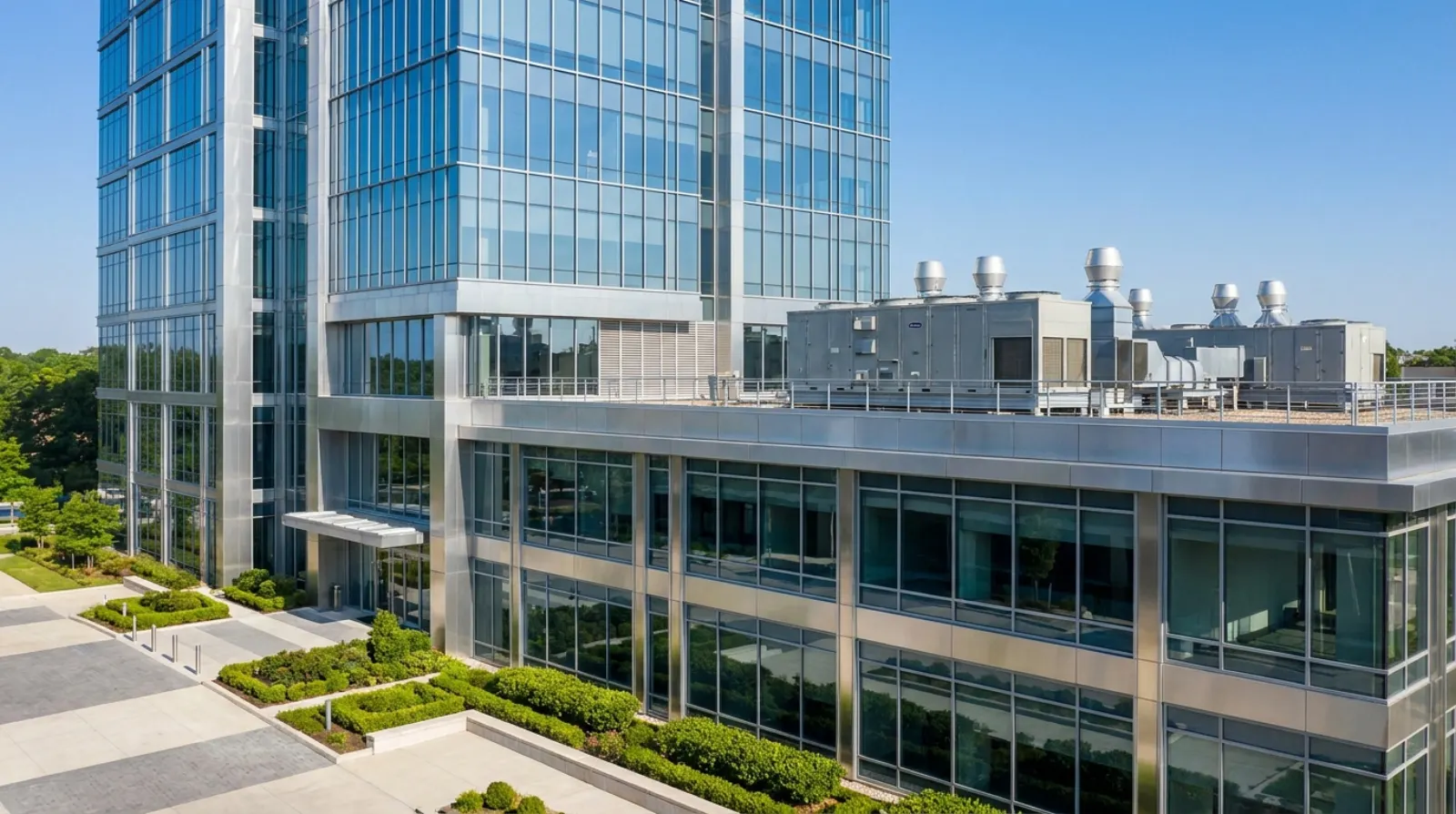
Office-building HVAC service in Birmingham keeps RTUs, chillers, VAV systems, and tenant-space splits running for facility managers responsible for lease-critical comfort during active hours.
Birmingham office buildings span from the 35-story Shipt Tower and 33-story Regions Center in the downtown core to the Class A suburban campuses along the Highway 280 and I-459 corridor — Colonnade at Inverness, the Summit 280 office complex, and the Grandview Medical Center medical-office cluster. Each of these stock types carries a distinct HVAC failure profile.
Downtown high-rises operate on central chiller plants — typically Trane CenTraVac, Carrier 19DV, or York YK platforms — serving VAV box distribution across dozens of floors. A chiller trip at 2:47 AM is a tenant-retention event by 7:30 AM when the building manager is on the phone with every lessee who walks in to a 78-degree office. Suburban office parks operate on packaged rooftop units in the 3 to 25-ton range, often 1990s to 2010s Carrier WeatherExpert or Trane Precedent equipment, where compressor failure during summer peak is the dominant urgent service call.
Medical office buildings in the Grandview and UAB corridors carry an additional layer: medical refrigeration, lab-area humidity control, and the tenant-mix sensitivity of specialized practices that cannot operate in an uncontrolled environment. Our medical-office service prioritizes equipment classes with the tightest environmental tolerance first.
We send a technician licensed, EPA Section 608 Universal certified technicians to Birmingham office buildings on a set schedule. For chiller emergencies on systems with refrigerant charges exceeding 50 pounds, we handle the Clean Air Act Section 608 leak-repair and reporting protocol. For VRF and VRV multi-zone systems in Class A suburban buildings, our factory-trained technicians handle Daikin VRV, Mitsubishi City Multi, LG Multi V, and Carrier VRF diagnostics with the proper refrigerant pressure analysis and communication protocol decoding.
Further reading for facility managers Commercial RTU lifecycle planning · HVAC maintenance contracts · HVAC compliance primer — or review the case-studies index across all five verticals.
Browse the office-building brand matrix →
Sources: ASHRAE Standards 62.1 and 90.1 ; EPA Clean Air Act Section 608 ; BOMA commercial office operations benchmarks ; AHRI certification directory .
Birmingham office corridors
Common equipment
- Packaged rooftop units (RTUs) 3–75 tons — Carrier WeatherExpert, Trane Precedent, York YHJF, Lennox Landmark
- Chillers — Trane CenTraVac, Carrier 19DV, York YK, Daikin Magnitude
- VAV box distribution — pneumatic and electric actuators
- VRF / VRV multi-zone — Daikin, Mitsubishi, LG, Carrier
- Make-up air units on multi-story office buildings
- Building automation system integration — Trane Tracer, Johnson Controls Metasys, Automated Logic WebCTRL
- Medical office humidity and filtration upgrades
- Commercial split systems for standalone office conversions
Commercial corridors we serve.
REV Birmingham financial district
Regions Tower, Wells Fargo Tower, Shipt Tower and the 1970s-era Class B high-rise belt. Centralized chiller plants (Trane CenTraVac, Carrier 19DV, York YK) on central systems serving VAV box distribution across 20-35 floors. Chiller trip at 2 AM is the dominant off-hours call.
Mid-rise suburban Class B
Lakeshore office parks and the Samford University adjacent commercial cluster. 1990s-2010s 4-to-8 story offices running packaged RTUs 5-25 tons, VAV zoning, aging economizer controls entering failure window.
Mixed-use Class B+ campus
Galleria-adjacent office towers with mixed retail tie-ins. Mix of packaged RTUs and mid-tonnage chillers. Peak failures cluster around Q4 holiday retail season when the entire campus runs extended hours.
Class A suburban office
Colonnade at Inverness, Grandview medical office cluster, Highway 280 office-park belt from Overton through Greystone. Newer Class A VRF installations (Daikin VRV, Mitsubishi City Multi) plus legacy packaged RTU stock from 1995-2010.
Professional service suites
Specialty practice medical offices and professional services in Cahaba Heights and Crestline. 3-8 ton split systems and small packaged RTUs. Humidity-sensitive tenants (imaging, labs, specialty practices) drive priority routing.
Tonnage and capacity matrix — offices.
Office building HVAC equipment sizing tracks the building envelope, occupancy type, and era of construction. Here is the capacity range we handle on Birmingham office buildings and where each class shows up across the metro.
Source: <a href="https://www.ahrinet.org/certification" style="color:var(--warm)" rel="noopener">AHRI certification directory</a> for commercial equipment capacity ratings; <a href="https://www.ashrae.org/technical-resources/ashrae-handbook" style="color:var(--warm)" rel="noopener">ASHRAE Handbook HVAC Applications</a> for office occupancy sizing; <a href="https://www.boma.org" style="color:var(--warm)" rel="noopener">BOMA</a> office building benchmarks for typical equipment class by building type.
What we respond to on office calls.
- RTU compressor failure during summer peak — most common off-hours call
- Chiller trip in downtown buildings — high-stakes tenant event
- VAV box actuator failure causing floor-wide temperature complaints
- Refrigerant leak in VRF / VRV multi-zone systems — EPA 608 reporting triggered
- Economizer failure — energy waste and code exposure on newer buildings
- Supply fan motor failure causing building-wide loss
- Condenser coil fouling from rooftop debris and Birmingham tree canopy
- Drain pan overflow causing ceiling tile and tenant-space damage
The facility manager calls once.
In a Birmingham office tower the person who calls us is rarely the person who feels the heat. The building engineer or facility manager fields the tenant complaints, but the consequence lands on the leasing side — a 78-degree floor at 9 AM is a lease-renewal conversation by lunch. So our office work is judged on two things the maintenance file actually records: how fast the floor came back into tolerance, and whether the equipment-condition report is detailed enough to defend the off-hours labor line to the asset manager who signs the capital budget. We write the chiller log, the VAV zone diagnosis, and the refrigerant-charge entry to survive that review.
Questions we hear from facilities teams.
Do you service for chiller emergencies on downtown Birmingham office buildings?
Can you work on VRF and VRV multi-zone systems in Class A suburban buildings?
How do you schedule service for office buildings?
Do you provide preventive maintenance contracts for office buildings?
Can you handle medical office HVAC with tighter environmental tolerance?
Do you coordinate with building automation contractors?
What brands do you work on for office building RTUs?
Do you document refrigerant compliance for our sustainability file?
What paperwork do you need to onboard as a vendor at our building?
What should a commercial HVAC maintenance contract explicitly cover?
How does scheduled service billing work under a contract?
What is the escalation path for a critical failure at 3 AM on a Sunday?
Is refrigerant responsibility on the owner or the contractor under EPA Section 608?
Can you provide warranty tracking on equipment we own?
Are your technicians Alabama licensed and EPA 608 certified — factually?
What is the difference between a facility manager, property manager, and asset manager decision tier?
Can you coordinate with our tenant-improvement contractor on build-out HVAC modifications?
Do you support multi-site portfolio servicing across Birmingham metro?
What does the commercial boiler service side look like for older office buildings?
Commercial RTU Health Audit Template
The rooftop unit audit template we use before scoping a repair-or-replace analysis. Walks through AHRI-certified capacity verification, refrigerant pressure benchmarks, coil and belt inspection points, and the decision tree we apply at year 12-15. Download it, walk your roof, and have a documented baseline before your next PM visit.
- Pre-audit equipment inventory (make, model, age, refrigerant type)
- Visual inspection checklist — cabinet, coils, belts, bearings, electrical
- Performance metrics: subcooling, superheat, TD, current draw
- Year 12-15 replace-or-repair decision tree
- AHRI Directory certification lookup walkthrough
Download the RTU Health Audit PDF
Delivered by email. No phone call. Commercial buyers only.
No phone call. We use your email only to deliver this resource and follow up if you request it.
Let’s set up your service plan.
Commercial buildings only. Tell us about your building and equipment and we'll follow up with a plan and a quote. Prefer to talk? Call (205) 649-4480 .
- Scheduled maintenance plans, scoped to your equipment
- RTUs, chillers, VRF, walk-in coolers, make-up air
- Priority service for plan customers
- Portfolio & property-management accounts
Request a service quote
We'll email you back within business hours. Prefer to talk now? Call the line above.
The medical office equipment stack.
Birmingham's medical office building inventory runs a mix of equipment configurations. Smaller specialty practices and dental offices in suburban medical office buildings — Cahaba Heights, Greystone, Hoover, Vestavia — typically operate on 3-to-8-ton split systems or small packaged rooftop units, often one per suite with the tenant carrying the maintenance responsibility. Larger multi-tenant medical office buildings near UAB and St. Vincent's run on built-up air handling units, often with chilled water from a central plant, distributed through VAV boxes per suite. Ambulatory surgical centers and imaging facilities frequently have dedicated dehumidification equipment and tighter zoning.
The equipment scope we service in Birmingham medical office buildings: packaged rooftop units 3 to 25 tons, commercial split systems with high-efficiency filtration, VAV terminal units with reheat, built-up air handling units with chilled water coils, dedicated outdoor air systems (DOAS) on newer construction, and humidity-control equipment for imaging suites and operating rooms. The technicians sent to medical office calls are EPA Section 608 certified and have specific commercial experience — we do not send residential-trained technicians into medical environments.
Birmingham's climate complicates the medical office HVAC job. Köppen Cfa humid subtropical climate means summer dew points routinely hit 70 to 74 degrees. Medical environments often require 40 to 60 percent relative humidity year-round. The HVAC system has to do real work to land the building inside that band, and the documentation has to prove it on every inspection visit.
Compliance, documentation, and the survey question.
The reason medical office HVAC is a different job is documentation. An ambulatory surgical center under accreditation review will be asked for HVAC maintenance records covering air-change rates, filter inspection and replacement intervals, pressure-relationship verification between clean and dirty spaces, and humidity logs for affected zones. A dental practice operating under state board oversight will be asked similar questions. An imaging facility will be asked about humidity-control logs for the equipment manufacturer's tolerance band.
We write our medical office HVAC service tickets with that documentation in mind. Every visit produces a written record covering the equipment serviced, the readings observed, the work performed, and the next inspection interval. Refrigerant pressures get logged. Filter changes get logged with the differential pressure reading at the new filter. Humidity setpoints and observed performance get logged. The paper trail is built for the accreditation survey, not for our convenience.
The relevant standards in the medical office HVAC scope: ASHRAE Standard 170 — Ventilation of Health Care Facilities for facilities under that scope, ASHRAE Standard 62.1 for general indoor air quality, ASHRAE Standard 180 for preventive maintenance scope, and the building manufacturer's humidity-control specifications for imaging and laboratory equipment. We work to these standards as a matter of course, not as an upcharge.
Uneven cooling in a commercial building is a diagnosis, not a mystery.
Uneven cooling in a commercial building — one suite freezing while the corner office bakes — almost always traces to one of four things: failed VAV boxes, a mis-staged rooftop unit, duct static pressure drifting out of spec, or a zone sensor lying to the controller. We diagnose by zone with instruments, fix the actual fault, and leave the facility manager a written map of what was found where.
Commercial HVAC Questions
Do you service for chiller emergencies on downtown Birmingham office buildings?
Yes. Centrifugal and screw chillers are a specialty. Our chiller technicians are factory-trained on Trane CenTraVac, Carrier 19DV, York YK, and Daikin Magnitude platforms. For systems with refrigerant charges exceeding 50 pounds we handle the Clean Air Act leak-repair and reporting protocol. Downtown service includes coordination with building engineering staff and, where applicable, the building automation contractor so a controls-caused trip does not become a mechanical-teardown event.
Can you work on VRF and VRV multi-zone systems in Class A suburban buildings?
Yes. We send a technician factory-trained technicians for Daikin VRV, Mitsubishi City Multi, LG Multi V, and Carrier VRF multi-zone systems. VRF service requires communication-protocol decoding, refrigerant pressure analysis across multi-zone circuits, and pressure-regulated service techniques that differ from conventional split systems. Our trucks carry the diagnostic interfaces and refrigerant recovery equipment specific to VRF service.
How do you schedule service for office buildings?
Our service line is staffed on a set schedule by a coordinator, not a call-center answering service. Off-hours calls are routed to the on-duty technician qualified for your equipment class — RTU, chiller, or VRF specialization — and the coordinator confirms the visit and travel time back to the facility manager by email within minutes of the call. For recurring off-hours coverage, we scope preferred-vendor contracts that give the building one escalation path.
Do you provide preventive maintenance contracts for office buildings?
Yes, and this is core to how we work with Class A office buildings. A preventive maintenance contract includes two to four visits per year scoped to equipment count and load, with written condition reports on every piece of equipment, refrigerant pressure and leak-check documentation, filter replacement, coil cleaning, belt inspection, and building automation system communication verification. Contracts are scoped per building or across a portfolio for multi-building property management accounts.
Can you handle medical office HVAC with tighter environmental tolerance?
Yes. Medical office HVAC carries humidity, temperature, and filtration requirements that exceed standard office-building tolerance, particularly in lab areas, imaging suites, and specialist practices with sensitive equipment. We send a technician for medical office calls with priority routing and carry replacement components for the tighter-tolerance thermostatic expansion valves, humidity controllers, and filtration platforms that medical environments require.
Do you coordinate with building automation contractors?
Yes. Many office-building HVAC issues that present as mechanical failures are actually controls-layer problems in Trane Tracer, Johnson Controls Metasys, or Automated Logic WebCTRL systems. Our technicians diagnose the mechanical equipment, isolate whether the issue is mechanical or controls-driven, and coordinate directly with the building automation vendor when a controls fix will restore service faster than a mechanical teardown.
What brands do you work on for office building RTUs?
For packaged rooftop units we work on Carrier WeatherExpert, Trane Precedent and Voyager, York YHJF and Sunline, Lennox Landmark and Strategos, Rheem Commercial, Daikin Applied RoofPak, and American Standard Commercial. Our truck inventory carries common failure components — compressor contactors, dual-run capacitors, condenser fan motors, blower motors, and thermostatic expansion valves — for all of these brands.
Do you document refrigerant compliance for our sustainability file?
Yes. Every commercial refrigerant service ticket documents refrigerant type, amount recovered, amount charged, and leak-check results. For buildings subject to EPA Clean Air Act Section 608 reporting (systems with more than 50 pounds of refrigerant), we provide the full documentation your sustainability or compliance team needs for annual reporting. We can also integrate with third-party refrigerant tracking platforms if your facilities team uses one.