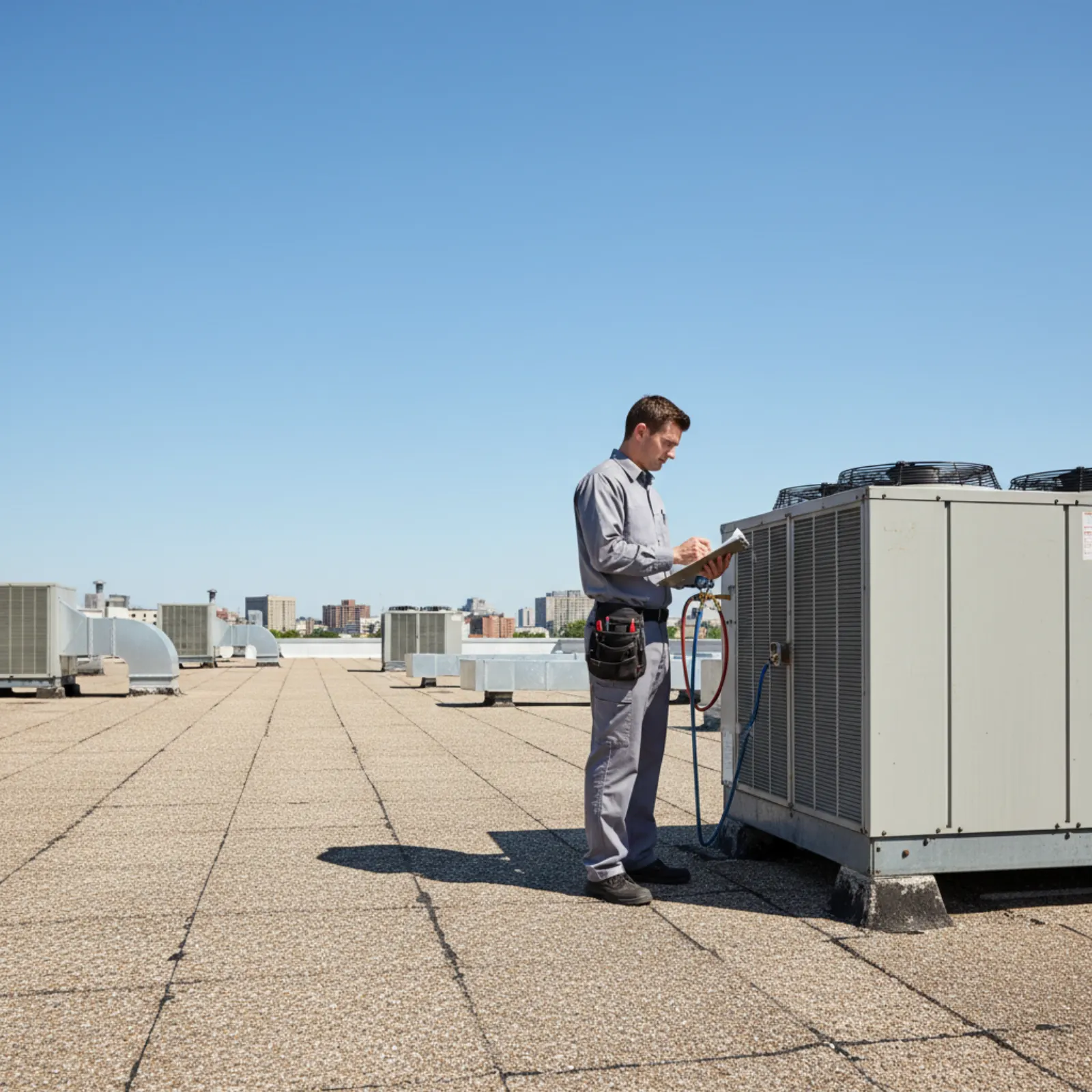
A commercial RTU runs ~4,000 hours per year in Birmingham's climate. Without quarterly PM, average systems lose 5–7% efficiency annually from coil fouling, refrigerant drift, and belt slippage. The PM contract pays for itself before the compressor replacement.
Four visits. Four seasons. Four different priorities.
Birmingham sits in ASHRAE Climate Zone 3A — hot and humid. The combination of heavy spring pollen and sustained summer humidity creates seasonal maintenance priorities that differ from drier markets. Here is what each quarterly visit actually targets.
Birmingham pollen season is among the heaviest in the Southeast. Tree pollen — pine, oak, sweetgum — loads condenser fins at rates that reduce airflow 15–20% in six weeks. Pre-season coil cleaning before first sustained cooling load is the single highest-value PM task in this market. Chiller startup inspections happen in this quarter.
Birmingham averages 90°F+ days from late June through early September with dew points regularly above 70°F. High wet-bulb compresses performance margin on every refrigerant-cycle system. Compressors marginal in April tip into failure in July. Q2 visits log full refrigerant pressures, motor amp draws against nameplate, and electrical connection torque.
Transition from cooling to heating mode. Gas-fired equipment — RTU heat sections, MUA units, warehouse unit heaters — gets combustion analysis (CO, CO₂, stack temperature) and heat-exchanger inspection before first heating demand. A failed heat exchanger on a restaurant MUA in December is a health-code and worker-safety problem.
Walk-in freezers are most vulnerable to defrost system failures in cold weather. Pipe insulation at exterior penetrations gets inspected. Cooling tower freeze protection (water-cooled chillers) gets verified before ambient drops below 35°F — a threshold Birmingham crosses most winters.
What the PM visit actually does on each equipment class.
"Checking filters" is task one of a 20-point checklist. Below: ASHRAE Standard 180 task scope applied to the four equipment classes we PM most often in Birmingham. Photos right, tasks left.
Rooftop unit PM scope
- Filter inspection and replacement (MERV-8 min; MERV-13 healthcare/office)
- Evaporator coil cleaning — chemical foam, low-pressure rinse
- Condenser coil cleaning — detergent + pressure wash
- Belt tension and condition check; replace if glazed/cracked
- Motor amp draw vs. nameplate FLA
- Compressor discharge / suction pressure vs. design
- Refrigerant leak check w/ electronic detector
- Economizer damper, linkage, actuator test
- Condensate drain pan inspection + flush
- Electrical connection torque (contactors, terminals, disconnect)
- Thermostat / BAS setpoint verification
- Heat exchanger visual inspection (gas units)
- Combustion analysis — CO, CO₂, stack temp
Chiller PM scope
- Refrigerant pressure log — suction, discharge, saturated temps
- Oil level and color check; oil sample for laboratory analysis
- Vibration check on compressor and pump bearings
- Purge unit inspection (CFC legacy chillers)
- Evaporator/condenser water differential temp verification
- Cooling tower inspection + water treatment check (water-cooled)
- Chilled water pump operation and flow verification
- Controls calibration — chilled water setpoint, demand limiting
- Electrical connection inspection — HV and control circuits
- Full-circuit leak check with electronic detector
- Refrigerant log update for EPA Section 608 compliance
- Capacity test under load conditions
VRF PM scope
- Outdoor unit coil cleaning + condenser fan amp draw
- All indoor unit filters (cassette, ducted, wall-mount)
- System-level refrigerant pressure at outdoor service ports
- BC/CMB controller error log review via mfr software
- Indoor unit drain pan + condensate pump check (all zones)
- Zone controller setpoint and schedule audit
- Pipe insulation inspection at exterior penetrations
- Error code log review — outdoor + BC controller
- Electronic leak detection sweep
- Refrigerant log update for EPA Section 608 documentation
Walk-in cooler / freezer PM scope
- Case temperature log — arrival and departure
- Evaporator coil condition and defrost cycle verification
- Condenser coil cleaning — critical in BHM high-pollen periods
- Condenser fan motor amp draw
- Door gasket and door heater inspection
- TXV (thermostatic expansion valve) check
- Drain line and condensate pan inspection
- Compressor amp draw + oil sight glass
- Refrigerant leak check at all joints
- Temperature controller calibration
Minimum PM frequency, with the basis we cite.
Standards: ASHRAE 180 · ASHRAE 62.1 · EPA Section 608 · NFPA 96 .
"On a recent Vestavia Hills office property, the building manager skipped one Q1 coil wash. By July third, three of seven RTUs had tripped on high head. That single deferred visit cost more than three years of contract."
Questions we hear from facilities teams.
How often should commercial HVAC equipment be maintained?
What does a real commercial HVAC PM visit include beyond "checking filters"?
Does preventive maintenance actually reduce urgent service calls?
Does your PM program include ASHRAE 62.1 compliance documentation?
What about NFPA 96 for commercial kitchens?
What refrigerant tracking is included in your PM service?
We walk the building. Document every unit. Deliver a written PM scope. No obligation.
60–90 minutes for most commercial buildings. You receive a written report with equipment inventory, condition assessment, refrigerant inventory, and recommended PM frequency.
Let’s set up your service plan.
Commercial buildings only. Tell us about your building and equipment and we'll follow up with a plan and a quote. Prefer to talk? Call (205) 649-4480 .
- Scheduled maintenance plans, scoped to your equipment
- RTUs, chillers, VRF, walk-in coolers, make-up air
- Priority service for plan customers
- Portfolio & property-management accounts
Request a service quote
We'll email you back within business hours. Prefer to talk now? Call the line above.
Commercial HVAC Questions
How often should commercial HVAC equipment be maintained?
Frequency depends on equipment class, operating hours, and environment. RTUs in standard office applications typically require quarterly PM — four visits per year. Chillers serving critical cooling loads require at minimum semi-annual inspection per ASHRAE Standard 180; high-load systems benefit from quarterly visits. Walk-in coolers in restaurant applications typically run 16 to 18 hours per day and require quarterly PM minimum. Equipment in high-pollen or high-dust environments — common in Birmingham from February through May — may require additional filter service between scheduled visits.
What does a real commercial HVAC PM visit include beyond "checking filters"?
A real PM visit on an RTU includes: filter inspection and replacement, evaporator and condenser coil cleaning, belt tension and condition check, motor amp draw measurement, compressor discharge and suction pressure verification against design targets, refrigerant leak check with electronic detector, economizer damper operation test, drain pan and condensate line flush, electrical connection torque check, and thermostat setpoint verification. For chillers, add oil analysis sample, vibration check, and purge unit inspection. For walk-ins, add evaporator defrost cycle verification and door seal inspection. "Checking filters" is step one of a 20-point task list.
Does preventive maintenance actually reduce urgent service calls?
Yes, for specific failure modes. Dirty condenser coils are one of the most common causes of compressor failure in Alabama summers — Birmingham humidity accelerates coil fouling, and a fouled coil raises head pressure, increases compressor runtime, and shortens compressor life. Regular coil cleaning directly prevents this. Refrigerant leaks caught at 5–8% annual loss during a PM visit are repaired before they reach the EPA Section 608 mandatory-repair threshold of 10% per year for commercial AC systems.
Does your PM program include ASHRAE 62.1 compliance documentation?
Yes. ASHRAE 62.1 (Ventilation for Acceptable Indoor Air Quality) requires that commercial HVAC systems maintain minimum outdoor air rates by occupancy class. Our PM reports document economizer position, outdoor air damper operation, and any conditions affecting ventilation effectiveness.
What about NFPA 96 for commercial kitchens?
NFPA 96 governs the inspection frequency for commercial kitchen exhaust systems. While hood cleaning is a separate trade, our PM program verifies make-up air unit operation, exhaust fan static pressure, and the interface between the make-up air system and the kitchen exhaust.
What refrigerant tracking is included in your PM service?
Every PM visit includes a refrigerant log entry: refrigerant type, EPA Section 608 certification number of the technician, amount recovered (if any), amount added (if any), and leak-check result. For systems with charges above 50 pounds, we track annual leak rate against the EPA Section 608 threshold of 10% per year.