
Commercial HVAC · Birmingham, AL
Retail HVAC measures in dwell time.
Retail HVAC is measured in customer dwell time. A failed strip-center RTU on Saturday afternoon empties the store; we send a technician to restore it before close.
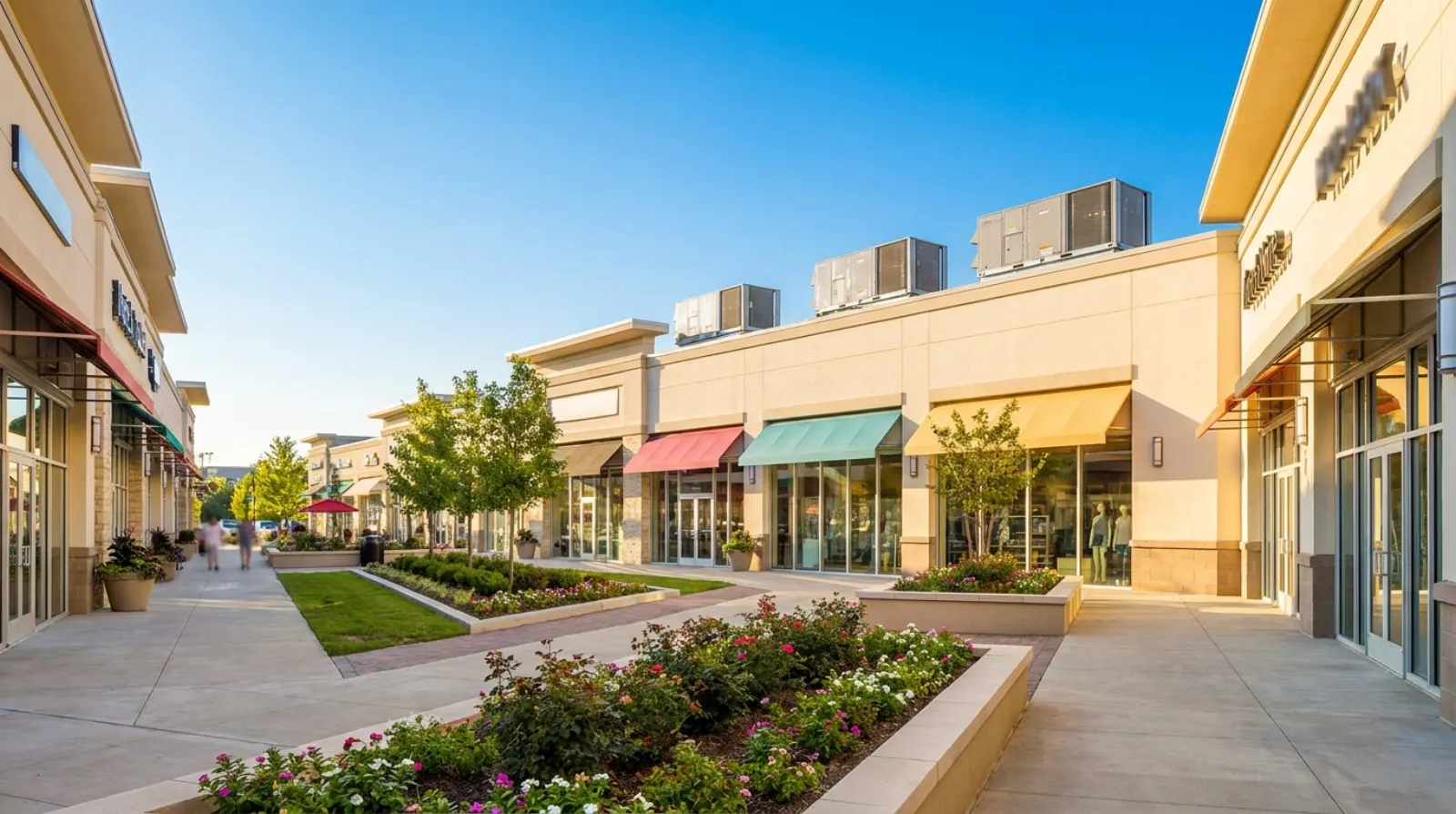
Retail HVAC is the bridge between customer experience and operational cost. A strip-center HVAC failure on a Saturday afternoon empties the store faster than any other commercial property type — customers leave, dwell time drops, and the quarter-end numbers reflect it. Birmingham retail densifies along the Highway 31 and US-280 Hoover corridor, the Summit Birmingham outdoor shopping complex, the Trussville Promenade, the Center Point Parkway value-retail corridor, the Bessemer US-11 aging strip-center belt, and the Eastern Valley Road McCalla growth corridor.
The dominant equipment class in Birmingham retail is the packaged rooftop unit. Strip-center tenants typically carry their own 3 to 10-ton RTU serving the individual tenant space, while common areas and anchor tenants run 10 to 25-ton equipment. Enclosed mall properties like Riverchase Galleria run centralized chiller plants; outdoor malls like The Summit and Brookwood Village run individual tenant RTUs. Older retail in Crestwood and the 1970s to 1980s strip-center belt along Bessemer runs aging Carrier, Trane, York, and Lennox packaged equipment well past its design service life, where deferred maintenance from the property management chain creates recurring urgent exposure.
Our retail service is structured around the buyer layer. Independent retail owners call directly. Chain locations route through store managers to the regional facilities coordinator. Commercial property owners managing multi-tenant strip centers deal with a rotating tenant roster where each tenant may or may not have an HVAC preferred vendor. We handle all three: direct-call priority service for the independent owner, chain-process service coordinated through regional facilities, and property-owner preferred-vendor contracts covering every unit in the strip.
Peak-season service is a specific retail reality. Q4 holiday retail and Q2 spring seasonal push both carry demand spikes that make every HVAC outage more expensive in lost-revenue terms. Preventive maintenance contracts scoped to hit peak-season preparation windows — filter replacement and coil cleaning in September for Q4, condenser service in March for spring — eliminate the majority of peak-season failure events.
For fitness retail tenants, the HVAC load profile differs from standard retail. Planet Fitness, LA Fitness, and boutique gyms with scheduled operation carry high equipment-generated heat loads that size differently than general-merchandise retail. Our retail service recognizes the distinction and routes fitness-tenant calls to technicians familiar with the higher load tolerance and longer equipment run times.
Retail operators also read RTU lifecycle for retail · Retail PM contracts · Refrigerant compliance — or review the case-studies index across all five verticals.
Retail-HVAC brands we actually service →
Sources: ICSC retail property benchmarks ; ASHRAE 62.1 retail occupancy ventilation ; Energy Star commercial retail benchmarks ; AHRI certification directory .
Birmingham retail corridors.
Mid-tier lifestyle center
Homewood Brookwood Village — mixed inline retail with restaurant tie-ins. Mid-tonnage RTU stock from 2000-2015, entering first-replacement window.
Enclosed mall, anchor tenants
Centralized chiller plant serving enclosed mall common areas; tenant-specific RTUs on peripheral inline shops. Dual service pattern — chiller service plus tenant-space RTU.
Outdoor lifestyle center
Summit Birmingham outdoor center with big-box anchors, upscale inline retail, and restaurant tenants. Higher-efficiency packaged RTU and some VRF on newer build-outs.
Mixed-use professional retail
Class B+ specialty retail and professional office mix. Smaller tenant-space RTU and split systems, high complexity from multi-tenant zone sharing.
Hoover lifestyle retail
Hoover Patton Creek with national chain anchors and restaurant hybrid tenants. Peak-season prep is priority for holiday retail and summer lifestyle traffic.
Suburban growth retail
Trussville Pinnacle with newer suburban retail build-outs. Builder-grade 2015-era RTUs entering capacity-verification window.
Upscale suburban retail
Greystone upscale retail belt with fitness-center tenants, specialty food, and professional services. scheduled operation on fitness tenants drives higher service frequency.
Capacity matrix — retail.
Retail HVAC sizing tracks tenant type and footprint. A 1,500 sq ft inline boutique runs different equipment than a 30,000 sq ft big-box anchor. Here is the capacity range we handle across Birmingham retail property classes.
Source: <a href="https://www.ahrinet.org/certification" style="color:var(--warm)" rel="noopener">AHRI</a> commercial equipment certification directory; <a href="https://www.ashrae.org/technical-resources/standards-and-guidelines/standards-addenda/ansi-ashrae-standard-62-1-2022" style="color:var(--warm)" rel="noopener">ASHRAE 62.1</a> retail occupancy ventilation rates; <a href="https://www.icsc.com" style="color:var(--warm)" rel="noopener">ICSC</a> retail property benchmarks for typical equipment class by tenant type.
What we work on.
- Packaged rooftop units 3–25 tons — Carrier, Trane, York, Lennox, Daikin, Rheem Commercial
- Split systems for inline strip-center tenants
- Common-area RTUs on enclosed mall and strip-center properties
- Multi-zone systems for anchor tenants and department stores
- VRF / VRV for newer Class A retail like The Summit
- Make-up air on fitness and restaurant anchor tenants
- Commercial refrigeration on grocery and convenience retail
- Controls systems — Trane Tracer, Carrier i-Vu, Johnson Metasys
What brings us in.
- Tenant-space RTU compressor failure during Saturday peak traffic
- Common-area HVAC loss affecting every tenant in strip simultaneously
- Q4 peak-season failure — holiday retail revenue exposure
- Multi-tenant thermostat dispute — zone balancing between tenants
- Condenser fan failure causing high-head-pressure trip and full shutdown
- Anchor-tenant chiller or VRF failure — district manager escalation
- Refrigeration failure on grocery and convenience retail
- Controls communication failure across multi-unit strip
Three buyers. Three service patterns.
Retail HVAC buyers split into three categories. The independent retail owner calls directly and wants the problem ended before close of business. The chain location routes through the store manager to a regional facilities coordinator who needs email documentation and standardized invoicing. The commercial property owner managing a multi-tenant strip-center portfolio needs preferred-vendor service covering every tenant in every strip and consolidated invoicing per property. We scope our retail service to all three.
Questions we hear from facilities teams.
Do you service for individual retail tenants or only for property owners?
Can you handle peak-season HVAC preparation before Q4 holiday retail?
What brands do you work on for retail rooftop units?
Do you handle enclosed mall chiller plants or only individual tenant HVAC?
Can you handle HVAC for fitness tenants with scheduled operation?
Do you service for commercial refrigeration on grocery and convenience retail?
How do you invoice for multi-tenant strip-center work?
Can you help with tenant HVAC disputes over temperature balancing?
What vendor onboarding paperwork do retail property managers require?
What should a retail HVAC maintenance contract explicitly include?
How is scheduled service handled under a retail contract?
What is the escalation path for a holiday weekend retail urgent?
Is refrigerant responsibility on the property owner, chain operator, or contractor?
Do you provide warranty tracking on retail equipment we installed or inherited?
Are your technicians Alabama HVAC licensed — verifiable?
Can you coordinate retail tenant improvement (TI) HVAC scope?
Do you support multi-site retail portfolio servicing across Birmingham metro?
What scope does commercial refrigeration on grocery and convenience cover?
Commercial HVAC Maintenance Contract 40-Point Evaluation Template
The 40-point evaluation framework property managers and retail facilities coordinators use when comparing commercial HVAC maintenance contract proposals. Covers scope inclusions, red-flag contract language, renewal terms, fast response tiers, and per-equipment service frequency.
- 40-point scope checklist (labor, parts, filters, refrigerant, urgent)
- Contract language red flags (auto-renewal, exclusive-vendor, liability caps)
- Renewal term negotiation framework
- Urgent response tier scoring (without response-time promises)
- Per-equipment service frequency table aligned to ASHRAE 180
Download the Maintenance Contract Template PDF
Delivered by email. No phone call. Commercial buyers only.
No phone call. We use your email only to deliver this resource and follow up if you request it.
Let’s set up your service plan.
Commercial buildings only. Tell us about your building and equipment and we'll follow up with a plan and a quote. Prefer to talk? Call (205) 649-4480 .
- Scheduled maintenance plans, scoped to your equipment
- RTUs, chillers, VRF, walk-in coolers, make-up air
- Priority service for plan customers
- Portfolio & property-management accounts
Request a service quote
We'll email you back within business hours. Prefer to talk now? Call the line above.
The retail HVAC stack we service in Birmingham.
Birmingham's retail inventory runs a mix of building types. Suburban strip centers — Hoover, Trussville, Pelham, Alabaster, McCalla — typically run dedicated packaged rooftop units per tenant suite, sized 3 to 7.5 tons depending on the suite. Lifestyle centers and mall in-line tenants run a mix of dedicated and shared HVAC, often with landlord-furnished common-area cooling and tenant-furnished suite cooling. Big-box anchors run multiple large packaged RTUs, often 7.5 to 25 tons each, with built-up air handling for the largest formats. Single-tenant retail boxes — automotive parts, drugstores, fast-casual restaurants in retail format — run dedicated packaged equipment.
The brands and refrigerants we see most across Birmingham retail: Carrier, Trane, York, Lennox, Daikin, and Goodman packaged RTUs across R-410A and R-454B. Legacy equipment on R-22 is still in service on retail buildings constructed before 2010 — we service it but we will discuss lifecycle planning on R-22 equipment past year 12 given the reclaimed-refrigerant supply situation. Equipment scope includes packaged RTUs 3 to 25 tons, split systems for older buildings or unusual tenant configurations, and built-up air handling for large-format big-box buildings.
The technicians sent to retail calls in Birmingham carry EPA Section 608 certification, Alabama state HVAC licenses, and the commercial truck inventory for the equipment scope. We are licensed, bonded, and insured for commercial work in Alabama. We provide certificate of insurance documentation directly to property management on request.
Commercial HVAC Questions
Do you service for individual retail tenants or only for property owners?
Both. Independent retail tenants can call directly for priority service on their tenant-space HVAC. Chain-location service routes through the store manager to the regional facilities coordinator — we accept PO numbers and coordinate back through corporate facilities on invoicing. Commercial property owners managing multi-tenant strip centers can scope preferred-vendor contracts that cover every tenant unit plus common-area HVAC with consolidated monthly invoicing per property.
Can you handle peak-season HVAC preparation before Q4 holiday retail?
Yes. Peak-season preparation is a core part of how we work with Birmingham retail. We scope fall preventive maintenance visits in September and early October for holiday-retail tenants to hit filter replacement, condenser coil cleaning, and compressor electrical testing before the peak-season demand curve. For spring seasonal retail we run the equivalent prep window in March and early April. Most peak-season failures we see are preventable with properly timed PM.
What brands do you work on for retail rooftop units?
We service the dominant retail RTU platforms: Carrier WeatherExpert and Flotronic, Trane Precedent and Voyager, York YHJF and Sunline, Lennox Landmark and Strategos, Daikin Applied RoofPak, and Rheem Commercial. Truck inventory carries common-failure components — dual-run capacitors, contactors, condenser fan motors, blower motors, thermostatic expansion valves, and thermostats — for all of these brands.
Do you handle enclosed mall chiller plants or only individual tenant HVAC?
Both. Centralized chiller plants at enclosed mall properties like Riverchase Galleria require specialty chiller service, and our technicians are factory-trained on Trane CenTraVac, Carrier 19DV, York YK, and Daikin Magnitude chiller platforms. For mall-facilities teams running centralized HVAC infrastructure, we scope preventive maintenance contracts that include the chiller plant, primary pumping, and secondary distribution on a scheduled visit cycle.
Can you handle HVAC for fitness tenants with scheduled operation?
Yes. Fitness tenants — Planet Fitness, LA Fitness, boutique gyms — carry a different load profile than standard retail, with scheduled operation, higher equipment-generated heat loads, and make-up air considerations on facilities with significant member volume. We route fitness-tenant service to technicians familiar with the longer run-time equipment profile and the higher service frequency these properties need.
Do you service for commercial refrigeration on grocery and convenience retail?
Yes. Grocery stores and convenience retail operate commercial refrigeration on the same Hussmann, Heatcraft, and Bohn platforms we service for restaurants. The equipment scale and footprint differs — grocery runs walk-in units plus open-case refrigeration plus frozen-food cases — but the service platform is the same. Refrigeration emergencies at grocery and convenience retail get the same priority service as restaurant refrigeration.
How do you invoice for multi-tenant strip-center work?
Depends on the scope. Individual tenant urgent service calls invoice directly to the tenant with a PO or credit card. Commercial property owner contracts for multi-tenant strips run on consolidated monthly invoicing per property with line-item breakouts by tenant unit when common-area work is shared across tenants. Chain location work routes through whatever invoicing channel your regional facilities group uses — PO-based, credit card, or direct corporate billing.
Can you help with tenant HVAC disputes over temperature balancing?
Yes. Multi-tenant strip centers frequently carry zone-balancing disputes where one tenant complains about their space running hotter or colder than the neighbor. We diagnose the actual equipment — whether tenant-space RTUs are sized correctly for the load, whether supply and return air paths are balanced, whether thermostat placement is causing the complaint — and provide a written report the property owner can use to resolve the dispute or scope corrective work.