
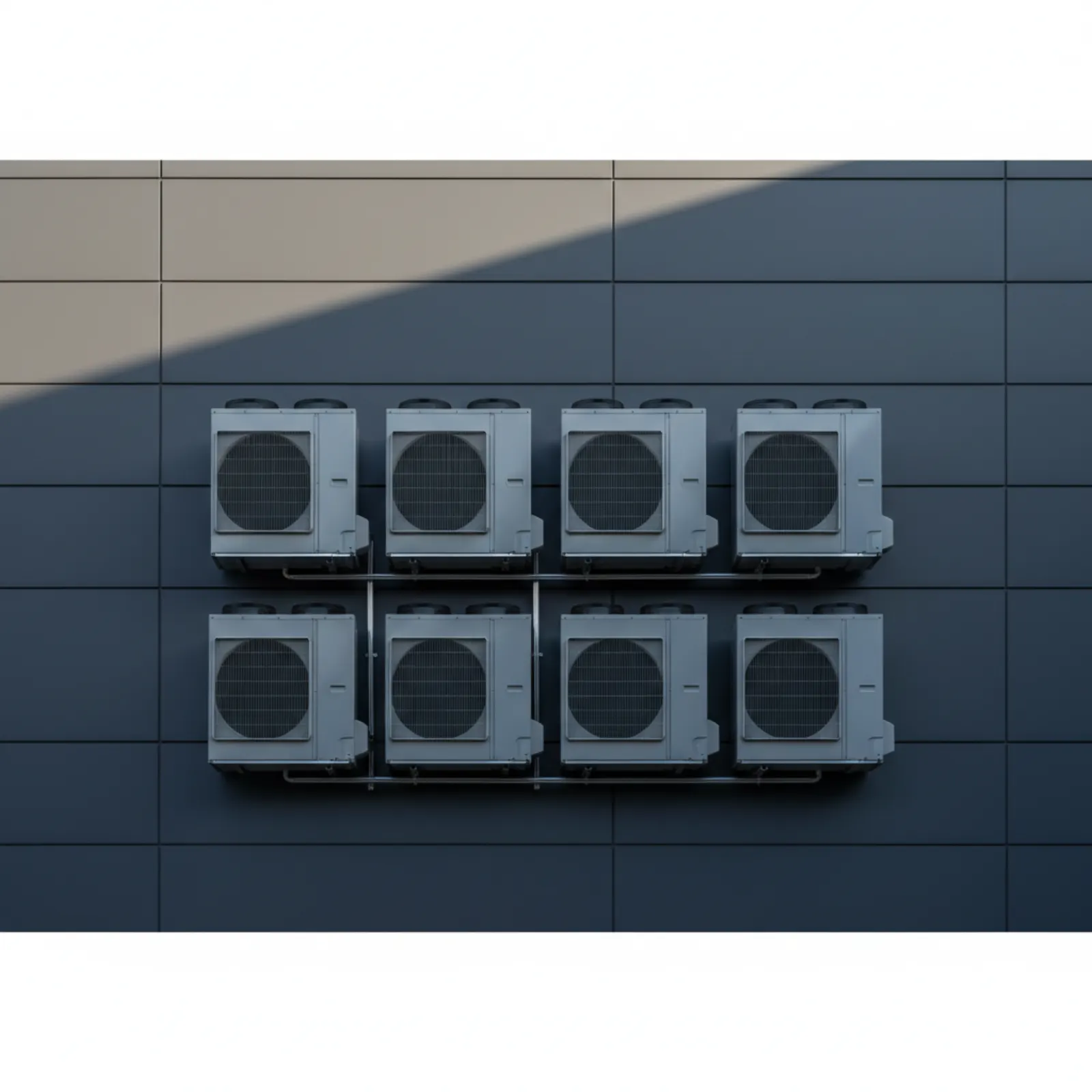
VRF gained significant share in Birmingham commercial construction between 2008 and 2020 — the technology suited tenant-flexibility requirements of multi-tenant office and hospitality. Those buildings are now in their first major service cycle, with R-410A platforms facing AIM Act phase-down scrutiny.
Four manufacturers. Four diagnostic interfaces. One technician credential.
Most field calls that present as "compressor failing" on a VRF system are actually BC controller logic errors, communication wiring issues, or zone-selection programming problems. Replacing a compressor on a controls-related fault is an expensive mistake that proper diagnostics prevents.
The original VRF platform. Common in Class A office and hospitality. Diagnostic via Daikin PC Configurator and DIII-NET controller network.
City Multi heat recovery (PURY) and heat pump (PUHY). Common in mid-size office and healthcare renovation. BC controller (CMB) programming is a frequent diagnostic point.
Grew share in Birmingham commercial construction from 2015 onward. Multi V 5 (heat pump), Multi V Water, Multi V S. Common failure: EEV calibration on indoor units after extended operation.
Present in some Birmingham renovations from 2018 onward. DVM S5 / S6 heat pump and heat recovery configurations. Samsung NASA protocol requires Samsung-specific interface.
Why heat-recovery VRF needs more than a manifold gauge set.
Branch circuit (BC) controllers manage refrigerant flow direction — heating or cooling — for each zone in a heat recovery VRF system. BC controller failures cause zone-selection errors that read as compressor or expansion-valve faults in the outdoor unit diagnostic log. Correct diagnosis requires reading zone-level fault data through the manufacturer's diagnostic interface, not just the outdoor unit error code.
Most BC misdiagnoses we see come from contractors who pulled the outdoor fault code, replaced what the code suggested, and never connected to the BC controller. The real root cause stayed in the building until the next service call.
R-410A
The dominant VRF refrigerant 2008–2024. AIM Act phase-down restricts production. Most installed Birmingham VRF runs R-410A.
R-454B / R-32
Lower-GWP replacements rolling out in new VRF equipment. Different oil compatibility, different leak detection chemistry. Service tooling differs.
The transition affects every VRF service call in the next 5 years. Standards: EPA AIM Act · EPA Section 608 .
Five things VRF systems fail on in Birmingham commercial buildings.
- Refrigerant charge imbalance. VRF systems designed for precise charge based on actual REFNET piping. Systems that leaked slowly over years — or were incorrectly charged at installation — operate with reduced capacity in warmest zones before manifesting as system-wide fault. Electronic leak detection at all joints is the only reliable method.
- BC / CMB controller failures (heat recovery). Branch circuit controllers manage refrigerant flow direction. BC failures cause zone-selection errors that read as compressor or expansion-valve faults in the outdoor diagnostic log. Correct diagnosis requires reading zone-level fault data, not just outdoor error code.
- Refrigerant pipe insulation degradation. Closed-cell foam insulation degrades over 10–15 years from UV, mechanical wear, pest damage. Insulation failures allow heat gain in summer (reducing cooling capacity) and condensation in winter (water damage above ceiling tiles).
- EEV calibration drift. EEVs regulate refrigerant flow to each indoor unit and drift over thousands of operating hours. Miscalibrated EEVs cause individual zone performance issues that present identically to refrigerant charge problems. Distinction: EEV issues are zone-specific; charge issues affect all zones.
- Communication network faults. VRF systems use mfr-proprietary communication wiring. Any wiring fault generates error codes across the entire network, making it appear the system has multiple simultaneous failures. Systematic wiring trace from outdoor outward is the correct diagnostic sequence.
"On a Mountain Brook hospitality property, three contractors had quoted compressor replacement on a 4-year-old Daikin VRV. We connected to the BC controller and found a single zone control board — $400 part instead of $40,000."
Questions we hear from facilities teams.
What is the difference between VRF and VRV?
What brands of VRF systems do you service?
What are the most common VRF failure modes?
How does VRF refrigerant tracking work under EPA Section 608?
Why is VRF commissioning data important for ongoing service?
Bring the commissioning data. We’ll evaluate the system.
A VRF system evaluation reviews commissioning paperwork, error logs, and refrigerant inventory before any field work. Bring what you have — even partial documentation helps.
Let’s set up your service plan.
Commercial buildings only. Tell us about your building and equipment and we'll follow up with a plan and a quote. Prefer to talk? Call (205) 649-4480 .
- Scheduled maintenance plans, scoped to your equipment
- RTUs, chillers, VRF, walk-in coolers, make-up air
- Priority service for plan customers
- Portfolio & property-management accounts
Request a service quote
We'll email you back within business hours. Prefer to talk now? Call the line above.
Commercial HVAC Questions
What is the difference between VRF and VRV?
VRF (Variable Refrigerant Flow) is the generic industry term. VRV (Variable Refrigerant Volume) is Daikin's trademarked name for their proprietary VRF system — effectively the same technology. When you see "VRV" on a building spec, it means Daikin equipment; when you see "VRF," it refers to the technology category that includes systems from Daikin, Mitsubishi, LG, Samsung, Carrier, and others.
What brands of VRF systems do you service?
We service Daikin VRV (IV, IV+ S, WIII water-cooled), Mitsubishi Electric City Multi (PUHY, PURY heat recovery and heat pump), LG Multi V (5, S, Water), Samsung DVM (S5, S6, Water), and Carrier VRF (38GXC, 38VMR). For indoor units, we work on all cassette, ducted, and wall-mount configurations from these manufacturers.
What are the most common VRF failure modes?
Refrigerant charge imbalance is the most frequent VRF issue we diagnose in Birmingham commercial buildings. VRF systems are highly sensitive to refrigerant charge — systems operating at 5–10% undercharge show measurable capacity reduction in individual zones before triggering error codes. Piping insulation failures at exterior wall penetrations and BC controller failures in heat recovery systems round out the top three.
How does VRF refrigerant tracking work under EPA Section 608?
Most commercial VRF systems carry refrigerant charges between 15 and 80 pounds. Systems under 50 pounds are subject to EPA Section 608 standards but below the mandatory leak-rate reporting threshold. Systems over 50 pounds — large heat-recovery VRF installations — are subject to the 10% annual leak rate threshold.
Why is VRF commissioning data important for ongoing service?
VRF systems are commissioned at installation with a full refrigerant charge calculation based on actual pipe length and elevation change. Systems that have lost their commissioning paperwork are difficult to correctly diagnose because the technician cannot distinguish "the system is undercharged from a leak" from "the system was never correctly charged at installation."