
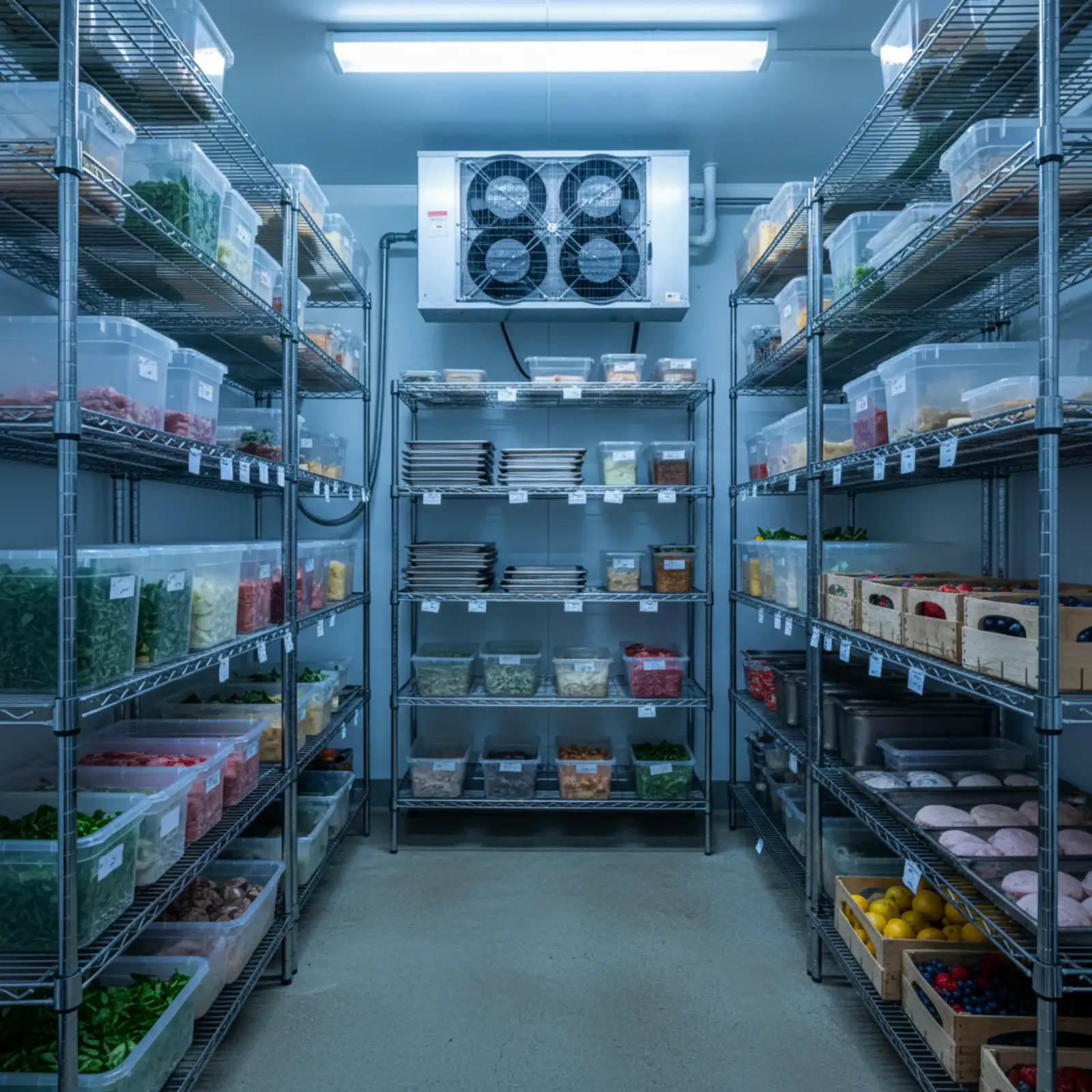
A failed walk-in cooler during dinner service is not a comfort problem. It's a food-safety urgent with a four-hour clock running before perishable inventory must be discarded or relocated. Alabama food code follows the FDA 41°F cold-holding standard.
Six components. Five common failure points.
Commercial refrigeration runs on the same vapor-compression cycle as HVAC — but the consequences of failure are compressed into a tighter window. Below: every component on a typical walk-in, with the failure rate we see and the part we keep on the truck.
Heatcraft Larkin, Bohn, Russell, Copeland scroll. Located outside or in mechanical room. Failure mode: condenser coil fouling from kitchen grease drives head pressure above trip threshold.
Heatcraft, Bohn, or Russell evaporator air units. Inside the box at ceiling. Common service points: evap fan motor (ECM/PSC), defrost heater, defrost termination thermostat.
Defrost timer, heaters, termination thermostat. Cooler defrosts 1–2x daily; freezer 3–4x. Failed defrost = progressive frost buildup until airflow drops and box temp climbs.
Degraded gaskets allow warm humid Alabama air infiltration. Compressor runs near continuously. Frost around door frames is the most visible symptom. Low-cost fix that extends compressor life measurably.
Thermostatic expansion valve regulates refrigerant flow. Stuck-open = compressor flooding. Stuck-closed = starving + high superheat. Diagnosed by superheat measurement, not pressure alone.
Dixell, Danfoss, Emerson Alco temperature controllers. Probe calibration drift causes "too cold" / "not cold enough" calls misdiagnosed as refrigerant or defrost problems.
Walk-in coolers defrost twice a day. Freezers, four times. When that breaks, here’s what happens.
A successful defrost cycle melts evaporator coil ice without warming the box too much. When any step fails, frost accumulates on the coil until airflow drops to zero — and the box can no longer hold temperature even though the compressor is running.
The four-hour clock — what every kitchen manager should know.
When a walk-in fails, the FDA Model Food Code 4-hour window starts when food temperature crosses 41°F. After that, perishable food must be discarded or relocated. Below: what should happen in each hour.
Verify with thermometer (probe in food, not air). Call us with: address, equipment make/model, current temp, food inventory. If you can't reach us first call, call competitor — every minute counts.
Group A: still under 41°F — can stay. Group B: 41°F–50°F — must move promptly. Group C: above 50°F more than 4 hr — must discard. Document with photos for insurance.
Most condensing-unit failures resolve at the truck — fan motor, contactor, capacitor, defrost heater. Compressor replacement is a return visit unless we have the unit on truck for that brand.
If repaired: log temps every hour for next 12 hours. If not repaired: relocate Group B to functioning refrigeration. Document with health inspector if asked. We provide written service report for your file.
Standards: FDA Model Food Code · Alabama Department of Public Health food code · EPA Section 608 for refrigerant handling.
"On a Five Points South restaurant, walk-in cooler dropped at 4:15 PM Friday. We were on site by 5:45, condenser fan motor swap. Box was back to 38°F before the dinner rush ended. That call is why we built this."
Questions we hear from facilities teams.
What refrigeration brands do you service?
What happens to food safety when a walk-in cooler fails?
What are the most common walk-in failure modes?
Do you service walk-in freezers as well as coolers?
Does a walk-in cooler service contract make sense for a small restaurant?
Let’s set up your service plan.
Commercial buildings only. Tell us about your building and equipment and we'll follow up with a plan and a quote. Prefer to talk? Call (205) 649-4480 .
- Scheduled maintenance plans, scoped to your equipment
- RTUs, chillers, VRF, walk-in coolers, make-up air
- Priority service for plan customers
- Portfolio & property-management accounts
Request a service quote
We'll email you back within business hours. Prefer to talk now? Call the line above.
24-hour industrial refrigeration service, because inventory does not wait.
Walk-in failures do not respect business hours, so this lane runs as 24-hour industrial refrigeration service: nights, weekends, and holidays, with the compressor, defrost, and gasket parts that cover the common failure modes already on the truck. Emergency industrial refrigeration repair follows the same triage as our commercial HVAC lane — inventory on the clock moves first — and scheduled industrial refrigeration audits document box temperatures, gasket condition, and compressor health before failure week arrives. Log the box temperature every 30 minutes while the truck is en route — your health inspector will thank you, and so will your insurance claim if product is lost.
Commercial HVAC Questions
What refrigeration brands do you service?
We service Hussmann, Heatcraft, Bohn, Russell, and Copeland refrigeration platforms. On the compressor side, we work on Copeland (Emerson) scroll and reciprocating compressors, which dominate Birmingham commercial refrigeration. For condensing units, Heatcraft Larkin, Bohn, and Russell. For rack refrigeration in larger applications, Hussmann P2000 and Tyler / Carrier rack systems.
What happens to food safety when a walk-in cooler fails?
Alabama Department of Public Health food code follows the FDA Model Food Code, which sets a maximum holding temperature of 41°F for potentially hazardous cold food. A walk-in cooler that fails during business hours puts food inventory at regulatory risk. USDA and FDA guidance generally allows a four-hour window before perishable food must be discarded or moved. We document case temperatures on arrival and departure on every urgent service call.
What are the most common walk-in failure modes?
Condenser coil fouling is the leading cause of walk-in compressor failure in Birmingham restaurants — kitchen grease migrates to the condensing unit and fouls coils, driving head pressure above trip thresholds. Defrost system failures cause progressive frost buildup until airflow drops. Door gasket failures allow warm humid air to infiltrate the box continuously.
Do you service walk-in freezers as well as coolers?
Yes. Freezer service involves the same components — condensing unit, evaporator, expansion valve, defrost system — but at lower suction temperatures (-20°F to -25°F evaporator, 0°F to -10°F box) with higher compression ratios and more demanding defrost cycle requirements.
Does a walk-in cooler service contract make sense for a small restaurant?
For restaurants with a single walk-in and moderate inventory, a quarterly PM agreement — coil cleaning, defrost verification, gasket inspection, refrigerant check — prevents the majority of urgent failures. The cost of a quarterly PM is typically less than a single urgent off-hours service call plus food loss from one failure event.